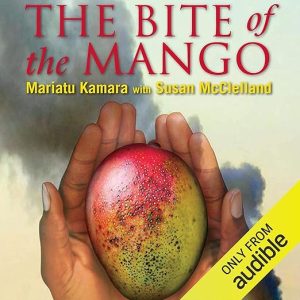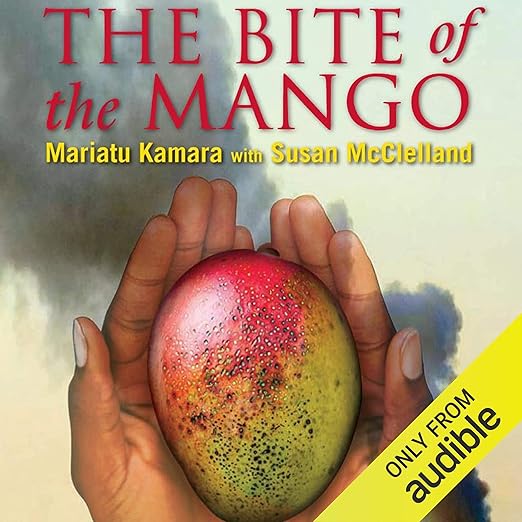
There are memoirs about surviving atrocity that arrive on your shelf with the weight of moral obligation, and then there are the ones that do something rarer: they make you understand a life rather than just a catastrophe. Mariatu Kamara's The Bite of the Mango is the second kind. I listened to it over a series of morning commutes, which in retrospect was both the right and wrong choice. Right because the short, contained sessions gave me room to recover between the more brutal passages. Wrong because by the third morning I was sitting in my parked car, not ready to move.
Kamara was twelve years old when rebel soldiers attacked her village in Sierra Leone and cut off both of her hands. The title refers to the mango she managed to hold between her bloodied arms in the immediate aftermath, the first food she ate after the attack, and her account of that moment carries the specific weight of detail that no fiction writer could manufacture. It is, as one reviewer put it, very realistic, without a grandiose sense of self. That restraint is the book's signature quality and its moral achievement.
Co-written with Susan McClelland, the memoir covers three distinct phases: Kamara's childhood in rural Sierra Leone before the attack, the years of survival, begging, and trauma that followed in Freetown and refugee camps, and her eventual arrival in Toronto where she began to rebuild. What is remarkable about Kamara's storytelling is her unwillingness to simplify herself. She describes her faults alongside her courage: the moments of fear, the choices she made that she regretted, the ways she internalized shame before she understood what had actually been done to her. This is not a book written by a saint looking back at suffering with redemptive distance. It is a book written by a person who went through something terrible and is still, during the writing, working out what it means.
The Sierra Leone civil war context is present without being over-explained, which reflects both the book's young adult orientation and a considered editorial choice not to let geopolitics crowd out the personal account. Reviewers who used the book in classroom settings noted that it prompted students to raise questions about colonialism and conflict that the text left space for without providing easy answers. That is exactly the right balance for this kind of memoir.
What Makes The Bite of the Mango Worth Hearing
Jessica Almasy's narration suits the material in ways that matter. The story is told in first person with Kamara's characteristic directness, and Almasy delivers it without imposing theatrical grief where Kamara herself has chosen plainness. There are passages in this memoir where the horror is related in flat, factual sentences, and that flatness is part of the power. A narrator who ornamented those moments would destroy them. Almasy understands the text well enough to follow Kamara's lead.
At six and a half hours, this is a short listen by audiobook standards, and that brevity is appropriate. The story has a specific scope and does not overreach it. Kamara's voice does not need padding or context-building beyond what she provides. The audiobook format also makes the memoir accessible to younger listeners who might struggle with the reading level in print, and several reviewers noted using it with middle school and high school students to strong effect.
Things to Know Before Starting The Bite of the Mango
The attack and its immediate aftermath are described in considerable detail. Kamara does not sanitize what happened to her, which is both the book's honesty and its most challenging element. Listeners under fourteen should ideally encounter this with an adult who can provide context. The book has been used in educational settings for older middle-schoolers, but the content, including sexual violence and extreme physical trauma, requires thoughtful handling.
The book also ends at a particular point in Kamara's life, her early days in Toronto and her appointment as a UNICEF Special Representative, rather than attempting a comprehensive update. Some readers may want more of the later story. The 2008 publication date means there are years of Kamara's public advocacy work that fall outside its scope.
Who Mariatu Kamara Is Writing For
Anyone who wants to understand the human cost of the Sierra Leone civil war through a single, honest, intimate account should listen to this. It is appropriate for older teens and adults, and excellent for classroom use at the high school level. Readers drawn to survivor memoirs that resist victimhood as the only available identity will find Kamara's self-portrait distinctive and worthwhile. Skip it only if graphic descriptions of violence and mutilation are something you cannot engage with, regardless of the literary or moral context.