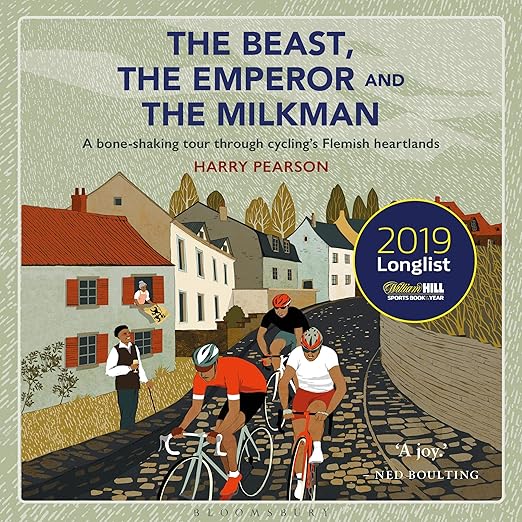
- Voice: Harry Pearson reading his own book is the only version of this audiobook that makes complete sense; his dry Teesside wit and genuine cyclist's enthusiasm give the prose a texture no hired narrator could replicate.
- Big ideas: Belgian cycling culture and national identity, the mythology of the Classics, beer and cobblestones as cultural diplomacy
- Atmosphere: Warm, eccentric, and pleasantly obsessive
- Worth it?: A deeply affectionate portrait of Flemish cycling culture that works beautifully in audio, especially for listeners who enjoy sports writing that never loses sight of how funny its subject is.
The craft of Harry Pearson's audiobook The Beast, the Emperor and the Milkman is clearest in its structure: rather than trying to write a history of cycling or a race diary, Pearson uses a single muddy Flemish spring as the vehicle for five hundred years of regional identity, national mythology, and the peculiar theology of road racing. Shortlisted for the Telegraph Sports Book Awards cycling category and longlisted for the William Hill Sports Book of the Year, this is a book that arrived with serious credentials, and listening to Pearson read it himself at eight hours and thirty minutes, it earns them.
I came to Belgian cycling through the Spring Classics, those cobblestone monuments that turn up every April looking like they were designed to punish optimism: the Tour of Flanders, Paris-Roubaix, the unreasonably brutal Amstel Gold. Pearson covers all of it, but what makes this audiobook unusual is the depth of the cultural excavation alongside the racing. Flemish cycling is not just a sport here; it is an argument about what Flanders is and what its people believe about endurance, suffering, and how you carry yourself in horizontal rain.
Where This One Lands
Pearson describes himself as a committed Belgophile and road cycling obsessive, and that combination produces something genuinely rare in sports writing: a book that respects its subject's genuine strangeness without condescending to it. The fans dressed as chickens, the shop window displays of constipation medicines, the beer cafes that serve as the real infrastructure of Belgian sport culture, all of this is treated by Pearson as serious evidence about who these people are and why they produce cyclists capable of riding over cobblestones in February sleet at a pace that would destroy most professional athletes.
The title itself is a perfect encapsulation of the tonal range. The Beast refers to Johan Museeuw, the Emperor to Eddy Merckx, the Milkman to Roger De Vlaeminck. Three archetypes of Flemish cycling mythology, three ways of being heroic that only make sense in this specific cultural context. Pearson is superb at tracing how these figures became not just champions but characters in an ongoing national story, and his knowledge of that story goes back centuries rather than stopping at the modern era of professional cycling.
The European history that Pearson ranges across is not window dressing. He is genuinely tracing how five centuries of Flemish political identity, its relationships with Spanish, French, and Dutch rule, the particularities of the Flemish language question, and the industrial character of the region, shaped what cycling became there. That depth is what separates this from a more conventional sporting travelogue, and it is why the book rewards readers who know very little about cycling almost as much as it rewards the deeply initiated.
Why The Beast, the Emperor and the Milkman Works as an Audiobook
Self-narration is always a gamble, but here it is an unambiguous asset. Pearson's voice carries his regional background naturally, and his delivery has the quality of a very knowledgeable friend explaining something he loves rather than a polished broadcaster maintaining professional distance. One reviewer described the experience as being taken mind and spirit to the best two weeks of cycling, and the sensory immersion that comes from Pearson's enthusiastic specificity, the smells, the weather, the taste of the beer, is central to why this works so well as an audiobook.
At eight and a half hours the runtime is comfortable for this kind of sports travel writing: long enough to develop real depth on the key figures and races, short enough that the eccentric energy of the book never curdles into exhaustion. Pearson has a journalist's instinct for when an anecdote has run its course, and the audiobook benefits from that discipline. It never overstays a section.
Points to Consider
Listeners who come to this expecting a purely athletic or tactical breakdown of professional cycling will need to adjust their expectations. Pearson is far more interested in culture, history, and character than in race analysis. The technical aspects of cycling are present, but they are always in service of a larger story about what Belgium is, why Flanders in particular has this relationship with the bicycle, and what the broader European history that shaped the region means for how its sports are understood and adored.
There is also a tonal register question worth naming. Pearson is funny, consistently and deliberately so, in the way that the best British sports writers have always been funny: not through jokes that announce themselves but through the deadpan observation that trusts the reader to catch the absurdity without being told it is there. The shop window displays of constipation medicines as cultural evidence about Belgian character is a perfect example. He notes it with the straightest possible face and lets the reader do the rest. Listeners who prefer their sports writing earnest and reverent may find this register disorienting, though Pearson is always clear that the affection underneath the comedy is genuine.
The book also assumes a baseline familiarity with European road cycling, specifically the Spring Classics. Listeners who have never heard of the Tour of Flanders or who could not name three riders from the last fifty years of Belgian cycling will still get something from the audiobook, but the references will land with less force. It is not inaccessible to newcomers, but it rewards familiarity considerably.
Who Should Pick Up The Beast, the Emperor and the Milkman
Cycling fans who have ever found themselves genuinely moved by the Spring Classics will find this audiobook a perfect companion to that obsession. Travel writers and readers who enjoy cultural histories told through unexpected lenses will also get substantial value here. Pearson occupies a space between Bill Bryson's wandering cultural curiosity and Nick Hornby's obsessive fan loyalty, and if either of those registers appeals to you, this is likely to click. Listeners who want a conventional sports biography or a tactical breakdown of professional cycling should look elsewhere; this is a portrait of a culture, not a race report.
Before You Listen
Do you need to know much about cycling to enjoy this audiobook?
Some familiarity with the Spring Classics and the broad tradition of Belgian professional cycling helps, but Pearson writes with enough cultural and historical context that a motivated newcomer can follow the book's main arguments. The greatest value, however, goes to listeners who already have at least a casual relationship with riders like Merckx, Museeuw, or De Vlaeminck and want to understand what they mean within Flemish culture.
Does Harry Pearson narrating his own audiobook work?
It works very well. His voice carries the dry humor and genuine regional enthusiasm of the prose in a way that a hired narrator would struggle to replicate. Several reviewers specifically cite the sense of being transported to Belgium, and that quality comes directly from Pearson's delivery. His self-narration is a genuine asset here, not a compromise.
Is this audiobook more sports writing or cultural history?
Substantially more cultural history. Pearson uses cycling as the lens through which he examines five hundred years of Flemish and European identity, national character, and the mythology that sport creates. Race results and rider profiles are present, but they serve the larger cultural argument rather than leading it.
How does this audiobook compare to other cycling books like A Dog in a Hat or Draft Animals?
Reviewers who have read those titles specifically place this one above both. It is less of a personal memoir than Joe Parkin's A Dog in a Hat and less focused on the American perspective than Phil Gaimon's work. Pearson is writing from deep inside Flemish cycling culture rather than as an outsider, which gives the book a different texture: more rooted, more mythological, and more interested in what the sport reveals about a specific place.