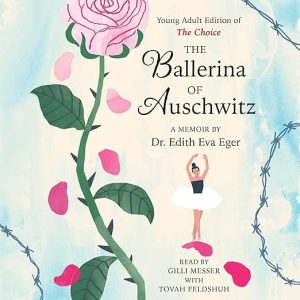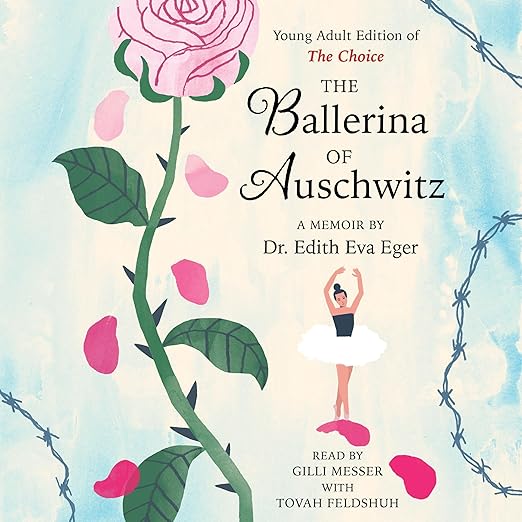
I first encountered Edith Eva Eger through The Choice, her adult memoir, and I'll admit I wasn't sure a young adult adaptation would serve the material. The fear with any condensed or repositioned version of a survivor memoir is that the editorial choices required for a different audience will sand down the edges that make the testimony meaningful. The Ballerina of Auschwitz puts that worry to rest. This is not a simplified version of Eger's story. It is a differently framed one, with the emphasis on the teenage Edie rather than the retrospective psychologist Dr. Eger, and that shift in temporal focus produces something that can be genuinely more immediate than the adult text.
The young adult edition, narrated by Gilli Messer and released by Simon and Schuster Audio in October 2024, covers the core of Eger's experience: her life as a dancer and gymnast in Hungary in 1943, her family's deportation to Auschwitz, her survival alongside her sister Magda, and the long shadow of survival guilt that followed. The detail that anchors both this version and the original, Edie being forced to dance for a Nazi leader while her parents were being killed, gives the title its force. That specific horror, the body made instrument in circumstances of absolute brutality, is not softened here.
How The Ballerina of Auschwitz Holds Up
What the young adult framing does well is center the love story. Eric, Edie's first love who whispers through the slats of the cattle car, "I'll never forget your eyes," gives the narrative a human anchor that carries readers through material that could otherwise become an overwhelming accumulation of atrocity. The book's structure understands something important about how teenagers engage with historical horror: through the specific, the personal, the relational, before they can encounter the systemic. Eric is the vehicle for that entry point, and Eger writes about him with the precision of memory that has been carefully preserved rather than sentimentalized.
The Kirkus starred review's description of the book as "luminous" is accurate and also slightly uncomfortable, as any description of beautiful writing about the Holocaust must be. But what the word is trying to capture is real: the book does not ask its readers to despair. It asks them to witness, and then it offers the possibility of choice, the explicit argument that you can't change what happened to you but you can choose how you live with it. That is Eger's life's work as a psychologist and it's woven through the narrative here without feeling like therapy-speak.
Why The Ballerina of Auschwitz Works as an Audiobook
Gilli Messer's narration is one of the audiobook's genuine assets. The material requires a narrator who can hold the internal emotional life of a teenage girl under conditions of extreme trauma without tipping into performance. Messer reads with an intimacy that keeps the listener close to Edie without making the experience voyeuristic. The moments of terror and the moments of small, defiant beauty are distinguished by the quality of Messer's attention to them rather than by dramatic register shifts. This is careful, disciplined work that serves the testimony rather than the narrator's performance of it.
At five hours and fifteen minutes, the book is shorter than many comparable memoirs, and that compression is largely a strength. The young adult edition does not linger in the camps the way an adult memoir might. It moves through the trauma with purpose, staying focused on Edie's interiority rather than accumulating documentary horror. The pacing reflects the book's conviction that survivor memoir is most useful to young readers when it moves toward the future rather than dwelling in the past.
Weak Spots in The Ballerina of Auschwitz
One reviewer who had read the adult memoir found this version somewhat less than they expected, noting it "touched my heart but it was like I expected more." That response makes sense for readers who already know the fuller account. The young adult edition necessarily leaves things out, and for adults who have read The Choice or other extended Eger writing, the condensed form may feel incomplete. This is not the book's failure; it's a feature of its intended audience. Listeners who are new to Eger's story will not miss what isn't there, but adult readers already familiar with the work should calibrate accordingly.
The Sydney Taylor Award Notable Young Adult Book designation situates this in the tradition of Jewish literature for young readers, and the book is explicitly designed to be taught and discussed rather than simply consumed. Teachers and book club facilitators will find the clean narrative arc and the explicit thematic statement, the choice framework, unusually useful for structured conversation. Listeners who prefer memoir that complicates easy meaning-making will find the book's purposefulness occasionally feels shaped rather than lived.
The Right Listener for The Ballerina of Auschwitz
Primarily for young adult readers encountering Eger's story for the first time, and for adults who want an accessible entry point to her memoir before or instead of the longer adult text. Parents who want to share Holocaust testimony with teenagers have flagged this as genuinely age-appropriate without being sanitized. Adults who are already familiar with The Choice will get less from this version than from revisiting the original. The audiobook is particularly suited for classroom use, book clubs, and paired listening between parents and teenagers. Messer's narration is strong enough that listening together rather than reading apart is a real option.
At a Glance
- Narrator: Gilli Messer brings extraordinary sensitivity to Edie's voice - the narration holds both the horror and the hope without allowing either to overwhelm the other, which is precisely what this material demands.
- Subjects: survival and its psychological weight, love as sustaining force, the choice to live toward meaning rather than away from grief
- Tone: Devastating and ultimately luminous, with the particular intensity of testimony
- Bottom line: A Holocaust memoir written for young adults that earns its emotional weight through specificity and restraint - it doesn't ask for your grief, it earns it.
Good to Know
How does The Ballerina of Auschwitz differ from Eger's adult memoir, The Choice?
The young adult edition centers on the teenage Edie's experience from 1943 through the immediate postwar period, emphasizing her relationship with Eric and the sisterhood with Magda as primary emotional anchors. The adult memoir includes substantial reflection from Dr. Eger as a practicing psychologist integrating the survivor experience with her clinical work. The YA version is shorter, more focused on the events themselves, and calibrated for readers who haven't yet encountered the full historical and psychological context.
Is Gilli Messer's narration appropriate for teenage listeners, or does it skew adult?
Messer's performance reads young in the best sense, staying close to Edie's interiority and avoiding the kind of interpretive distance that adult narrators sometimes impose on YA material. Several parent reviewers noted giving the audiobook to middle school and high school daughters who responded strongly to it. The narration is age-appropriate without being simplified.