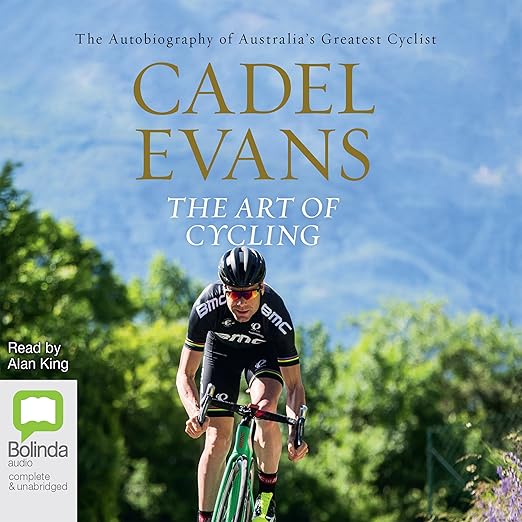
Quick Take
- Narration: Alan King delivers a steady, unhurried performance well-suited to Evans’s measured, introspective tone, not flashy, but it holds.
- Themes: athletic obsession and preparation, the politics of professional cycling, clean racing in the doping era
- Mood: Methodical and revealing, like a long training ride that rewards patience
- Verdict: A detailed insider account that rewards cycling fans deeply and may lose general sports readers in the tactical weeds.
I came to Cadel Evans late. I was somewhere on a treadmill in early January, scrolling through Audible looking for something that felt like discipline, and Evans’s autobiography caught me at exactly the right moment. I knew his name vaguely, Tour de France champion, 2011, older winner, Australian, but I had none of the context that makes his story genuinely remarkable. Fifteen hours later I had all of it, and more than I had bargained for.
What sets this book apart from the standard athletic memoir is Evans’s refusal to perform modesty or heroics. He is forensic rather than dramatic, which is either the book’s greatest strength or its central tension depending on what you bring to it. Reviewers split roughly along those lines: cycling enthusiasts tend to call it riveting; general sports readers find stretches that drag. Both assessments are accurate and not incompatible.
Our Take on The Art of Cycling
Evans structures his autobiography around what I’d call the logic of marginal accumulation, the idea that every result, every setback, every piece of team politics and nutrition protocol, adds up to something. That approach mirrors how he actually raced. He was never the flashiest rider on any stage; he was the one still standing at the end of three weeks. The book works the same way. It builds. The early chapters on mountain biking, where he became the youngest winner of a World Cup in the discipline, are genuinely surprising, most listeners will arrive expecting the Tour story and find themselves detoured into a completely different sport, one that shaped his later temperament in ways he traces carefully.
The Tour de France chapters are, predictably, the heart of the book. Evans placed in the top ten six times before finally winning in 2011 at age 34, making him the oldest post-War winner. He describes those years of near-misses not with bitterness but with something closer to scientific curiosity, what needed to change, what finally clicked, why patience was never resignation. That framing is quietly compelling.
Why Listen to The Art of Cycling
Alan King’s narration suits the material well. He reads with a calm authority that matches Evans’s own voice on the page, there is no melodrama, no artificial elevation of stakes. For a book about one of the most physically grueling sports in the world, it sounds almost contemplative, and I mean that as a compliment. The audiobook format works particularly well during the race sequences, where King’s steady delivery keeps the intricate tactical detail, breakaways, peloton dynamics, stage finishes, from becoming overwhelming.
Evans also addresses doping with a directness that feels earned rather than performative. He raced through the Lance Armstrong era. He is one of only four cyclists to have finished on the podium of all three Grand Tours. His standing to speak on clean racing is not rhetorical, it is biographical. Reviewer deblo noted that it is refreshing to see this from the point of view of someone who raced clean, and that framing shapes the entire book’s moral atmosphere.
What to Watch For in The Art of Cycling
The book’s weakness is its relationship with interiority. Evans is meticulous on preparation and strategy but somewhat guarded about the emotional texture of defeat. One reviewer noted that at times he sees things a bit too much from his own side and thus becomes a bit simplistic, which points at something real: the book can flatten the human cost of years of near-misses. You sense the toll without quite feeling it. Compare this to someone like Andre Agassi’s Open, where vulnerability is treated as primary material, and Evans’s reticence becomes visible.
There are also stretches, particularly in the middle sections covering races like the Settimana Coppi e Bartali or Tirreno-Adriatico, where the level of detail about competitors and team dynamics will delight the cycling enthusiast and exhaust everyone else. This is not a flaw exactly, it is a genuine insider account, not a popularization, but it is worth knowing before you start.
Who Should Listen to The Art of Cycling
Cycling fans, particularly those who followed the Grand Tours during Evans’s career, will find this essential. Athletes interested in the psychology of long-form competition and meticulous preparation will also get a great deal from it. Listeners who want a fast-moving, emotionally exposed sports memoir should look elsewhere. This is a book for people who enjoy the details as much as the destination.
Frequently Asked Questions
Do I need to follow professional cycling to enjoy this audiobook?
Prior knowledge helps, especially for the detailed race sections covering the Tour de France, Giro, and Vuelta. Evans explains enough context that a patient non-specialist can follow, but the deepest rewards go to listeners with some cycling background.
How does Alan King’s narration handle the technical race descriptions?
King keeps a calm, measured pace throughout, which works well for the tactical detail. He does not dramatize artificially, so the audiobook feels more like a long interview than a performance, suitable for the material, if not especially dynamic.
Does Evans address the doping culture of his era extensively?
He addresses it directly but not exhaustively. His comments on doping are substantive and credible given his position as a clean rider who competed through the Armstrong years, but this is not primarily a book about doping, it is about his own career and preparation.
Is this a standalone autobiography or does it require familiarity with earlier Evans interviews or coverage?
It is fully standalone. Evans builds from his mountain biking beginnings through every major career moment, so no prior knowledge of him beyond his name is required.