Quick Take
- Narration: Gil Sidaway delivers a competent, clean performance that serves the YA pacing without over-dramatizing.
- Themes: Pandemic survival, displacement and identity, coming-of-age under crisis
- Mood: Tense and propulsive in short bursts, with a cliffhanger structure designed to pull readers toward the next episode
- Verdict: A short, accessible entry point to YA post-apocalyptic fiction that works best as the beginning of a series rather than a standalone, and at under three hours represents a low-risk sample.
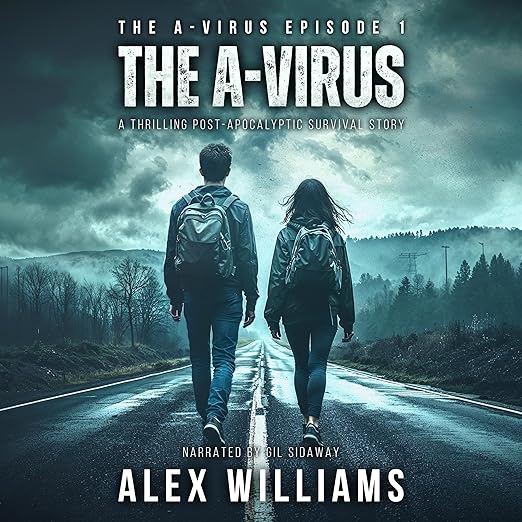
I came to The A-Virus on a weekday afternoon when I had about two and a half hours free and wanted something that required genuine attention without the kind of emotional investment that a longer work demands. Alex Williams has structured this as the opening episode of a serialized post-apocalyptic story, and at two hours and forty-five minutes it is precisely sized for that role: long enough to establish a world and a character, short enough to function as a commitment-free introduction to the series.
Will Batchelor is seventeen, recently relocated to London from Brighton, miserable about the move, resentful of his father, missing his friends. That setup is entirely conventional for YA fiction, and Williams is not trying to disguise that. The emotional groundwork is laid quickly because the point is not Will’s adolescent discontent in isolation, the point is the world that is about to come crashing down on top of it. The A-Virus arrives as Will’s ordinary problems are still very much present, and the collision between those ordinary problems and something catastrophic is the story’s central engine.
Our Take on The A-Virus
What Williams does well here is proportion. The virus’s arrival is gradual rather than instantaneous, reviewer Nichole notes that the unfolding of the contagion is not entirely realistic by epidemiological standards, which is a fair observation, but for the purposes of a YA thriller the pacing serves the story well. The audience for this book is not reading it as a virology textbook. They are reading it because they want to follow Will through a world that is breaking apart, and on those terms the escalation is effectively handled.
Reviewer Babetta makes a pointed observation about how a post-pandemic readership might respond to the specific social behaviors characters display in the novel, the compliance with stay-home orders, the hand-washing routines, noting that recent experience has complicated how those moments read. That is an interesting side effect of writing pandemic fiction in the current era: real-world experience has given every reader an informed skepticism about exactly how populations actually behave during contagions.
Why Listen to The A-Virus
Gil Sidaway’s narration is clean and well-paced for the YA market. He does not overperform the teenage angst in the opening sections, which would be the obvious failure mode, and he handles the shift into survival thriller mode without making it feel jarring. At under three hours, the audiobook is also an easy gateway for listeners who are not sure whether they want to commit to a longer series, a try-before-you-buy structure that Williams has clearly thought about.
The family relationships in the novel, which reviewer Nichole specifically praises as feeling genuine, are one of the stronger elements. Will’s relationship with his father is frustrating in the way that actual parent-child relationships are frustrating, not in the way that fictional ones are frustrating for plot convenience. That groundedness is important because it gives the later crisis sequences something real to threaten.
What to Watch For in The A-Virus
As reviewer kgparkhurst notes, the story moves relatively slowly in its early section, particularly given the short total runtime. This is a structural tension inherent to episode-one-of-a-series storytelling: you need to establish character before you can threaten them, but readers who came for the apocalypse may find the setup stretched. The payoff arrives, but not instantly.
The serialized structure is also the book’s most significant practical limitation. This episode ends with enough momentum to pull you toward the next installment, but it does not offer a satisfying standalone conclusion. Reviewer kgparkhurst notes uncertainty about whether to spend $2.99 to continue after getting the first episode free, which is exactly the commercial calculation the series structure is designed to create. Listeners who are satisfied by open-ended first episodes will find this works well. Those who need closure within a single audiobook will be frustrated.
Who Should Listen to The A-Virus
YA readers with an appetite for post-apocalyptic fiction and a willingness to follow a serialized format will find this a satisfying opening. The short runtime makes it an easy experiment, and the production quality is solid for an independently published audiobook. Fans of James Dashner’s Maze Runner series or Susan Beth Pfeffer’s Life As We Knew It will find familiar territory here, though The A-Virus is more intimate in scale, focused tightly on one teenager rather than on the broader social collapse.
Listeners who need a complete, self-contained story, or who are not interested in following a serialized format, should be clear-eyed about what they are entering. This is episode one of a series, designed to leave you wanting more. Whether that is a virtue or a limitation depends entirely on your relationship with serialized fiction.
Frequently Asked Questions
Is The A-Virus a complete story or does it end on a cliffhanger?
It is the first episode of a serialized series and does not offer a standalone conclusion. The story establishes Will and the virus premise effectively but ends with significant threads unresolved, designed to lead readers into subsequent episodes. If you need narrative closure in a single audiobook, this format is not for you.
How does the post-pandemic real-world context affect reading The A-Virus?
Reviewer Babetta notes that recent pandemic experience has complicated how certain character behaviors, compliance with stay-home orders, hand-washing routines, read to contemporary audiences. The novel was written with a more idealized sense of how populations respond to contagion threats, and readers who lived through 2020-2021 may find those moments slightly naive in retrospect.
Is the nearly three-hour runtime enough to get invested in the characters?
Enough to establish Will’s situation and generate investment in his survival, but the short format means character development is necessarily compressed. Reviewer Nichole praises the family relationships as feeling genuine, which suggests Williams has prioritized emotional authenticity within the constraints. The opening section is slow by some accounts, so the payoff comes in the second half.
How does narrator Gil Sidaway handle a teenage protagonist’s voice?
Sidaway avoids the trap of over-performing teenage angst, which would have made the opening sections grating. His narration is clean and credible for a YA audience, and he handles the tonal shift from adolescent displacement to genuine survival crisis without jarring the listener. The performance is solid without being remarkable.