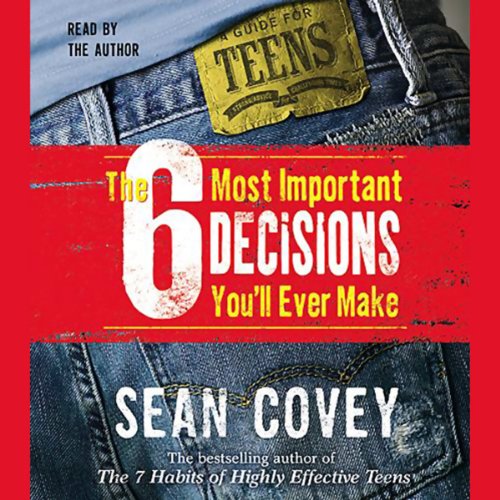
Quick Take
- Narration: Kirby Heyborne’s youthful, natural delivery makes the book feel like it’s coming from a peer rather than a lecture, which is exactly the right register for a teen audience.
- Themes: Identity formation in adolescence, navigating parental relationships, decision-making frameworks for long-term wellbeing
- Mood: Friendly and direct, occasionally earnest to a fault, but reliably honest with its audience
- Verdict: A practical guide for teenagers that actually sounds like it respects them, updated thoughtfully for the social media era.
I was in my early twenties when Sean Covey’s first book, The 7 Habits of Highly Effective Teens, was doing well in schools and family libraries, and I remember thinking it was one of the few books marketed to teenagers that didn’t feel like it was quietly rolling its eyes at them. The 6 Most Important Decisions You’ll Ever Make, originally published in 2006 and revised since to address the digital and social media age, carries that same quality. Kirby Heyborne reads it with the kind of warmth and directness that makes the material feel like conversation rather than instruction.
I listened to part of this on a weekday evening, which was a useful context for a book explicitly aimed at people a couple of decades younger than me. What struck me was how little of the underlying advice has dated, and how thoughtfully the social media update integrates into material that was structurally sound to begin with. The six decisions Covey addresses, self-esteem, parents, friends, sex, substances, and school and career, are not novel categories. What distinguishes this treatment is its refusal to talk around the hard parts.
Our Take on The 6 Most Important Decisions
Sean Covey is his father’s son in the best sense: he works within the 7 Habits framework without requiring it, and he applies those principles to the actual situations teenagers face rather than to abstract professional success. The reviewer Jamison Fox, who works with first-offender youth and uses this book as a counseling resource, describes it as “straightforward, provides common issues that kids face, and provides straightforward ways of dealing with those conflicts.” That directness is not accidental. Covey writes knowing that his audience is capable of handling honesty and that they’ll disengage from anything that condescends.
One honest note from reviewer N. Ybarra: the book can feel “cheesy” to adults reading it, and skews toward a 6th-to-8th grade sensibility more than older high schoolers. That’s accurate. The approachability that makes it effective with 12- to 14-year-olds is the same quality that makes it feel slightly younger to an adult reader. This is, ultimately, a feature in context. The question is whether the book reaches the audience it’s for, and the answer, based on reviewer after reviewer describing giving it to their actual teenagers and watching them engage with it, is clearly yes.
Why Listen to The 6 Most Important Decisions
Kirby Heyborne is a smart choice for this. His voice doesn’t sound authoritative in the adult-lecturing-youth sense; it sounds like someone slightly older who has actually thought about these things talking to someone slightly younger. That’s the register Covey is writing in, and Heyborne honors it. The pacing is comfortable and age-appropriate without being condescending in its slowness.
At 5 hours and 37 minutes, this is a practical length for a teenager’s attention span. Shorter than a novel in the YA space but substantial enough to feel like a complete engagement with real material. For parents who are considering this as a conversation-starter with their kids, the length works in its favor: it’s completable in a car ride or a weekend afternoon, making it more likely to actually be listened to.
What to Watch For in The 6 Most Important Decisions
The book’s values framework is grounded in broadly secular practical wisdom rather than a specifically religious worldview, which makes it more widely applicable than some alternatives in the teen self-help category. That said, Covey’s approach reflects a fairly conventional set of assumptions about what good decisions look like in the six areas he covers. Teenagers whose home lives, identities, or circumstances fall outside those conventions may find the framing less directly applicable, though the underlying decision-making skills translate broadly.
The social media update is integrated rather than bolted on, which is a credit to how the revision was handled. Technology isn’t treated as a separate chapter but as a dimension of each of the six decision areas, which is how young people actually experience it. This gives the revised edition a coherence that updates-as-addendum often lack.
Who Should Listen to The 6 Most Important Decisions
Best suited for teenagers roughly between 12 and 16, though the reviewer who gave it to a 14-year-old who was initially resistant and had him describe it as “kinda cool” by the end is probably the most representative use case. It works equally well as a parental gift, a school counseling resource, and as something a teenager discovers independently. Jamison Fox’s use of it in a first-offender counseling program points to its value as a conversation framework rather than just a solo listen.
Adults reading this for themselves will likely find it useful in the abstract but pitched below them. The book knows its audience and stays there. If you’re a parent who wants to understand what the book contains before handing it off, a single listen is worthwhile. If you’re coming to it for your own personal development, the 7 Habits original series offers more complexity at an adult register.
Frequently Asked Questions
Does a teenager need to have read The 7 Habits of Highly Effective Teens first to get value from this book?
No. Covey applies the 7 Habits framework to the six decision areas, but he explains the relevant principles as he goes. Prior familiarity helps, but it’s genuinely not required. Many readers encounter this book first and then return to the earlier one, which is a reasonable sequence.
Is the social media update substantial, or does the revised edition feel dated despite the revision?
The update is well-integrated rather than superficial. Rather than adding a standalone chapter on technology, Covey works the social media dimension into each of the six decision areas as a contextual layer. The result feels current rather than retrofitted. Listeners who have read the original edition will notice real additions, not just a new cover.
Kirby Heyborne is a recognizable narrator in the Christian and LDS fiction space. Does his specific background affect how this book reads?
This is a fair question to raise. Heyborne’s narration here is neutral and relatable rather than denominationally inflected. Covey’s own background is LDS, and some of his assumptions about family, values, and decision-making reflect that, but the book’s language and framing are broadly secular in register. Listeners from various backgrounds have found it applicable without denominational friction.
At what age is this book most effective? One reviewer suggested it skews younger. Is it less useful for older teens?
The sweet spot is roughly 12 to 15. The tone and examples are calibrated for early-to-mid adolescence, and several reviewers note that it resonates most before the decisions it’s about are already fully in play. That said, reviewer M. Baskett describes her daughter continuing to return to it throughout high school and finding it “makes more and more sense each time,” which suggests ongoing utility even past the primary target age.