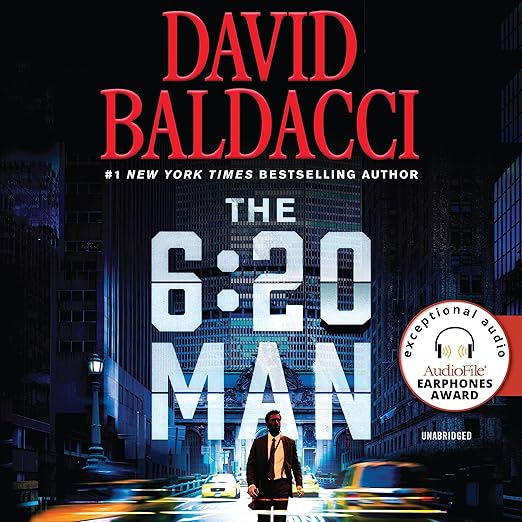
Quick Take
- Narration: Zachary Webber brings exactly the right quality to Travis Devine, slightly guarded, precise, with a military bearing that never quite relaxes even in civilian settings.
- Themes: Class aspiration and resentment, financial system corruption, the weight of military secrets on civilian life
- Mood: Taut and observational, with a sardonic eye on Wall Street’s gilded machinery
- Verdict: A strong series launch from Baldacci that earns its complexity, though the resolution draws some criticism for contrivance, the journey is better than the destination.
I started The 6:20 Man on a weekday morning, which felt appropriate. The book is built around commuter time, the specific psychic state of watching other people’s wealth slide past the train window while you’re on your way to do their bidding. Travis Devine’s daily ritual, boarding the 6:20 commuter train to Manhattan in a cheap suit with a faux-leather briefcase, gazing at the lavish homes of the uberwealthy and dreaming about joining their ranks, is one of the most efficiently established character situations David Baldacci has written. We understand Devine before the murder even happens.
And then Sara Ewes, Devine’s coworker and former girlfriend, is found hanging in a storage room. The NYPD calls it a presumed suicide. Before the day is out, Devine has received an anonymous email and a covert visit that threatens to expose grim secrets from his Army past unless he agrees to participate in an internal investigation into his own firm. The dual-investigation structure, official and unofficial, external and internal, is the book’s real engine.
Our Take on The 6:20 Man
Baldacci is doing something more interesting here than a straight financial thriller. Devine is a character built on a specific kind of American disappointment: a decorated military officer reduced to entry-level analyst status, watching wealth concentrate at a level he can see but cannot touch. One reviewer puts it well, powerful people exploiting and deceiving in dark places, with broken and lost individuals in the backdrop without hope of a future. That moral texture gives the book a weight that distinguishes it from Baldacci’s more plot-mechanical earlier work.
The financial setting is used well. Baldacci doesn’t require you to understand derivatives or quantitative trading, the corruption he’s interested in is human, not algorithmic. The investment firm functions as a social ecosystem with its own power dynamics, loyalty structures, and secrets, and Devine’s position as the outsider-insider gives him access that a true insider would be too comfortable to notice.
Why Listen to The 6:20 Man
Zachary Webber is well-matched to Devine. The character is a man who has disciplined himself into careful observation, Army training applied to corporate surveillance, and Webber’s measured delivery captures that quality without making Devine seem cold. The class-consciousness running through the book benefits from a narrator who can convey quiet hunger alongside professional competence.
At eleven hours and forty-eight minutes, this is a properly substantial thriller listen. Baldacci plots efficiently at this length, there’s very little waste. The story’s ambition to keep every character suspicious until the final pages (noted by one reviewer) is genuinely achieved; this is a book where you’ll catch yourself reconsidering people you’ve already assessed.
What to Watch For in The 6:20 Man
The most consistent criticism in the listener reviews is that the conclusion feels contrived. One reviewer who read the series out of order (starting with the third entry) found this first book slower and less depth-rich in the most critical relationships than subsequent installments, which is actually a useful data point. The foundation Baldacci is laying here is character infrastructure, not maximum entertainment. Some patience in the middle section is required.
Listeners hoping for wall-to-wall action will find the book more observational than they expect. Devine’s commuter gaze, the surveillance of wealth from a position of exclusion, is a structural motif that recurs, and Baldacci slows down for it. That’s a feature for readers who enjoy the class analysis embedded in the thriller; it’s a friction point for readers who want pure propulsion.
Who Should Listen to The 6:20 Man
Strong recommendation for Baldacci’s existing readership and for thriller fans interested in the financial world as a setting for moral corruption rather than technical complexity. Also recommended for listeners who enjoy protagonists with military backgrounds navigating civilian institutions, and for anyone who wants a series opener with genuine character investment. Skip if you need a fast-burning thriller from page one, or if contrived resolutions are a significant irritant. If starting the series, be aware that readers who’ve gone further say it improves.
Frequently Asked Questions
Is The 6:20 Man the first book in the series, and does it matter where you start?
Yes, this is book one of the 6:20 Man series. One reviewer who read out of order found the first entry slightly slower with less relationship depth than later books, suggesting the series builds on foundations laid here. Starting at book one is the right call.
How much financial industry knowledge do you need to follow the plot?
None. Baldacci uses the investment firm as a social and moral setting rather than a technical one. The corruption at the center of the story is human rather than algorithmic, understanding of finance is not required.
Does Zachary Webber’s narration suit the military-veteran-turned-analyst character?
Yes. Webber’s measured, slightly guarded delivery fits Devine’s profile, a man trained to observe carefully and reveal little, applying Army discipline to the entirely different battlefield of Wall Street.
How does the class-consciousness theme develop through the commuter train motif?
The 6:20 train is both literal and symbolic. Devine’s daily view of wealthy homes from the commuter rail, aspiration through glass, is a recurring structural device that grounds the book’s interest in economic inequality and the rot that exists just below the surface of displayed wealth.