Quick Take
- Narration: Michelle Ferguson handles Ember's emotional intensity with consistency across a demanding third installment, keeping the pace high without losing nuance.
- Themes: Apocalyptic stakes, the blurring of good and evil, sacrifice and love
- Mood: Action-driven and emotionally raw, with a sense of mounting inevitability
- Verdict: A strong continuation for fans already invested in the Wings of War series, though newcomers should absolutely start at book one.
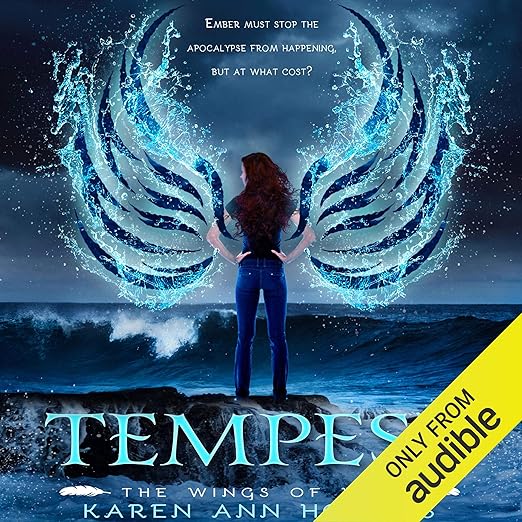
I will be honest: I came to Tempest midway through a stretch of reading heavier material, and there is something to be said for a book that asks you to simply hold on and pay attention. This is the third installment in Karen Lynch's Wings of War series, and it does not ease you in. The angels of destruction have arrived, the barrier between celestial creatures and humans has broken, and Ember is standing between the apocalypse and everyone she loves. Lynch is not interested in preamble.
The Wings of War series sits in a corner of YA paranormal fantasy that combines apocalyptic mythology with the emotional intensity of teenage experience. What distinguishes it from comparable series is Lynch's willingness to follow consequences. Things break. Relationships are lost. The cost of being the person who stands in the gap is not abstracted or softened.
Our Take on Tempest
This book has more action than the first two installments, which is both what fans of the series wanted and, for some, a slight trade-off in terms of the quieter character development that made the earlier books work. One reviewer who praised the series noted that Tempest was "not as good as the first two, but there is a lot of action crammed into this book." That assessment is measured and fair. Lynch has chosen to use this penultimate volume as an escalation engine rather than a deepening one, and the result is propulsive but occasionally breathless in ways that leave some emotional threads slightly underexplored. What is not shortchanged is the central premise that the line between good and evil, between angels and demons, between enemies and allies, is far less clear than any mythology suggests. One reviewer called it hard to "tell the good guys from the evil entities because nothing is as it seems," and that thematic ambiguity is the series' strongest quality.
Why Listen to Tempest
Michelle Ferguson is a reliable narrator for this series, and her work in Tempest is particularly strong in the action sequences, which in audio can easily become confusing if a narrator does not hold spatial clarity and character distinction simultaneously. Ferguson does. She also handles the emotional rupture that arrives late in the book, the moment when love is ripped away in what Lynch herself describes as "the most terrifying way possible," with restraint rather than melodrama, which is the right call. Several reviewers described the book as impossible to put down, with one simply writing "I couldn't put the book down" and another noting they read until their eyes refused to stay open. That experience translates to audio in a format that makes late-night listening easy to justify and hard to stop.
What to Watch For in Tempest
This is emphatically not a standalone entry point. The relationships, the world-building, the significance of specific character choices, all of it assumes deep familiarity with the first two books. Jumping in here means losing the emotional context that makes the stakes feel real. One reviewer acknowledged that the series "didn't click" for them, and that it may be a matter of reading headspace. That is an honest note: Lynch's world requires a certain commitment to a relatively dense mythological framework, and if you approach it skeptically, the payoff takes longer to arrive. Series readers will also want to know that the book ends in a way that makes book four necessary, not optional, for closure.
Who Should Listen to Tempest
Wings of War fans who have been waiting for this installment since finishing the second book will find exactly what they came for: escalation, sacrifice, meaningful chaos, and the promise of resolution in what follows. New listeners should begin with book one, which sets up the world and the central relationship with the attention they need. Listeners who like their YA paranormal with genuine emotional cost rather than safety nets will be well-served here. If you want something lighter or more self-contained, this is not the place to start.
Frequently Asked Questions
Is Tempest book three in the Wings of War series, and does it need to be read in order?
Yes, it is the third installment, and reading in order is essential. The emotional stakes, the world-building, and the significance of specific plot developments all depend on context built in the first two books.
Does Michelle Ferguson narrate the entire Wings of War series, or just this installment?
Ferguson has narrated the series. Listeners who have followed the audio versions of books one and two will find a consistent voice here, which is particularly important for a series with a strong ongoing relationship arc.
How does Tempest end, with resolution or a cliffhanger?
The book does not provide a full resolution. It functions as a penultimate volume, escalating toward a conclusion that arrives in book four, Eternity. Listeners should have the next book ready.
Is the mythology in the Wings of War series original, or does it draw heavily from existing angelology?
Lynch draws on traditional concepts like angels of destruction, psychopomps, and celestial hierarchy, but combines them with her own paranormal world-building that includes shifters and other supernatural beings. The result is more original than it might initially appear from the premise.