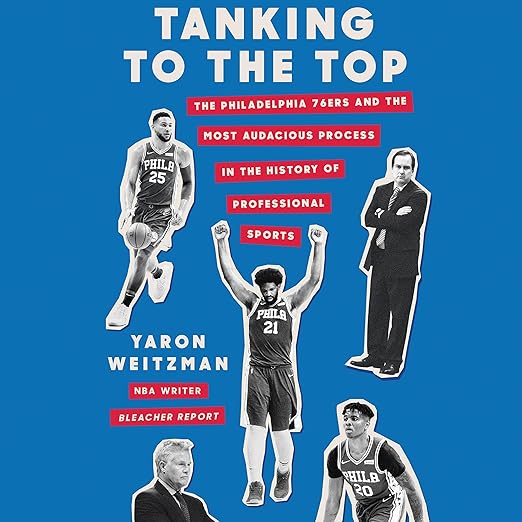
Quick Take
- Narration: Weitzman reading his own work is the right call – his journalist’s cadence keeps the palace intrigue moving without inflating the drama, and his familiarity with the material shows in how he handles the more technical basketball passages.
- Themes: organizational risk and its human costs, the collision of analytics culture with competitive sport, institutional loyalty and its limits
- Mood: Propulsive and occasionally jaw-dropping – sports journalism at its most readable
- Verdict: One of the better NBA books in recent memory, essential for Sixers fans but genuinely compelling for anyone interested in how modern professional sports organizations work.
I spent a good part of one December evening listening to the Markelle Fultz chapters of this book in my kitchen while making dinner, and I had to keep stopping to tell whoever was nearby what I’d just heard. That’s a particular quality in sports writing: when the facts are stranger than anything a novelist would risk inventing, the writing’s only job is to get out of the way and let the story run. Yaron Weitzman does that consistently across nine-plus hours that cover one of the stranger strategic experiments in professional basketball history.
The Philadelphia 76ers’ Process – Sam Hinkie’s deliberate multi-year tank strategy, designed to accumulate enough lottery picks to build a championship contender from the draft rather than through free agency – generated extraordinary amounts of coverage while it was happening. What Tanking to the Top provides is the inside account: the boardroom conversations, the ownership tensions, the way Hinkie’s relationship with the team’s demoralized owner deteriorated, the NBA’s unusual intervention through the appointment of a former coach as an advisory governor. Drawing from nearly 175 interviews, Weitzman builds a picture of an organization simultaneously running a bold long-term experiment and falling apart at the seams in the short term.
Our Take on Tanking to the Top
The book’s central achievement is making the organizational drama as compelling as the on-court narrative. Sam Hinkie is a genuinely fascinating figure – an analyst who believed in his model with the kind of conviction that makes him look either visionary or reckless depending on where you’re sitting, and who was ultimately pushed out before his project fully bore fruit. Weitzman treats him fairly without lionizing him, and the sections covering Hinkie’s removal are the kind of inside-baseball institutional reporting that most sports books never manage. Joel Embiid, Ben Simmons, the mysterious injuries, the burner Twitter accounts – all of it is here, and it’s all stranger in context than it was in the newspaper headlines at the time.
Why Listen to Tanking to the Top
Weitzman narrates his own work, and the choice works well. His pace is measured – he’s a journalist, not a performer, and the lack of theatrical flourish suits material that doesn’t need embellishment. The audio format handles the interview-based material naturally: you’re essentially being told this story by someone who was in the room, or who spoke to everyone who was, and Weitzman’s delivery conveys that authority without tipping into self-congratulation. At nine hours and eighteen minutes, the length matches the scope of the story. Nothing feels padded, and the structure – moving between the organizational level and the individual player stories – keeps the pacing from becoming monotonous.
What to Watch For in Tanking to the Top
One reviewer makes a fair point: the story feels somewhat incomplete, because in a real sense it is. The book was published in 2020, and the Sixers’ story has continued to develop in ways that couldn’t be anticipated. The Process yielded the players Hinkie envisioned, but the championship he designed it for hasn’t materialized. That’s not the book’s fault – sports history doesn’t pause for publication deadlines – but listeners should know they’re getting the middle chapters of an ongoing story rather than a definitive account. The book is also primarily a Sixers story, and while Weitzman provides enough NBA context for non-fans to follow the logic of tanking as a strategy, the emotional resonance of the player narratives will mean more to those who followed the team through those years.
Who Should Listen to Tanking to the Top
Philadelphia 76ers fans will find this essential. Basketball fans who followed the Process era more broadly will find material they didn’t know, particularly on the organizational and ownership sides of the story. And readers who enjoy sports journalism as institutional reporting – who want to understand how professional sports organizations actually function rather than the on-court product – will find this among the better examples of that genre in recent years. Casual sports fans looking for narrative biography rather than front-office drama may find the organizational chapters less compelling. But the individual player stories, particularly Embiid’s emergence and the Fultz situation, are accessible to anyone who appreciates a well-told story about human ambition and the price of organizational dysfunction.
Frequently Asked Questions
Do I need to be a Philadelphia 76ers fan to get value from Tanking to the Top?
Not at all. The book is fundamentally about organizational decision-making under uncertainty, and the institutional drama is compelling regardless of team allegiance. That said, the emotional weight of the player narratives will land harder for those who followed the team through those years.
How does Weitzman handle the ethics of the tanking strategy itself – does the book take a position on whether it was the right approach?
He presents the debate fairly rather than advocating. The book gives ample space to the arguments against tanking – the demoralized players, the fans, the NBA’s institutional discomfort – without dismissing the logic of Hinkie’s model. Readers on both sides of the debate will find their position represented.
The book was published in 2020 – is it still worth listening to given how the Sixers’ story has continued?
Yes. The book covers a specific and complete episode: Hinkie’s tenure, his removal, and the emergence of the core players he assembled. That story is finished regardless of what’s happened since. Think of it as the definitive account of a particular era rather than a current state-of-the-team portrait.
Does Weitzman cover the Ben Simmons situation in depth, and does the audiobook include any updated material?
The book was published before the Simmons situation became the source of prolonged public conflict, so that story is covered as it existed in early 2020 – his early development and role in the team’s emergence. No updated audio material is included beyond the original publication.