Quick Take
- Narration: Rebecca Soler brings a cool, precise elegance to the tales that suits their deliberate strangeness without overselling the fairy-tale register.
- Themes: the cruelty of enchantment, female agency in hostile worlds, the mythology beneath the surface of other stories
- Mood: Dark and crystalline, each story a small cold gem best savored one at a time
- Verdict: Readers who came to Melissa Albert through The Hazel Wood will find the mythology they were promised; newcomers may want to treat this as an entry point rather than a standalone anthology.
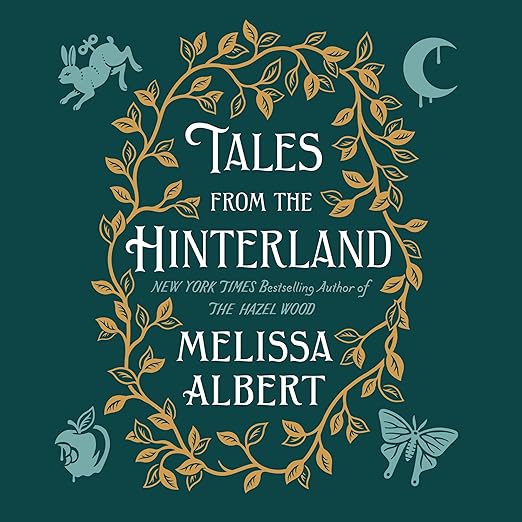
I listened to Tales from the Hinterland across three evenings in January, one or two stories at a time, which turned out to be exactly the right approach. These are twelve pieces that do not want to be consumed in a rush. Melissa Albert writes in a register that is closer to Angela Carter than to the softened fairy tale tradition she is ostensibly working within, which means the prose demands attention the way that poetry does. You notice a sentence and then you stay with it for a moment before moving on. I had read The Hazel Wood a few years earlier and remembered finding it beautiful in a way I could not quite explain. These tales are the mythology that novel was built on, and hearing them in sequence gave me the strange retroactive pleasure of understanding something I had loved without fully comprehending it.
Twelve Tales, One World’s Interior Logic
The Hinterland is a place of absolute rule rather than comfortable wonder. Women spend nights with Death. Brides are married to houses in the trees. An enchantress is killed twice and survives both deaths. Albert’s fairy tales are not the softened versions of anything. They sit firmly in the tradition of the originals: pre-Disney, pre-sanitized, interested in transformation as a form of violence as much as a form of magic.
Each story has its own internal logic that it establishes quickly and then follows with rigorous consistency. Albert does not cheat her own rules. When a character makes a bargain, the terms govern everything that follows, even when following them produces outcomes that feel genuinely terrible. This fidelity to consequence is what separates Albert’s work from decorative dark fantasy. The darkness is structural, not merely atmospheric.
One reviewer compared the experience to eating dark chocolate truffles one at a time, which is a precise and useful description. The richness is real, but the appropriate serving size is small. I found the middle stretch of the collection less immediately arresting than the opening and closing pieces, and I think that is partly a function of the anthology form: no collection sustains the same intensity across all twelve entries, and Albert does not quite manage it here either. The weaker pieces are still beautifully made, but they register as minor rather than essential.
What Rebecca Soler Brings to the Strangeness
Soler’s narration is one of the more interesting casting choices in recent YA audio. She does not warm the material toward comfort, which would be the easy and wrong decision. Her voice is precise and slightly cool, with a quality that makes the most unsettling moments feel inevitable rather than shocking. The effect is something like hearing a very accomplished reader perform the stories at a private reading: controlled, aware of the craft, never doing more than the material requires.
The twelve tales vary considerably in length and tone, and Soler shifts register between them without calling attention to the shift. The briefer, more aphoristic tales land differently from the longer, more novelistic ones, and she handles both modes without flattening the distinction. This is narration that respects what it is performing, which is the minimum a collection like this deserves.
Context for New Listeners and Returning Fans
The collection is marketed as accessible to listeners who have not read The Hazel Wood or The Night Country, and technically this is true. Each tale stands alone as a piece of fiction. But the deeper pleasure comes from understanding that these stories exist in relationship to those novels, that the mythology you are hearing was glimpsed there and is being fully revealed here. For new listeners, the tales will read as accomplished dark fairy fiction. For fans of the series, they will feel like finally getting to read the source material that was always mentioned but never fully given.
Kelly Link’s quoted description of the collection as lush and deliciously sinister is accurate. Albert writes in Link’s tradition without merely imitating it. The comparisons to Angela Carter and the Brothers Grimm that some reviewers have made are also apt, though Albert’s voice is distinctly contemporary in ways those comparisons might obscure. She is not nostalgic for an older darkness but writing a new version of it.
What Albert does particularly well, and what distinguishes this collection from the large body of fairy tale retellings that have flooded literary fiction in recent years, is her refusal to give the reader a stable interpretive position. You are never quite sure whose side you are on, whether the enchantment is punishment or gift, whether the outcomes are just or arbitrary. That uncertainty is the point. Real fairy tales do not reassure, and these do not either. Soler’s narration honors that ambiguity by never editorializing through inflection, which is exactly the right choice.
Ideal Listeners and Those Who May Struggle
Listeners who responded to the atmosphere of The Hazel Wood will find this collection deeply satisfying. Fans of Kelly Link, Holly Black, or Angela Carter’s fairy tale fiction will recognize the register and settle in quickly. This is also a strong entry point for anyone who wants literary dark fantasy that takes its own rules seriously and does not tidy its endings.
Listeners who prefer fantasy with plot-driven momentum and clearly resolved narratives will find the anthology form frustrating. These are tales that end rather than resolve, in the older fairy tale tradition, and some of them leave you with the uncomfortable feeling of having witnessed something without being allowed to comment on it. That is a feature, not a flaw, but it is worth knowing before you begin.
Frequently Asked Questions
Do I need to read The Hazel Wood first to enjoy Tales from the Hinterland?
Not strictly. Each tale works independently as dark fairy fiction. But the collection exists in relationship to Albert’s novels, and listeners who have read The Hazel Wood or The Night Country will find a significantly deeper layer of meaning in hearing the mythology fully rendered.
How dark is this collection, and is it appropriate for younger teen listeners?
It is genuinely dark in the tradition of pre-sanitized fairy tales. Violence, death, and morally complex outcomes are central rather than peripheral. The material is literary rather than graphic, but it is not softened for comfort. Older teens with a taste for dark literary fiction will find it rewarding.
Does Rebecca Soler’s narration suit the fairy tale register of the material?
Yes. Soler takes a cool, precise approach rather than a warm or theatrically performative one, which turns out to be the right call for Albert’s prose. The narration treats the strangeness as matter-of-fact, which amplifies its effect considerably.
Is the collection better listened to all at once or in smaller sessions?
Smaller sessions work better. The richness of Albert’s prose and the density of the imagery reward a pace that lets each story breathe before moving to the next. One or two stories per sitting is closer to the natural consumption rhythm than a full single session.