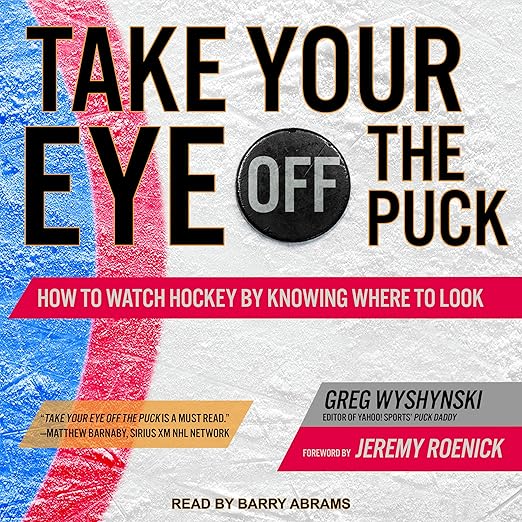
Quick Take
- Narration: Barry Abrams delivers a clean, sports-broadcast quality performance that suits the book’s analytical but accessible tone.
- Themes: Game strategy and spatial awareness, the coach’s perspective, hockey as chess
- Mood: Enthusiastic and clear-eyed, written by someone who genuinely loves explaining how the game works
- Verdict: The most useful intermediate-level hockey analysis book currently in audio form, pitched perfectly between basic fan guides and technical coaching manuals.
I am not a lifelong hockey person. I grew up in France and came to the NHL relatively late, first as a casual viewer and then, after a few seasons of paying closer attention, as someone who wanted to understand what I was actually watching. That experience is exactly what Greg Wyshynski’s book is designed for, and I can confirm from the reader’s side that it works.
I listened to most of Take Your Eye Off the Puck during a long weekend, including a stretch on a Sunday afternoon when there was actually an NHL game on in the background that I kept pausing to watch, which is probably the highest possible compliment I can give to a book about how to watch a sport.
Our Take on Take Your Eye Off the Puck
Wyshynski is a longtime hockey writer, and the book reflects that background in the best possible way. He is not performing expertise; he is sharing it, and the distinction matters enormously in sports writing. The title is a piece of counterintuitive advice: most casual fans track the puck because it is the most obviously active object on the ice, but the more productive vantage point is to watch what happens away from the puck, where positioning, lane creation, and defensive assignments are being worked out in real time. Wyshynski builds the book around that single reorienting idea and applies it to offense, defense, goaltending, special teams, and roster construction in turn.
What makes the book work is that it takes coaching intelligence seriously without becoming inaccessible. The chapter on why playing center might be the most demanding position in professional sports is the kind of analysis that changes how you watch a game. After reading it, you start tracking the faceoff battles, the two-way requirements, the responsibility for reading and communicating defensive breakdowns, rather than just crediting whoever happens to put the puck on net.
Why Listen to Take Your Eye Off the Puck
Barry Abrams brings the right energy to this material. His delivery has the quality of a knowledgeable friend walking you through what you are watching, which is exactly the register the book calls for. He does not condescend, but he does not assume familiarity either. For a listener who is reasonably new to hockey and slightly anxious about not understanding the game’s deeper structures, that measured confidence from the narrator is genuinely reassuring.
The book also benefits from Wyshynski’s sense of humor, which runs throughout without ever undermining the analytical substance. The puck daddy voice that longtime readers of his blog will recognize is present, and it keeps the book from feeling like a manual. Hockey writing can be intensely serious in a way that occasionally tips into self-parody, and Wyshynski avoids that entirely. The anecdotes about specific players and games are chosen to illustrate tactical points rather than to name-drop, which is a more disciplined approach than many sports books take.
What to Watch For in Take Your Eye Off the Puck
One reviewer who had been watching hockey for more than ten years found the book useful but not revelatory. Another noted that it does not quite bridge the gap between genuine beginners and intermediate fans, citing specific hockey terms and player references used without full explanation. Both observations are fair. The book is best served by readers who are somewhere in the middle: comfortable with basic rules and some roster knowledge, but wanting to understand the strategic layer underneath the fast surface.
Pure beginners may occasionally need to pause and look up terms or players. And very experienced fans or people with coaching backgrounds will find the tactical analysis familiar, though they may appreciate the quality of Wyshynski’s writing and the specific examples he chooses. The sweet spot is the engaged fan who has been watching for a season or two and wants to move past surface-level comprehension.
Who Should Listen to Take Your Eye Off the Puck
This is the right book for the intermediate hockey fan who wants to understand what coaches and analysts are actually paying attention to. It works equally well for people who came to the sport recently through a local team, people who are following someone they care about’s passion and want to participate more meaningfully, or fans who want to stop feeling lost when the broadcast discussion turns to line matchups or power play structure.
Lifelong hockey devotees with deep tactical knowledge will find it an enjoyable read, but they should set appropriate expectations. As several reviewers note, this fills the gap between entry-level guides and coach’s manuals, and it fills that gap extremely well. That is a specific and genuinely useful thing to do.
Frequently Asked Questions
Is Take Your Eye Off the Puck appropriate for someone who has never watched hockey before?
It is better suited to someone with at least a basic familiarity with the game. Complete beginners may find certain hockey terms and player references unfamiliar, and the book assumes you know what icing and offsides are, for example. Starting with a few televised games first would help.
Does the book cover women’s hockey or is it focused exclusively on the NHL?
The book focuses primarily on the NHL and professional men’s hockey. Its tactical analysis applies broadly to the sport, but the specific examples, coaching strategies, and player references draw from the NHL context.
How does Barry Abrams’s narration work for someone listening rather than reading?
Very well. His delivery has the quality of an informed, enthusiastic guide rather than a performance. The conversational register suits Wyshynski’s writing style, and the pacing works well for audio consumption of analytical material.
Will experienced hockey fans find anything new in this book?
Most experienced fans report enjoying the book without finding it revelatory. The tactical analysis will feel familiar to longtime watchers, but the quality of writing and the organization of ideas make it a worthwhile read even without dramatic new insights.