Quick Take
- Narration: Jack Curry’s performance is widely praised, with reviewers noting his ability to convey O’Neill’s voice and personality while maintaining the flow of what is essentially a hitting manual wrapped in memoir.
- Themes: perfectionism and athletic identity, the craft of hitting, the dynasty Yankees of the late 1990s
- Mood: Intense and nostalgic, occasionally technical
- Verdict: A worthwhile audiobook for baseball fans who want Paul O’Neill’s actual thinking on hitting, though casual fans may find the technical chapters demanding.
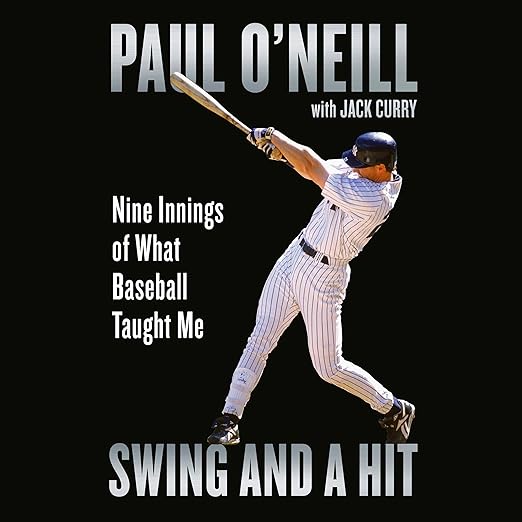
There’s a particular kind of sports memoir that exists mainly as an extension of the athlete’s public persona, a product rather than a document. Paul O’Neill’s Swing and a Hit is not that book, or at least it’s more than that. I picked it up knowing O’Neill’s reputation as one of the more intense, self-critical hitters in late-1990s Yankees history, the guy who famously treated water coolers as an outlet for post-strikeout frustration. What I found was something closer to a hitting philosophy treatise than I expected, with the memoir woven through it.
The book’s unusual structure telegraphs its priorities. Ten chapters corresponding to nine innings plus an extra inning, each one focused on a specific aspect of hitting: adjustments, confidence, umpire management, pitch recognition. This is not primarily a book about O’Neill’s life. It’s a book about what O’Neill figured out at the plate over a thirty-six-year career, from swinging a bat at age two through his final professional at-bat at thirty-eight. The life stories are there, but they’re in service of the hitting lessons rather than the other way around.
Our Take on Swing and a Hit
O’Neill makes no secret of his perfectionism, and the book benefits from that. He is genuinely thoughtful about the psychology of hitting in a way that goes beyond platitude. His account of receiving a surprise call from Ted Williams, who told him “using a round bat to hit a round ball is the most difficult thing to do in sports,” anchors the book’s central argument: that hitting is harder than it looks, demands constant adjustment, and rewards deliberate practice over raw talent. The comparison to how the modern game has shifted toward swing-for-the-fences approaches versus choking up for contact feels particularly pointed from someone who played in an era when contact hitting was still a respected craft.
The clubhouse stories earn their place. Joe Torre, Derek Jeter, Don Mattingly, Pete Rose, Bernie Williams: O’Neill’s relationships with these figures illuminate the dynasty-era Yankees in ways that feel earned rather than name-dropped. The episode with Pete Rose is particularly revealing, two hitting-obsessed athletes comparing notes across generations. Jack Curry, who collaborated with O’Neill on the book and serves as narrator, brings obvious familiarity with the material. His voice has a journalist’s economy that keeps the anecdotes moving.
Why Listen to Swing and a Hit
The audiobook is specifically appealing as a gift for younger baseball players, which reviewers confirm. One listener bought it for a thirteen-year-old aspiring ballplayer and found it useful even for adults. The practical hitting advice is specific enough to be applied, not just appreciated from a distance. O’Neill describes grip adjustments, approach changes against different pitch types, and mental routines in concrete detail. For baseball players at any level, that specificity is the book’s most valuable quality.
One reviewer’s comment that the book is “a tamed down version” of O’Neill’s famous intensity is probably accurate. The water cooler stories are present but brief. What you get instead is the thinking player’s memoir, which is a different and arguably more valuable document than a purely anecdotal account of his famous temper. The intensity comes through in the precision of the hitting analysis rather than in fireworks.
What to Watch For in Swing and a Hit
The book’s technical depth is both its strength and its limitation. Reviewers who are longtime Yankees fans and baseball enthusiasts find it essential. Reviewers who wanted more personal biography are occasionally frustrated by chapters that read closer to instructional material. One reviewer specifically noted wanting “more depth into his upbringing” and less hitting analysis. That preference is legitimate. O’Neill’s relationship with his family, his Catholic faith, and his Ohio roots are touched on but not fully developed. Listeners expecting a comprehensive life story will find the balance weighted heavily toward craft.
The book is also, as one reviewer notes, most rewarding for serious baseball fans rather than casual ones. The hitting terminology and strategic concepts are explained but not simplified. If your baseball knowledge is limited to following a team as a spectator, some sections may require more patience than others.
Who Should Listen to Swing and a Hit
The ideal listener is a serious baseball fan who grew up watching or playing during the 1990s dynasty Yankees era. Players who have ever faced the mental challenge of hitting will find the most specific value in O’Neill’s approach. Parents of young baseball players have flagged this as genuinely useful for motivated kids. Yankees fans of any age will enjoy the clubhouse material. Listeners primarily interested in personal memoir over craft analysis, or casual fans without strong knowledge of the game’s technical side, will find the book rewards only partial attention.
Frequently Asked Questions
How much of Swing and a Hit is practical hitting instruction versus storytelling?
The balance tips toward instruction, which surprises some listeners expecting a standard memoir. The ten chapters are each anchored in a specific hitting principle, with personal stories and clubhouse anecdotes threaded through them. If you’re primarily interested in the memoir arc, the technical chapters may slow you down. If you’re interested in how one of the better contact hitters of his era actually thought at the plate, those chapters are the book’s best material.
Does the book cover the full arc of O’Neill’s career, including his time with the Cincinnati Reds before joining the Yankees?
Yes, though not with equal depth. The Reds years are covered in the earlier chapters and inform O’Neill’s development as a hitter, including his work to overcome early struggles. The book does not shortchange his pre-Yankees career, but the dynasty-era Yankees stories naturally dominate given the material.
Jack Curry narrates rather than O’Neill himself – does this affect how the book feels?
Most reviewers find Curry’s narration effective, partly because he co-authored the book and knows the material intimately, and partly because his journalistic delivery suits the analytical tone. One reviewer specifically praised his ability to convey O’Neill’s character. The lack of self-narration is less of a loss here than it would be for a more confessional memoir, given how much of the book is craft analysis rather than personal storytelling.
Does O’Neill address how modern baseball’s shift toward power hitting and launch angle metrics relates to his contact-first philosophy?
He does, and these passages are among the more interesting in the book. O’Neill is clearly skeptical of modern approaches that prioritize launch angle over contact, and his discussion of choking up and situational hitting feels deliberately positioned as a counter-argument to analytics-driven swing optimization. He doesn’t pretend to have all the answers about modern hitting, but he makes a case for what he believed worked.