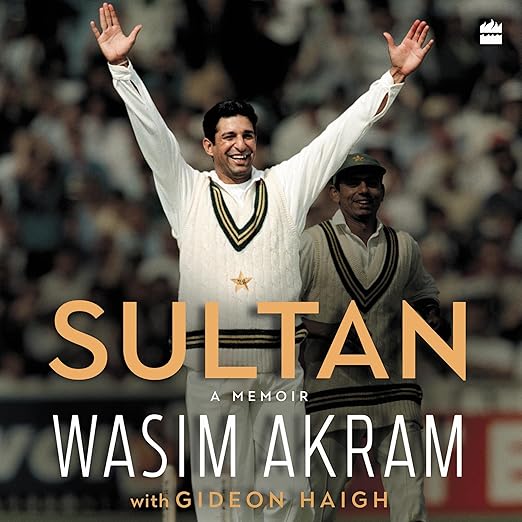
Quick Take
- Narration: Ranjit Madgavkar is an excellent choice, his delivery of the subcontinental cricket world, the Lahore streets, and the weight of Pakistani national expectation carries genuine authority and texture.
- Themes: Cricketing legacy and personal redemption, the politics of Pakistani cricket, resilience under public scrutiny
- Mood: Candid and emotionally honest, with the cadence of a long career fully examined
- Verdict: Wasim Akram’s autobiography is one of the more honest sports memoirs you will encounter, particularly on the match-fixing controversy and the years of silence that preceded this account.
Our Take on Sultan
I knew Wasim Akram by reputation long before I knew much about his story, the left-arm swing that made him one of the most feared bowlers in cricket history, the 1992 World Cup final, the controversies that followed him into retirement. What Sultan the audiobook does is fill in the human architecture behind that reputation, and the result is more complicated and more interesting than the legend alone would suggest. Sports autobiography is a genre that tends toward self-justification, and this one earns its departures from that tendency.
Gideon Haigh, one of cricket’s finest writers, is credited as collaborator, and that partnership shows in the quality of the prose. This is not a ghostwritten memoir that sounds like a press release. The sentences have texture. The anecdotes have specificity. And when Wasim gets to the subjects he has spent two decades deflecting, ball tampering, match-fixing, his finances, the years after his first wife’s death, the book earns its place in the sports autobiography canon rather than simply occupying it.
Why Listen to Sultan
The cricketing content here is exceptional for anyone who cares about the game at the level of craft. Wasim’s analysis of swing bowling, the mechanics, the variables, the specific conditions that made certain deliveries possible, is the kind of inside knowledge that even attentive watchers of the game rarely access. He writes about his rivalry with Sachin Tendulkar, his relationship with Shane Warne, his encounters with Viv Richards and Ian Botham, and about Imran Khan’s role in shaping Pakistani cricket culture in ways that feel earned rather than name-dropping.
The Imran Khan chapters are among the most revealing in the book. One reviewer noted that Imran’s influence was central to understanding Pakistani cricket of that era and how it essentially collapsed once he left, Sultan documents that transition from the inside. Wasim was chosen from the streets of Lahore and groomed directly by Imran, and the book is honest about what that mentorship meant, what it gave him, and where it left him unprepared for what followed. The transition from being Imran’s protege to carrying the Pakistani side himself has a weight that the book gives proper attention to.
The most unusual quality of Sultan is its willingness to stay in the uncomfortable zones rather than navigate around them. The match-fixing inquiry and the ball-tampering allegations had followed Wasim for years, and the book represents his attempt to finally set the record straight on his terms. Whether readers find his account fully convincing will vary, but the fact that he engages directly with these questions rather than dismissing them as politics is itself noteworthy. Sports autobiographies that tell the actual story of their most controversial chapters are rarer than they should be.
What to Watch For in Sultan
One reviewer who described himself as a devoted fan noted several factual discrepancies, a specific match score attributed to the wrong player, a few other details that seemed slightly off against his memory of events. These are minor in the context of a book that spans twenty years and two hundred matches, but listeners with deep cricket knowledge may notice similar moments. The emotional arc is more reliable than the statistical record, which is consistent with the memoir’s priorities.
The book is most alive when it is inside Pakistan and inside cricket. Some of the more recent material, covering Wasim’s television career and his rehabilitation as a public figure after the controversies of his playing years, is thinner in texture than the playing years sections. The transition from match-playing to commentary is a difficult subject to make as vivid as the sport itself, and Sultan is not entirely an exception to that challenge. The first two-thirds of the runtime carry more urgency than the final third.
Ranjit Madgavkar’s narration is one of the book’s genuine assets. He delivers the Lahore scenes and the Pakistani cricket world with an authority that a narrator without that cultural grounding could not provide. The cadence of his reading suits the retrospective, sometimes elegiac quality of Wasim’s storytelling, and he handles the more emotionally raw passages, Wasim’s account of his first wife’s illness and death, with appropriate restraint that makes those moments land rather than overwhelm.
Who Should Listen to Sultan and Who Might Approach It Differently
Essential for cricket followers, particularly those who watched Pakistani cricket in the 1980s and 1990s and want to understand the era from the inside. Accessible enough for general sports biography readers who do not know cricket deeply, the story of navigating fame, controversy, grief, and reinvention is universal enough to carry non-specialist listeners. Those who find match analysis slow going can treat those sections as context rather than centerpiece. At nine hours it is a manageable commitment for a memoir of this scope and consequence.
Frequently Asked Questions
Does Sultan address the match-fixing allegations directly or does it sidestep the controversy?
Wasim addresses the allegations directly, which is one of the more notable aspects of the book. He gives his account of what happened during the match-fixing inquiry period, what he knew, and what the accusations cost him personally and professionally. Readers will form their own judgments, but he does not avoid the subject.
How much cricket knowledge does a listener need to fully appreciate Sultan?
General sports biography readers will get a great deal out of it without deep cricket knowledge, the personal and political story is compelling on its own terms. The sections on swing bowling technique and tactical analysis will mean more to listeners who follow the game closely. The 1992 World Cup final chapter is accessible to anyone.
Is Sultan a full career retrospective or does it focus on specific periods of Wasim’s life?
It is comprehensive, covering from his early life in Lahore and his selection by Imran Khan through to his retirement and television career. The playing years from the late 1980s through the late 1990s get the most detailed treatment, with the post-playing years covered more briefly.
Does Ranjit Madgavkar’s narration work for listeners unfamiliar with Pakistani and South Asian cricket culture?
Yes. Madgavkar brings genuine cultural credibility to the material but narrates in standard English throughout. Listeners unfamiliar with Pakistani cricket culture will not be lost, Haigh’s writing provides enough context that the cultural setting becomes clear through the story itself.