Quick Take
- Narration: Jennifer Jill Araya manages the four-POV structure with distinct voices for Jessa, Sage, Ted, and Sheena, though the child’s perspective requires particular care that Araya delivers with credibility rather than affectation.
- Themes: Buried guilt and redemption, children as moral agents, the limits of institutional rescue
- Mood: Claustrophobic and urgent, with a ticking-clock pressure that accumulates rather than spikes
- Verdict: A tense, character-driven thriller inspired by real events that puts the emotional lives of its trapped characters ahead of pure plot mechanics, to mostly strong effect.
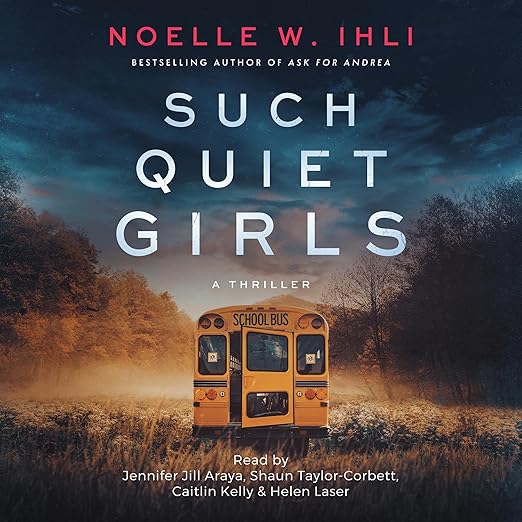
I started Such Quiet Girls on a Tuesday afternoon and finished it the following morning, which tells you something about the efficiency of Noelle Ihli’s pacing. This is not a restful listen. Ten children and their bus driver abducted in broad daylight and buried alive in a shipping container twenty feet underground: the premise removes every comfort zone from the first chapter and does not return them until the final pages. What impressed me most was that Ihli earns her darkness through character investment rather than incident accumulation. By the time the air begins running thin, I cared about Jessa and Sage in ways that made the stakes feel personal rather than abstract.
The novel is inspired by actual events, which adds a layer of discomfort to the listening that compounds the already-claustrophobic atmosphere. There is a specific kind of dread that attaches to fiction derived from real incidents: the knowledge that this approximate scenario was once someone’s actual experience, not a genre scenario designed to be resolved by chapter fifteen.
Our Take on the Four-POV Architecture
Ihli narrates from four perspectives: Ted, the kidnapper; Jessa, the bus driver; Sage, an eleven-year-old student; and Sheena, Sage’s mother, who is working the outside investigation simultaneously. Reviewers have divided on this choice, with the strongest objection being to Sheena, whose chapters were perceived as the weakest and whose subplot involving her father felt truncated. That assessment is fair. Sheena’s exterior chapters disrupt the buried-alive claustrophobia at moments when the tension is building most effectively, and her emotional arc is less fully realized than Jessa’s or Sage’s.
But the Ted chapters, told from the kidnapper’s perspective, are a deliberate and largely successful risk. He is described as an idiot who is nonetheless dangerous, and that combination is more frightening than a sophisticated villain would be. The unpredictability of incompetent malevolence is harder to plan against, and Ihli uses Ted’s POV to maintain uncertainty about whether the captives’ plans will work even when those plans seem logically sound.
Why Listen for the Child Protagonist
Sage is the novel’s most impressive achievement. Writing a credible eleven-year-old narrator in a genuine survival thriller is a technical challenge that many adult literary novels fail to meet: child protagonists either sound impossibly wise or patronizingly naive. Ihli has calibrated Sage to feel specific and real, old enough to understand the threat and young enough to be terrified in ways that are not self-consciously adult. Jennifer Jill Araya’s narration of the Sage chapters is the strongest of the four perspectives, capturing a child’s particular way of processing extreme fear without letting it tip into performance.
What to Watch For in the Pacing
At nine and a half hours, the novel has a middle section that slows relative to the opening urgency. Reviewers noted the sense of being slightly stuck, and the suggestion to speed up the audio in those sections is understandable. The container sequences can only generate so much new incident before the emotional escalation has to carry the momentum, and there are stretches where the emotional escalation plateaus between beats. The novel’s final third recovers this momentum convincingly, and the resolution is earned rather than convenient. But listeners who need consistent incident-level tension throughout may find the middle demanding of their patience.
Who Should Listen to Such Quiet Girls
Readers who have already found Noelle Ihli’s earlier work and trust her instincts will find this a natural next listen, though fans have noted this is not quite their favorite from her, ranking it below her most distinctive titles. For new Ihli readers, it is a strong introduction to her ability to balance thriller mechanics with genuine character investment. The real-events inspiration adds a dimension of weight that not all thriller readers will welcome, particularly given the premise involves children. Listeners who want their thrillers psychologically grounded rather than plot-mechanistic will find the four-POV approach more rewarding than frustrating. Anyone sensitive to content involving child abduction should be fully aware of the central premise before beginning.
Frequently Asked Questions
Is the Sheena POV as strong as the Jessa and Sage chapters?
Reviewers have consistently identified Sheena as the weakest perspective, with her subplot feeling less developed and her chapters occasionally disrupting the buried-container tension at inopportune moments. Jessa and Sage are the emotional core of the book.
How closely is the novel based on the real events that inspired it?
The novel is described as inspired by actual events rather than a direct dramatization. Ihli has fictionalized the scenario significantly while preserving the essential premise of children abducted on a school bus.
Does Jennifer Jill Araya’s narration of the child perspective feel authentic or staged?
Araya calibrates the Sage chapters well, capturing a plausible eleven-year-old’s cognitive and emotional response to extreme fear without either infantilizing or precociously aging the character.
Is this a standalone novel or the beginning of a series?
Such Quiet Girls is a standalone thriller. It resolves completely within its runtime and does not set up a continuing series or sequel.