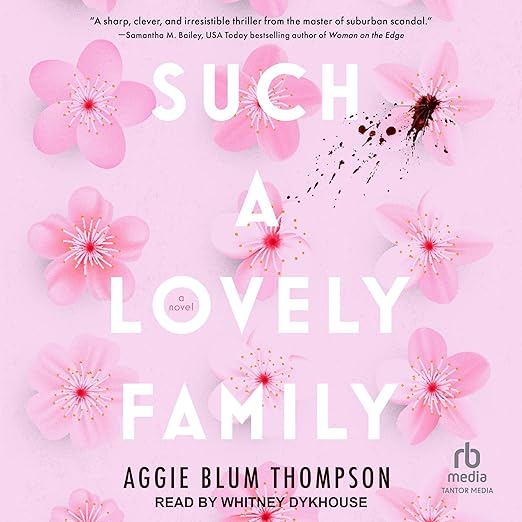
Quick Take
- Narration: Whitney Dykhouse manages the multiple Calhoun perspectives cleanly, giving each family member a distinct enough voice that the shifting suspicion lands as intended.
- Themes: family dysfunction under wealth, secrets and manipulation, the performance of perfection
- Mood: Tense domestic noir with dark comedic undertones
- Verdict: A locked-room family murder mystery that keeps its cards close long enough to make the reveal satisfying, even if the final chapter leaves some threads loose.
I started listening to Such a Lovely Family on a Friday afternoon and finished it by Saturday evening, which tells you most of what you need to know about its pacing. Aggie Blum Thompson sets the scene efficiently: Washington, D.C. in cherry blossom season, the Calhouns hosting their annual spring party, a house full of friends and family and careful performances of happiness. Within the first hour, someone is dead in the middle of the celebration, and every guest has become a suspect.
The locked-room structure is deliberately chosen. The Calhouns are insular, wealthy, and practiced at presenting a face to the world that does not match what is happening inside. That gap between performance and reality is the book’s central subject, and Thompson constructs it carefully through the parallel stories of the three adult children: the black sheep son trying to outrun his mistakes, the new father willing to risk everything for his child, and the Instagram influencer daughter who refuses to see her husband clearly. These are archetypal figures, but Thompson fills them with enough specific detail to make them feel like observations rather than types.
The Calhouns as a System
What distinguishes this book from a standard domestic thriller is the attention it pays to the parents as architects of the family’s dysfunction. Nora and Gordon Calhoun are not background figures; they are the mechanism by which all three children have been shaped into people who carry secrets and make dangerous choices. The money and emotional manipulation Thompson assigns them is precisely rendered, and the scenes where these dynamics surface during the murder investigation have a particular nastiness that feels true to a certain kind of old-money family management. One reviewer described the Calhouns as the kind of family you love to hate, which is an accurate characterization of the intended emotional experience.
The murder investigation itself is structured to maximize suspicion. Thompson rotates perspective among family members and a handful of outsiders, including what one reviewer called a nosy neighbor who had her full attention throughout. Each shift in perspective adds information that modifies your suspicion about the previous narrator. This is technically demanding to pull off without cheating, and Thompson manages it with only occasional moments where a character seems to withhold something that they would reasonably have considered more urgently. The cherry blossom party setting creates a useful contrast between the seasonal beauty outside and the ugliness being uncovered within.
Whitney Dykhouse in the Middle of a Family Siege
Whitney Dykhouse’s narration is the right choice for this kind of multi-character domestic thriller. She differentiates the Calhoun family members clearly enough that the shifting perspectives remain legible even when the plot is working hard to keep you off-balance. Her performance is particularly strong in the scenes where social performance is cracking: the party-face conversations that are actually threat assessments, the family meals that are really negotiations. The tension between the words being spoken and the subtext underneath them is where this kind of thriller lives, and Dykhouse understands how to play that gap.
At eleven and a half hours, the book has room to develop its characters and subplots without rushing. The pace quickens significantly as the investigation narrows, which is the right structure for this genre. The final third is where the multiple secrets begin to intersect, and Thompson has planted enough genuine surprises to make the convergence feel earned. The revelation of which Calhoun has been hiding which truth lands with the weight of something the reader should have seen but did not, which is the goal of any locked-room mystery worth the name.
The Ending Problem
The one reservation worth naming directly comes from multiple readers: the book ends somewhat abruptly, without the resolution some were hoping for regarding certain characters and subplots. One reviewer gave it three stars specifically because of inadequate wrap-up, suggesting that one more chapter would have lifted it to five. This is a real structural issue in domestic thrillers with ensemble casts: the mystery plot resolves, but the character arcs sometimes get cut off before they reach their natural endpoints. The Calhoun children’s individual futures feel incompletely sketched after the investigation concludes, which is frustrating given how much work Thompson put into establishing their specific vulnerabilities.
Who Will Find This Worthwhile
Fans of domestic noir in the tradition of Big Little Lies and The Family Upstairs will find Such a Lovely Family a satisfying entry in that mode. The Calhoun family is a well-constructed system of mutual damage, and Thompson handles the ensemble with enough control to keep the investigation genuinely uncertain until the final reveal. The audio version benefits from Dykhouse’s navigation of the multiple perspectives, and the D.C. cherry-blossom setting gives the story a seasonal atmosphere that slightly undercuts the grimness in an effective way. If the ending had extended one chapter further, this would be an easy recommendation. As it stands, it is a strong listen with one real frustration at the close.
There is also something worth noting about the book’s D.C. political backdrop. The Calhouns exist in a city built on performance and the maintenance of appearances, and Thompson uses that environment to amplify the family’s particular brand of self-presentation. The party culture of Washington, the obligation to show up and seem well, is the water the Calhouns swim in, and it makes their compulsion to maintain the facade even as the murder investigation closes in feel culturally specific rather than generic. The city is not just a setting; it is a mirror for the family’s way of being in the world.
Frequently Asked Questions
Is Such a Lovely Family a standalone mystery or does it connect to other books by Aggie Blum Thompson?
It is a standalone novel. The Calhouns are a self-contained family, and the mystery resolves within this single book. There is no series continuity required.
Does the book actually function as a locked-room mystery given that the party has many guests?
The locked-room quality is more about the Calhoun family unit than the physical space. The murder occurs during the family’s annual party, and while there are outside guests as potential suspects, the investigation keeps returning to the family members themselves as the people with the most to hide.
How much does the D.C. setting and cherry blossom framing factor into the story?
The setting is primarily atmospheric rather than plot-functional. Washington D.C. gives the Calhouns a particular kind of old-money social register, and the spring party tradition is the mechanism that brings everyone together. The seasonal framing contrasts usefully with the darker material.
Multiple reviewers mentioned the ending felt abrupt. How significant is this problem?
It is a genuine structural issue noted by several listeners. The mystery plot resolves, but some character arcs and subplots are left without full resolution. If complete closure on all threads matters to you, the ending may feel incomplete. If the primary mystery resolution is your main concern, you will likely find it satisfying.