Quick Take
- Narration: Scotty Kwas reads with energy appropriate for a teen audience, direct and motivating without being preachy.
- Themes: Emotional intelligence and self-regulation, financial and career readiness, confidence building in adolescence
- Mood: Encouraging and actionable, structured like a workshop rather than a lecture
- Verdict: A practical, respectful guide to the life skills gap that schools consistently leave open, better suited to motivated teens than to reluctant ones, and genuinely useful for parents and mentors too.
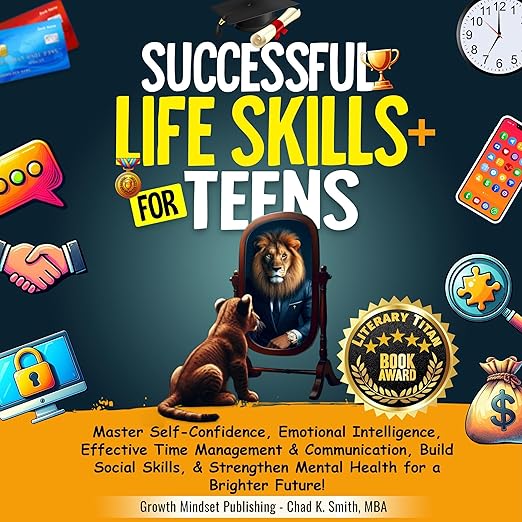
My niece turned fifteen last fall, and the question of what actually prepares young people for adulthood has been on my mind more than usual. Schools teach algebra and essay structure. They do not, as a rule, teach how to manage stress, build a budget, or communicate under pressure. Chad K. Smith’s Successful Life Skills for Teens positions itself directly in that gap, and based on the reviewer response from parents, teens, and educators, it appears to fill it more effectively than most titles in the category.
Published in September 2025 by Growth Mindset Publishing, this is part of the A Disciplined Mind for Greatness series. Smith is described as a youth development expert, and the book covers time management, emotional intelligence, communication, self-discipline, healthy friendships, self-esteem, and financial and career readiness. That is a broad scope for four hours of listening, which means the treatment of each topic is necessarily compressed. Whether that is a strength or a limitation depends on what the listener needs.
Our Take on Successful Life Skills for Teens
The most consistent note across reviewer responses is that this book respects its audience. Reviewer StDa2 captures it directly: many books aimed at teens either talk down to them or feel too abstract to be useful. This one felt different. Reviewer A. A echoes this, noting the advice is supportive rather than preachy. That register is harder to sustain than it sounds, especially across topics like managing setbacks and building self-esteem where the temptation to moralize is strong. Smith appears to resist it consistently. Reviewer Gelitos specifically calls out the personal stories and simple exercises that make the lessons relatable. The book does not position teenagers as problems to be fixed. It positions them as young people who deserve practical tools and honest respect.
The financial independence section earns specific mention from multiple reviewers. Money basics, including budgeting and understanding financial systems, are areas where the gap between school curriculum and real-world need is widest, and Smith treats the topic with the same directness he brings to emotional skills rather than saving it for a back-of-book afterthought.
Why Listen to Successful Life Skills for Teens
Narrator Scotty Kwas brings a tone that is grounded without being flat. For a teen audience, the narration needs to avoid two failure modes: condescension and forced enthusiasm. Kwas navigates that successfully. The four-hour runtime is well-calibrated for the listening patterns of teenage listeners. It is long enough to be substantive but short enough to complete across a week of commutes or study breaks without the content feeling like a commitment.
For parents and educators looking for a resource to recommend, the reviewer consensus is consistent. Reviewer Amazon Customer, writing as an educator, notes that the balanced tone motivates without being pushy and is organized without feeling strict. Reviewer Gelitos highlights emotional awareness skills specifically, noting these are skills many young people do not learn in class. The format of chapter-by-chapter focus areas, each building toward a connected competency, makes this accessible as a reference as much as a linear listen.
What to Watch For in Successful Life Skills for Teens
The breadth of topics covered in four hours means that each chapter functions as an introduction rather than a comprehensive treatment. Teens who are looking for extended practice exercises, deep psychological exploration, or topic-specific depth will likely need supplementary resources. The book is most valuable as an orientation and framework. It gives young listeners the vocabulary for conversations about emotional intelligence, financial planning, and resilience rather than substituting for those conversations. The Growth Mindset Publishing branding is accurate to the content. This is in the positive psychology and self-determination tradition, and readers who are skeptical of that framework may find the tone optimistic beyond what they find credible.
Who Should Listen to Successful Life Skills for Teens
Teens who are motivated to develop skills that school does not explicitly teach will get the most from this. It works particularly well for listeners approaching transitions, heading into high school, preparing for college applications, or taking on their first jobs. Parents and mentors looking for a resource to discuss with a young person will find it thoughtfully structured for that use. Educators developing life skills curricula will find it a useful supplementary reference. Reluctant readers who need to be persuaded that this kind of learning matters may need a different entry point before this one lands effectively.
Frequently Asked Questions
Is this audiobook aimed primarily at teens themselves or at parents and educators?
The book is written directly for teens, but the synopsis and reviewers both confirm it is valuable for parents, teachers, mentors, and coaches as well. Smith explicitly addresses both audiences in the framing. The narration by Scotty Kwas pitches to the teen listener directly.
How does this compare to other teen life skills audiobooks in terms of depth versus breadth?
At four hours covering seven major skill areas, this is explicitly a breadth-first guide. Each chapter introduces a competency rather than exhausting it. Teens who want deep treatment of a single topic like financial literacy or emotional intelligence will benefit from supplementing with more specialized titles.
Is the financial independence section substantive enough to be genuinely useful for teenagers?
Multiple reviewers flag money basics as one of the stronger sections. It covers budgeting, financial planning, and career readiness with the same practical directness as the interpersonal chapters. It will not replace a dedicated personal finance course, but it gives teens a functional vocabulary and framework.
Does narrator Scotty Kwas make this engaging for teen listeners who might resist a self-help format?
Kwas reads with enough energy to avoid the flat, academic delivery that alienates teen listeners, without tipping into the forced enthusiasm that feels performative. Reviewers do not flag the narration as a weakness. Whether a specific teen engages will depend more on their openness to the format than on the performance itself.