Quick Take
- Narration: Mark Rippetoe narrating himself is the only version of this that makes sense, his voice has the same dry, unvarnished authority as the prose, and you can hear thirty years of gym time in it.
- Themes: Strength training philosophy, the culture of iron gyms, practical wisdom versus fitness industry noise
- Mood: Dry, opinionated, intermittently funny, always direct
- Verdict: Essential listening for anyone serious about barbell training, Rippetoe’s accumulated perspective is genuinely hard-won and delivered without flattery toward the listener or the fitness industry.
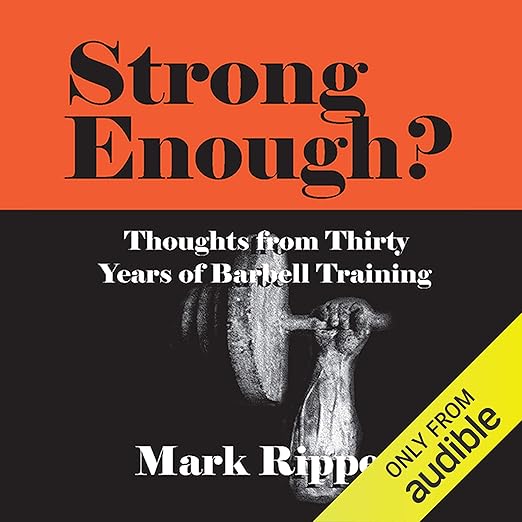
I was on a rest day when I started Strong Enough, which felt appropriate. Mark Rippetoe’s book of essays is the kind of thing you read when you are not in the gym but thinking about the gym, what you are doing, why you are doing it, and whether you understand the principles well enough to actually get better at it. I had Rippetoe’s voice on while stretching on my living room floor, and within twenty minutes I had given up on the stretching and was just listening. He has been coaching since 1978 and has owned a black-iron gym since 1984, and that biography is present in every sentence, not as credential-dropping but as the specific texture of someone who has watched thousands of people train and made careful observations about what that reveals about human physiology and motivation.
The book is a collection of essays rather than a linear argument, covering the five major lifts Rippetoe champions (squat, deadlift, press, bench press, power clean), human biomechanics, how to advance in training, strength training as one ages, gender differences in training, and extensive commentary on the fitness industry’s relationship with actual physical preparation. The deadlift form analysis alone, which one reviewer describes as pretty technical but very useful, repays close attention. The philosophy sections are where Rippetoe is most himself, opinionated, occasionally impatient with widespread foolishness, and intermittently very funny in a dry, experience-backed way.
Our Take on Strong Enough
Rippetoe’s Starting Strength has been the foundational barbell text for a generation of lifters, and Strong Enough functions as the companion volume, less instructional, more reflective. One reviewer described reading this alongside Starting Strength as covering everything you need mentally before picking up a barbell. That is probably true, with the caveat that mental preparation and actual coaching under load are different things. What Rippetoe offers here is perspective: on why strength matters, on how the fitness industry consistently misdirects people away from it, on the specific challenges of training through age, and on the cultural dimensions of a serious lifting practice. These are not topics that most fitness books engage with at this level of specificity, and his willingness to be unflattering about industry trends is a genuine service.
Why Listen to Strong Enough
Self-narration is the right choice here, and Rippetoe makes it work. His voice has the same quality as his prose, no softening for accessibility, no performed enthusiasm, just the thing he actually thinks delivered at the speed he thinks it. Reviewers describe the style as direct, practical, and easy to follow, with dry wit in places that makes what could be arid technical content genuinely enjoyable. At under six hours, the collection moves quickly, and the essay format means individual sections can be returned to without re-listening to the whole, useful for something you might want to revisit before a specific training phase or workout challenge.
What to Watch For in Strong Enough
Rippetoe has strong opinions about long-distance running and certain aspects of endurance training, and he expresses them without diplomatic softening. Listeners who view distance running as a primary fitness modality will find his perspective blunt to the point of dismissiveness. The book also tends to assume a reader who is already interested in lifting rather than someone who needs to be convinced to start. The technical sections on form analysis, while valuable, require visualization that audio does not fully support, listeners who can access the written version for the detailed mechanics sections will get more from those passages. This is a specialist’s book, not a general fitness introduction.
Who Should Listen to Strong Enough
Anyone who trains with barbells and wants to understand the principles behind the practice at a deeper level. Anyone who has wondered why the fitness industry so consistently produces confused, undertrained clients. Anyone who wants thirty years of carefully accumulated coaching observation delivered without marketing language or soft-pedaling. Skip it if you are looking for motivation, a complete training program, or an introduction to fitness broadly. For people already inside the tent of serious strength training, it is close to irreplaceable as a perspective text.
Frequently Asked Questions
Do you need to have read Starting Strength before this book, or does Strong Enough stand alone?
Strong Enough stands alone as a collection of essays and philosophy. It is not a sequel to Starting Strength in the way that requires prior reading. That said, listeners familiar with Starting Strength will get more from the technical sections, and the two books complement each other well.
Is this book useful for someone who is relatively new to barbell training, or is it aimed primarily at experienced lifters?
It works at multiple levels. Newer lifters will find the philosophical sections about why strength matters and how the fitness industry misleads people immediately relevant. The more technical biomechanics and form analysis sections reward experience. Reviewers describe it as accessible even without significant lifting background, while still containing things that experienced lifters will find novel.
How does Rippetoe handle topics like training for women or training as you age?
Both are covered with the same directness as everything else. His perspective on strength training for older athletes is particularly developed, he has coached long enough to see the differences between trained and untrained people as they age, and his observations on this are among the more practically valuable parts of the book.
Does the essay format make this harder to follow as an audiobook than a conventional fitness book would be?
Actually easier in some ways. The essays are self-contained, which means the listen is more forgiving of interruption and resumption than a linear argument would be. The technical form analysis sections are the exception, those benefit from close, uninterrupted attention. The philosophical and cultural essays work very well in audio.