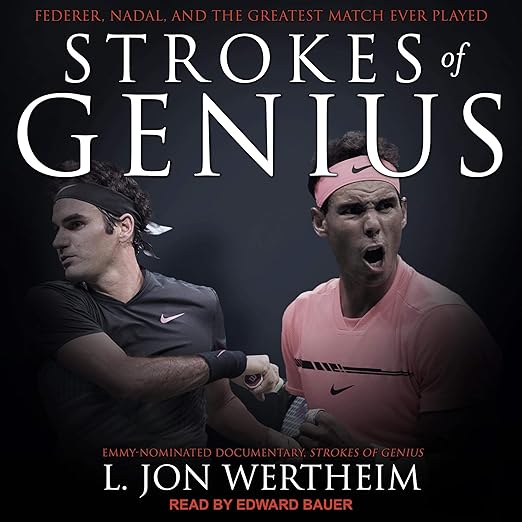
Quick Take
- Narration: Edward Bauer reads Wertheim’s prose with appropriate gravity and pace, capturing the tension of the match without overdramatizing.
- Themes: athletic rivalry, the intersection of science and artistry in sport, what a single moment reveals about two careers
- Mood: Precise and celebratory, with genuine depth beneath the surface
- Verdict: A masterclass in sports writing that uses one match as a prism for everything that makes tennis, and competitive sport, worth watching.
The 2008 Wimbledon men’s final between Roger Federer and Rafael Nadal is the only sporting event I can recall watching three times in full, including once with a friend who doesn’t follow tennis and still found it impossible to stop watching. Jon Wertheim’s Strokes of Genius is the book that explains why a five-set match between two people hitting a ball across a net can feel like the kind of thing you’ll remember decades later. I started listening on a commute and finished it that same evening.
The structure is elegant: Wertheim uses the match itself, played across the course of a fading summer afternoon and into the early evening, eventually completed in near-darkness, as the spine of a broader examination of what tennis is and what this particular rivalry meant. Each section of the match becomes an entry point into the science, psychology, history, and strategy of the game. You never lose the thread of what’s happening on court, but you come to understand it with a depth that live commentary can’t provide.
Our Take on Strokes of Genius
Wertheim was Sports Illustrated’s tennis writer for years, and the book shows the best qualities of that training: he writes with the precision of someone who has watched more professional tennis than almost anyone alive, and the warmth of someone who genuinely loves the sport rather than merely covering it. His description of the match as a four-hour, 48-minute infomercial for everything that is right about tennis is both accurate and a little wonderful, it’s the kind of line that only works if the author means it, and Wertheim clearly does.
The portraits of both players are intimate without being sycophantic. Federer in 2008 was the prohibitive favorite, the player who had won five consecutive Wimbledons and was on track to be recognized as the greatest ever. Nadal was the twenty-two-year-old outsider who had already beaten Federer on clay but hadn’t yet established himself on grass. The way Wertheim constructs the tension between these two trajectories, one defending a legacy, one building one, is sophisticated sports writing.
Why Listen to Strokes of Genius
Edward Bauer’s narration suits the material well. Wertheim’s prose has a measured quality that Bauer respects, he doesn’t push for drama where the writing supplies it naturally. The pace is deliberate, which mirrors the way the book itself moves: with the unhurried confidence of someone who knows they have a genuinely great subject and doesn’t need to oversell it.
At seven hours, this is a comfortable listen for anyone interested in the intersection of sports and ideas. One reviewer described a concern going in that a book about a single match might be redundant, and found instead that with the author’s extras it was a great read, which is the right expectation to manage. This isn’t a shot-by-shot recreation of the match. It’s an excavation of what the match meant.
What to Watch For in Strokes of Genius
Listeners without any prior investment in tennis should consider whether they have the context to appreciate Wertheim’s deeper analysis. He does provide background on both players and on the game’s mechanics, but the emotional core of the book relies on understanding why Wimbledon matters, why Federer’s dominance had the quality of inevitability, and why Nadal’s victory registered as an upset even to people who watched his clay-court results. Casual listeners may find the match-recreation sections more engaging than the analytical ones.
The book was published in 2009, based on a match from 2008. The rivalry it chronicles continued to develop over the following decade, with Federer winning three more Wimbledons and Nadal adding to his own major count. This edition does not incorporate that subsequent history, which is worth noting for listeners who know how the careers continued.
Who Should Listen to Strokes of Genius
Tennis followers, both casual and devoted, will find this a genuinely illuminating listen. Sports writing readers who appreciate the form, David Halberstam, John Feinstein, Roger Angell, will recognize Wertheim as working in that tradition. Listeners interested in the psychology and biomechanics of elite athletic performance will find the analytical sections rewarding. If you watched the 2008 final and want to understand what you saw, this is the essential companion. If you’ve never watched tennis and have no particular interest in starting, the book’s emotional impact will depend largely on your tolerance for sports-as-metaphor writing.
Frequently Asked Questions
Do I need to know tennis well to appreciate Strokes of Genius?
Some familiarity helps considerably, particularly with why Wimbledon carries the weight it does and what Federer’s five-title streak meant in context. Wertheim provides enough background that complete beginners can follow the match narrative, but the emotional depth of the book depends on understanding the stakes.
Is the book purely about the 2008 Wimbledon final or does it cover the broader Federer-Nadal rivalry?
The 2008 final is the structural spine, but Wertheim uses it as a lens for examining both players’ careers, personalities, and the history of tennis. The match is the frame; the content goes considerably wider.
How does Edward Bauer’s narration handle the match-recreation sequences?
Bauer reads with measured gravity that serves the tension of those sequences without overdramatizing. He respects Wertheim’s prose enough not to oversell it, which is the right call for material this well-written.
Does the 2009 publication date mean the book feels dated given how both careers developed?
The book’s focus is the 2008 match and what it revealed about that moment in both careers. It does not attempt to cover the subsequent decade of the rivalry, so readers who know how Federer and Nadal’s careers continued will find that context is simply absent, not contradicted.