Quick Take
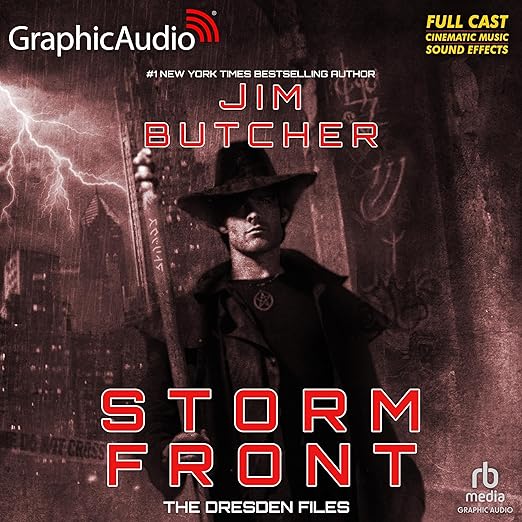
- Narration: A full-cast dramatization with immersive sound design and cinematic music, impressive production values, though fans of James Marsters’ solo performance will feel the absence keenly; the new Harry voice divides opinion sharply.
- Themes: Urban fantasy detective noir, magic in the mundane world, the cost of being the only one who can do the job
- Mood: Energetic and cinematic, noir-tinged with pulpy momentum
- Verdict: A genuinely different way to experience Storm Front that works best for readers new to the series or Graphic Audio converts, longtime Marsters devotees should go in knowing what they are trading.
I came to Storm Front late. I know, I know, years of Dresden Files fans telling me to start the series, and I kept bouncing off the sheer length of the thing. So when Graphic Audio released this full-cast dramatization, it felt like my opening. I queued it up on a rainy Thursday evening, settled in with tea, and let magical Chicago wash over me for eight hours.
What struck me first was how much the Graphic Audio treatment genuinely commits to the premise. This is not an audiobook with a narrator doing character voices. It is a radio drama in the classic sense, a full ensemble, layered sound design, and a score that knows when to go tense and when to pull back. For a novel built around the kinetic energy of Harry Dresden moving through a city full of threats, that production choice pays off in ways I did not entirely expect.
Our Take on Storm Front
Jim Butcher’s first Dresden Files novel holds up as a tight, propulsive urban fantasy mystery. The hook is clean: Chicago’s only professional wizard gets called in by the police to consult on a double murder committed with black magic, and promptly makes himself a target of whoever did it. Butcher keeps the plot moving, the stakes escalating, and Harry’s sardonic internal voice doing a lot of heavy lifting throughout. What the Graphic Audio adaptation preserves is the plot momentum. What it necessarily changes is that inner voice, and this is where listeners will either adapt or resist.
Harry Dresden is famously a first-person narrator in the novels. His commentary on what he sees, what he fears, and what he finds absurd is arguably the series’ greatest strength. In a full-cast format, those interior monologues have to be delivered aloud by an actor, and the performance here drew genuinely divided reactions. One reviewer said flatly that the new Harry voice cannot pull off the deep gruff quality that makes Dresden’s exasperation charming. Another came in without the comparison point of Marsters and found the banter and inner monologues unexpectedly fun. Both responses make sense, and both are valid.
Why Listen to Storm Front
The Graphic Audio production earns its place as a genuine alternative listening experience, not a replacement. The immersive sound design gives the magical combat sequences a texture that a solo narrator simply cannot replicate. Thunder, the crackling of a ward going up, the ambient noise of Chicago streets at night, these layers push the story into something closer to a film soundtrack than a traditional audiobook. For listeners who enjoy BBC radio drama adaptations of novels, or who came to the Dresden Files without the prior attachment to Marsters, this format clicks in satisfying ways.
Reviewer Liz Loyal, who described herself as primarily a romance reader, said she resisted the series for years before the dramatized format finally drew her in. That is not a small thing. If Graphic Audio can make the Dresden Files accessible to listeners who would not have picked up a solo-narrated version, that is a real service to the story.
What to Watch For in Storm Front
The adaptation is not without friction. The most vocal criticism in the reviews centers on the casting of Harry himself, specifically, that the actor chosen for the lead has a softer quality that undercuts Dresden’s defining characteristic: his barely-contained irritability. Harry spends most of Storm Front being put-upon, endangered, and annoyed, and the performance in those moments matters enormously to how the character lands. Listeners with no prior Marsters comparison may find this less disruptive than those who do.
It is also worth noting that this is book one of a very long series. The novel introduces a lot of world, the White Council, the supernatural ecosystem of Chicago, the rules governing magic, without always stopping to fully explain it. The full-cast format does not slow down for exposition any more than the novel does, so first-time listeners should be prepared to follow along with trust that the world will fill in over time.
Who Should Listen to Storm Front
Listeners new to the Dresden Files who enjoy audio drama formats will find this a propulsive and entertaining entry point. Graphic Audio enthusiasts already familiar with the studio’s style will feel at home. Reluctant readers who respond better to full-cast productions than solo narrators are exactly who this version was made for.
Listeners who love James Marsters’ performance in the original audiobook series should approach this as a separate artifact rather than a substitute. The novel is the same; the experience is different. Whether that difference is welcome depends entirely on what drew you to Dresden in the first place.
Frequently Asked Questions
Do I need to have read the Dresden Files novels to enjoy this Graphic Audio version?
No. Storm Front is the first book in the series and introduces Harry Dresden’s world from scratch. The full-cast format is actually a friendly entry point for listeners who have never encountered the series, as the sound design and ensemble cast carry a lot of the world-building weight.
How different is this from the original James Marsters narrated audiobook?
Very different in format and feel. The Marsters version is a solo narration that leans into Dresden’s first-person voice. The Graphic Audio version is a full ensemble radio drama with multiple actors, sound effects, and a score. The plot is the same but the listening experience is distinct, and many fans of Marsters find the new Harry casting a significant adjustment.
Is the full-cast production well-organized, or does it get confusing with so many voices?
Reviews suggest it is generally well-organized. The ensemble is large, more than twenty named performers, but the sound design helps anchor scenes. Listeners familiar with BBC radio dramas or Graphic Audio’s other productions report no significant confusion following characters.
At 8 hours, how does this dramatization compare in length to the original novel content?
The original novel, narrated solo by Marsters, runs around 15 hours. The Graphic Audio version at 8 hours is substantially condensed, which is typical of dramatized adaptations that trim internal monologue and description in favor of dialogue and action.