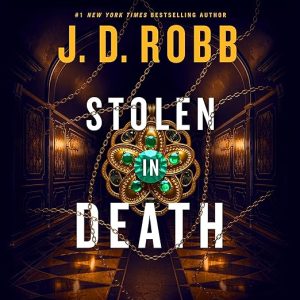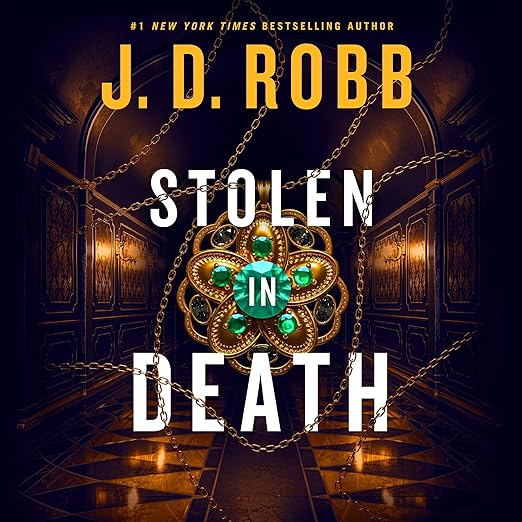
Quick Take
- Narration: Susan Ericksen's performance earned a Kirkus Earphones Award for this entry, and deservedly so, she has been Eve Dallas's voice for so long that the two feel inseparable.
- Themes: Inherited secrets, the weight of the past, justice across generations
- Mood: Taut and familiar, with a darker undercurrent than recent entries
- Verdict: Book 62 delivers the core pleasures of the series while opening a new vein of moral complexity through Roarke's past.
There is a particular kind of comfort in returning to a long-running series, and by book sixty-two of J. D. Robb's In Death sequence, that comfort is deeply established. I came to Stolen in Death mid-week, picking it up during a long commute and finishing the final chapters on a quiet Thursday evening. At thirteen hours and nine minutes, it is a substantial listen, and it earns that length. The series has always understood that its loyal readers are not there simply for mystery resolution but for time spent with these specific characters, and Robb continues to honor that understanding.
The setup is elegant in the way the best procedural setups are: a multibillionaire dead from a blow to the head with a block of amethyst, and nearby, a vault full of stolen art and jewelry that nobody in the household knew existed. Lieutenant Eve Dallas arrives with her usual controlled intensity, and the investigation unfolds outward from that image of the open vault, drawing in a dead patriarch's secrets and, critically, Roarke's own complicated past.
Our Take on Stolen in Death
What distinguishes this entry from a routine procedural is the thread connecting the present crime to Roarke's misspent youth in Ireland as, in Robb's words, a scrappy thief. He recognizes stolen pieces among the vault's contents. That recognition becomes a moral weight the narrative carries throughout, complicating the investigation in ways that go beyond the standard procedural dynamic. Reviewers have noted an OMG moment where Roarke's past surfaces in ways that feel genuinely consequential rather than decorative. Long-running series can become predictable in their reveals, and this one subverts that expectation with some care. One longtime reader described the revelation as the kind of moment that makes the series worth staying with across sixty-plus books.
Why Listen to Stolen in Death
Susan Ericksen received a Kirkus Earphones Award for this performance, which reflects both consistent craft and the accumulated intimacy she has developed with these characters. Her handling of Eve's emotional register, controlled, wry, occasionally vulnerable, has been a constant across the series, and it remains so here. Kirkus noted specifically her adept handling of the cast of characters, including Dallas's partner Peabody, commander Whitney, and the victim's family. That breadth of characterization is what makes these long audiobooks feel populated rather than thin. Ericksen has the rare quality of making a large ensemble feel individually distinct without caricature.
What to Watch For in Stolen in Death
One longtime reader observed a slight change in Robb's writing over the last three or four books: not quite as sharp and gritty as earlier entries. That is worth flagging for listeners who have been with the series from the beginning. The plotting remains strong, and the investigation here is more morally layered than a standard procedural. But if you are arriving expecting the raw intensity of the early books, you may notice the series has softened somewhat in its long middle age. For most fans, that evolution is acceptable. The story involving what Nathan Barrister's father concealed in that vault, and why his son was killed over it, keeps sufficient tension through to the final pages.
Who Should Listen to Stolen in Death
Established fans of the series will find this a satisfying and somewhat richer entry than recent installments, with the Roarke material providing genuine emotional stakes rather than simple procedural complication. New listeners should know that book sixty-two is not a starting point; the series rewards reading in order, and the character relationships have decades of development behind them. If you are curious about the series but coming in fresh, start with Naked in Death and work forward. Those already invested will find Stolen in Death worth the thirteen hours without hesitation, particularly for the vault reveal and what it opens up in Roarke's character.
The broader cast of the In Death series, including Peabody's partnership with Dallas and the professional dynamics at the NYPD, is handled by Ericksen with the same consistency she has brought to previous entries. One longtime reader described the series as delivering romance and humor alongside murder in each book, and that balance is maintained here. The investigation into the Barrister family and what Nathan's father concealed generates enough procedural momentum to sustain thirteen hours without relying solely on character affection. This is, by most measures, one of the more narratively complex entries in the series' recent run.
Frequently Asked Questions
Can a new listener start with Stolen in Death, or is it necessary to read earlier books first?
Starting at book sixty-two is not ideal. The series rewards its long-running character arcs, and much of what gives this entry emotional weight depends on knowing Eve, Roarke, and their supporting cast from earlier volumes. Naked in Death is the recommended starting point.
What earned Susan Ericksen the Kirkus Earphones Award for this performance?
Kirkus cited her ability to convey Eve's emotional range while also differentiating the supporting cast, including Peabody, Whitney, and the victim's family. After years in this role, Ericksen has developed a near-seamless embodiment of the characters.
How prominent is Roarke's backstory in this installment?
More prominent than in recent entries. His recognition of stolen pieces in the vault becomes a significant plot thread, and reviewers have noted a moment of revelation involving his past that adds genuine moral weight to the investigation.
Does the mystery stand on its own, or does it require knowledge of earlier In Death plotlines?
The central murder mystery is self-contained. The emotional and character layers are not. Readers familiar with the series will get more from the Roarke material; newcomers will still follow the procedural plot without difficulty.