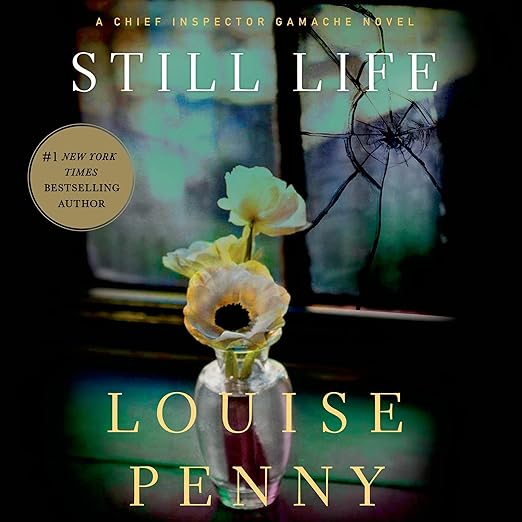
Quick Take
- Narration: Ralph Cosham’s measured, warm baritone is perfectly calibrated to Gamache’s moral seriousness and the quiet, observant quality of Three Pines itself.
- Themes: Community as both shelter and suspect, the ethics of investigation, what village life reveals about human nature
- Mood: Unhurried and atmospheric, with the particular quality of winter Quebec rendered in sentences that feel lived in
- Verdict: A debut that introduces one of literary crime fiction’s most fully realized investigators, with Ralph Cosham making Gamache feel like an old friend within the first hour.
There are mystery series, and then there are the ones that become a kind of habitual comfort, where you return not just for the puzzle but for the company. I came to Louise Penny’s Chief Inspector Gamache series at the recommendation of a colleague who pressed the first book on me with the kind of quiet insistence that usually means the recommender knows something you do not. She was right. I listened to Still Life over the course of a long, rainy weekend in November, and by the time Gamache walked into Three Pines for the first time, I understood why this series generates the kind of loyalty it does.
The set-up is deceptively simple. Jane Neal, a retired schoolteacher and fixture of the tiny Quebec village of Three Pines, is found dead in the woods the morning after Thanksgiving. The Surête du Québec initially rules it a hunting accident. Chief Inspector Armand Gamache, arriving with his small team of investigators, is almost immediately certain it is not. What follows is a mystery that moves deliberately, almost slowly, through the social topography of a village where everyone knows everyone and the distances between affection and resentment are shorter than they appear.
Our Take on Still Life
Penny is doing something specific with the traditional detective novel form that is easier to experience than to describe. She is using the mystery structure as a way to examine the hidden lives of small communities, the way proximity creates intimacy and conflict simultaneously, the way people who live alongside each other can simultaneously know everything and understand nothing about their neighbors. Three Pines is a fictional village, but it operates with the particularity of a place that a novelist has inhabited imaginatively for years. The houses, the bistro, the bookshop, the church: these are described with the kind of specific sensory detail that makes a setting feel inhabited rather than constructed.
Gamache himself is the series’ central achievement. He is moral in a way that most fictional investigators are not quite, not self-righteously so, but in the way of a man who has spent a long career looking at what people are capable of and still believes in something. His relationship with his team, particularly the complicated dynamics with Jean-Guy Beauvoir and the warmth with Isabelle Lacoste, is established here with a lightness of touch that suggests Penny was always thinking in terms of a series rather than a standalone novel. The team functions as an ensemble, and the pleasure of watching them work together is substantial even in this opening volume.
Why Listen to Still Life
Ralph Cosham’s narration has become so associated with this series that it is worth stating clearly: his death in 2014 means that later volumes have a different narrator, and listeners who begin here should be aware that they will need to make an adjustment when they move further into the series. What Cosham brings to Gamache is a quality of moral weight without solemnity, a baritone warmth that makes the inspector’s combination of intelligence and humanity feel absolutely natural. He handles the French-Canadian characters without caricature, maintaining the linguistic texture of the bilingual setting without making it feel like a performance.
One reviewer noted that Penny, unlike writers of more violent crime fiction, does not show us the murders occurring. The Columbo comparison is useful: you arrive after the fact, you observe the evidence and the community, and you piece things together alongside Gamache rather than in a separate thriller time zone. This is a more intimate and in some ways more demanding form of crime fiction, and Cosham’s unhurried delivery perfectly matches its pace.
What to Watch For in Still Life
The novel was Penny’s debut and won several major crime fiction awards including the New Blood Dagger, Arthur Ellis, Barry, Anthony, and Dilys awards. The craft is evident from the first chapter, but first novels do sometimes show their seams, and attentive readers will notice that certain emotional revelations in the final act are telegraphed earlier than Penny’s later novels would allow. This is a minor complaint against a book that achieves so much in its opening act: the atmosphere is fully realized, the characters fully drawn, and the solution satisfying rather than arbitrary.
Three Pines itself, it is worth knowing, is not on any map. Penny has been explicit that it is an intentionally fictional place, somewhere south of Montreal and north of the US border, and its unreality is part of its function in the series. It is not a cozy village of the British murder mystery tradition; it is a place where real grief and real menace live alongside the bistro and the literary discussion group. Penny’s achievement is that it feels entirely plausible anyway.
Who Should Listen to Still Life
Readers who love traditional detective fiction in the Agatha Christie mold but want something with more psychological depth and literary ambition will find this exactly what they are looking for. Listeners who burned out on procedural crime fiction featuring dead bodies as obstacles rather than people will find Penny’s approach a significant change. The listener who should probably look elsewhere is one who needs fast pacing and continuous external action; Still Life moves at the pace of January in Quebec, which is precisely why it works.
Frequently Asked Questions
Do you have to read the Chief Inspector Gamache series in order, starting with Still Life?
Starting with Still Life is strongly recommended. Three Pines and its inhabitants are introduced fresh here, and the team relationships Gamache develops over the series have their foundation in this first book. Some readers have started later in the series and gone back, but the emotional investment builds more naturally from the beginning.
Ralph Cosham died in 2014. Does the narrator change partway through the series, and how disruptive is the transition?
Yes. Cosham narrated the first ten books in the series before his death. Robert Bathurst then took over for subsequent volumes. The transition is noticeable and some longtime listeners found it an adjustment, but Bathurst received strong reviews and the series continued successfully. If you fall in love with Cosham’s Gamache, it is worth being prepared for the change rather than surprised by it.
Still Life is described as a traditional mystery. Does it include graphic violence or is it closer to the cozy mystery tradition?
It is firmly on the traditional literary side, closer to classic detective fiction than to graphic crime thrillers. Penny does not depict violence in real time, the murders have already occurred when Gamache arrives, and the focus is on investigation and character rather than on recreating the crimes. One reviewer compared the approach favorably to Columbo.
Is Three Pines a real village in Quebec?
No. Penny has been explicit that Three Pines is entirely fictional, described as existing somewhere south of Montreal and north of the US border. Its fictional status is partly intentional: it functions as a symbolic space, a community small enough to hold all its residents at once, and Penny has said she did not want it pinned to a real location.