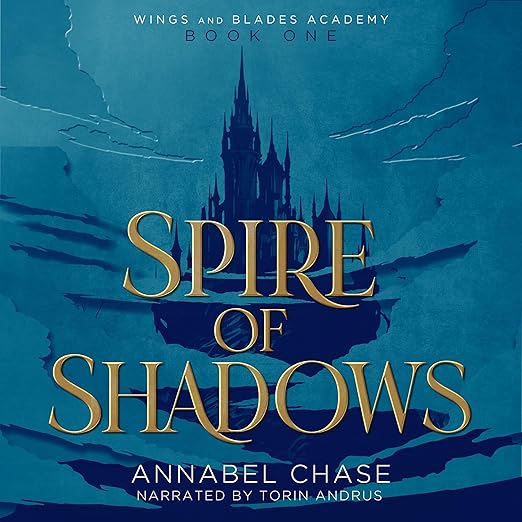
Quick Take
- Narration: Torin Andrus brings clear energy to a large cast of cambion students, keeping character voices distinct without overdoing the vocal differentiation.
- Themes: Chosen-one identity, found family among the outcast, secrets embedded in institutional power
- Mood: Propulsive and atmospheric, genuinely mysterious in its setup
- Verdict: A strong series opener for YA fantasy listeners who want their academy setting to come with actual stakes and a mystery that does not resolve too easily.
I spent a Wednesday evening with Spire of Shadows when I needed something that would pull me through without demanding the kind of sustained literary attention I give to more complex work. What I found was better than I expected: Annabel Chase, working at the edge of her usual register, has constructed a YA fantasy opener that moves with genuine purpose and does not waste its setup on excessive scene-setting before getting to the actual story.
The premise is a specific one. Domus Academy exists hidden above the mortal world as a sanctuary for cambions, the half-human, half-demon children despised by every realm. Cassia, the protagonist, has wings and a past shrouded in secrecy, and she has spent her entire life under the Elders’ protection, isolated from the other students. When she finally enters her final year among peers, there is an immediate murder, a stolen sacred book, and a killer who is almost certainly inside the walls. Chase does not make you wait for any of this. The plot is operational from the first chapters, which is rarer in academy fantasy than it should be.
The Academy That Doubles as a Prison
What Spire of Shadows does well, particularly in its opening third, is establish Domus Academy as a place with layered architecture: literal, social, and historical. The academy has political structures among its students, hierarchies of power based on the nature and strength of individual demons, and a history of secrets that Cassia’s emergence into the general population begins to disturb. Chase is careful to make the isolation that has defined Cassia’s life feel genuinely consequential rather than simply tragic backstory. When she enters the social world of Domus for the first time, she does not know how any of it works, and that ignorance is plot-generative rather than just characterization, because her outsider perspective lets Chase reveal the institution’s structure gradually rather than through exposition dumps.
Reviewer Vik Carroll described Cassia as a strong and caring, gentle heroine who can definitely kick ass when necessary, which is an accurate description of how Chase has written her. Cassia is not defined by toughness alone, which is a common failure mode in this genre, and the balance between her capacity for genuine kindness and her willingness to fight when the situation requires it gives her arc real range to work with across what promises to be a full trilogy. She feels like someone who would make interesting choices in situations the first book has not yet presented, which is the test a series protagonist should pass.
The Murder Mystery and What It Asks of the Listener
The stolen book containing the names and powers of every cambion at Domus is the central MacGuffin, but Chase is smart enough to complicate it. The murder of Cassia’s caretaker is personal in ways that go beyond the plot, and the book spends real time letting Cassia process that loss alongside the investigation rather than treating grief as a momentary beat before moving to the next action sequence. The mystery itself is genuinely constructed: the suspects are distributed through the cast in ways that make the eventual reveal feel earned rather than arbitrary, which is harder to accomplish in a first-in-series book than it sounds.
Reviewer M. Reese gave the book three stars and noted that while there is plenty of suspense and mayhem, the action scenes lack depth and some character development feels thin. That is a fair observation about a series opener carrying a great deal of world-establishment weight alongside its mystery plot. The first book in an academy fantasy has to introduce the setting, the social dynamics, the magic system, and the core cast while still telling a complete story. Chase mostly manages this but does sacrifice some secondary character depth in the process, which is the kind of trade-off readers will accept if the central mystery and protagonist are strong enough to carry the weight.
Torin Andrus and the Sound of Domus
Andrus is a sensible choice for this material. YA fantasy with a large ensemble requires a narrator who can differentiate voices clearly without making the distinctions so theatrical that they distract from the story, and Andrus navigates this correctly. His reading of Cassia’s internal voice is clean and age-appropriate without being condescending, and his handling of the tenser sequences gives them real pace. The audiobook runs just over seven hours, which is compact for the genre and means the pacing never lags long enough to test your patience.
Reviewers note this represents a tonal departure from Chase’s usual work. One described it as not the usual work from the author but excellent in its own right, while another specifically praised how quickly the book gets into the guts of the story. Chase is clearly stretching toward something more serious in tone and consequence, and for the most part the stretch is successful.
Who Should Start This Series and Who Should Not
Spire of Shadows is for YA fantasy listeners who want their academy setting to come with genuine consequence rather than just aesthetic atmosphere. The murder is real, the theft is urgent, and Cassia is operating in a world where being wrong about who to trust has significant costs. Listeners who want light academy fantasy with minimal violence and clean resolution will find this a bit darker than they are looking for. Those who enjoy enemies-to-allies dynamics, found family in unlikely places, and slow-developing mysteries woven through larger political intrigue will find this a solid first entry in what looks to be a well-structured trilogy worth following to its conclusion.
Frequently Asked Questions
Is Spire of Shadows appropriate for younger YA readers, or does it skew toward older teens?
It skews toward older teens and adult YA readers. The murder of Cassia’s caretaker is treated with genuine weight, the political violence of the cambion world is real, and the themes around institutional secrecy and betrayal are complex. It is not graphic, but it is not middle-grade light either.
How self-contained is the story in book one, and how much does it set up future books?
The mystery at Domus is substantially resolved within this installment, but the larger questions about Cassia’s origins and the secrets surrounding her birth are clearly being held for later books. There is a satisfying enough resolution that the ending does not feel like pure setup, but this is clearly the first volume of a series.
Is Torin Andrus familiar from other audiobook series, and does that affect the listening experience?
Andrus has narrated other YA and fantasy projects. Listeners coming to him fresh will find his performance clear and well-paced. There are no distracting vocal choices and his energy fits the material without overwhelming it.
Annabel Chase is known for other series. How does Spire of Shadows differ from her usual work?
Multiple reviewers noted a tonal departure toward something more serious and darker. One reader specifically called it not the usual work from the author while still rating it highly. Listeners familiar with her other series should expect a more sustained level of threat and a more complex narrative architecture.