Quick Take
- Narration: Ray Porter is ideally cast here; his ability to distinguish between the Saints, the Moretti family, and the Vega cartel without caricature is what keeps a three-faction plot navigable.
- Themes: Vigilante ethics in institutional collapse, loyalty as a survival mechanism, the violence required to fight violence
- Mood: Propulsive and morally complicated, with the gritty momentum of a noir crime epic
- Verdict: Sons of War 3 delivers exactly what the series has built toward, and Ray Porter’s narration is one of the better pairings of voice to material in crime fiction audio.
I was halfway through Sons of War when I realized I had stopped thinking of it as a thriller and started thinking of it as a moral argument. Nicholas Sansbury Smith is not a writer who announces his themes. He buries them in plot mechanics and character decision-making, and the result is that you arrive at the question of what distinguishes the Saints from the criminals they are fighting before you have noticed you are being led there. That is craft, even if it is craft deployed in service of a genre novel rather than a literary one, and it is the reason this series has earned the fierce reader loyalty that the reviews consistently reflect.
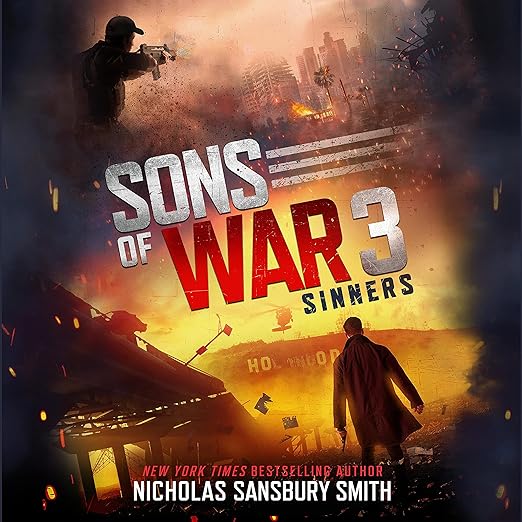
Sons of War is the third book in Smith’s ongoing Los Angeles crime series, set in a near-future America where climate change, governmental collapse, and nuclear fallout have turned the city into a contested zone where the Sicilian Moretti family, the Vega narco organization, and a vigilante squad called the Saints are fighting a three-way war for control. Dominic Salvatore leads the Saints under the motto his father the marine sergeant coined: to fight evil, you must embrace evil. The moral corrosion that motto licenses is what the series is actually about, and book three is where Smith makes that corrosion most visible and most costly for the people trying to live inside it.
Three Factions and the Problem of Keeping Them Distinct
The structural challenge of a three-faction crime narrative is keeping the factions legible without flattening them into caricatures. Smith navigates this more successfully than the setup might suggest. Don Antonio Moretti is the book’s most complex figure, a man who has constructed himself as a rationalist of power and who believes the logic of his position with enough consistency that his reasoning has its own coherence even when his actions are monstrous. The Vega family operates differently, with a more overtly brutal hierarchy that does not trouble itself with justification. The Saints occupy a third position: they believe they are the good guys, and the series is slowly, methodically demonstrating the cost of that belief when the methods required to fight criminal organizations begin to resemble the organizations themselves.
One reviewer described reading this entry with a growing sense of dread about where Smith is taking his characters, and that response is appropriate. The darkness in Sons of War is not gratuitous; it is the point. The city-of-Angels framing, Los Angeles as both setting and irony, gives Smith a mythological backdrop for a story about fallen institutions and the compromised people who fill the vacuum when those institutions collapse.
The Post-Apocalyptic Frame and What It Adds
The near-future setting deserves more credit than crime thrillers usually receive for their world-building. Smith’s Los Angeles is not simply a backdrop; the radiation from a nearby nuclear attack, the drug RX-4 that manages radiation symptoms and is controlled by criminal organizations, the breakdown of municipal services, all of these elements actively shape the moral and tactical choices characters make. The scarcity that drives the criminal economy here is not the ordinary scarcity of money and territory but the scarcity of survival itself. That raises the stakes in ways that conventional crime fiction cannot access, and it gives the three-way conflict between the Morettis, the Vegas, and the Saints a genuinely existential dimension.
Several reviewers compared the series favorably to Smith’s earlier work in the Hell Divers and Orbs universes, noting that Sons of War is doing something more nuanced with its characters across the full arc of the series. That comparison holds up. Smith is a highly productive writer, and not everything in his catalog reaches the same level of ambition. This series does, and book three is where the ambition is most fully realized in terms of moral complexity.
Ray Porter and the Three-Voice Problem
Ray Porter is a narrator with a specific gift: he can inhabit morally compromised male protagonists with a kind of dangerous authenticity that does not tip into camp or caricature. He brings that quality to Sons of War across three separate character networks. His Dominic Salvatore is tight-wound and earnest in his mission; his Don Moretti is measured and cold with a contained menace underneath the civility; his supporting cast of Saints members is differentiated enough that the ensemble sequences do not blur into each other over the twelve-hour runtime.
At twelve hours and thirty-nine minutes, the audiobook benefits enormously from Porter’s stamina and consistency. Crime fiction audio often sags in the middle third when plot mechanics take over from character development, but Porter keeps the energy calibrated even in the expository chapters. Listeners who have followed him through other Smith series will find exactly what they expect here; listeners new to his narration will understand quickly why he is consistently sought for this particular genre and this particular type of morally complicated male protagonist.
Sons of War 3 is not a recommended entry point for the series. Characters, relationships, and the moral contamination of the Saints have all been established across the first two books, and arriving at book three without that history will leave you with a competently told crime thriller that lacks its full emotional weight. Start at the beginning. The series rewards the commitment, and readers who have followed from book one will find this installment the most thematically rich entry yet, which explains the fierce loyalty readers like Cindy, who described mentally shouting at Smith after finishing this one because no further book was immediately available, have developed for this series.
Frequently Asked Questions
Does Sons of War 3 need to be read in sequence or can it work as a standalone?
It requires the earlier books. The Saints as a group, their backstory under Dominic Salvatore’s leadership, and the moral erosion that drives the plot all develop across books one and two. Starting here will leave significant emotional and narrative context missing.
How does the near-future post-apocalyptic setting affect the crime fiction genre conventions?
The radiation, governmental collapse, and resource scarcity Smith builds into the setting raise the stakes beyond conventional crime territory. Criminal control of RX-4, the only drug that manages radiation symptoms, gives the faction conflict an existential dimension that changes the moral calculus for characters on every side.
Is Ray Porter’s narration suited to the series’s moral complexity?
Very much so. Porter’s particular strength is voicing morally compromised characters with authenticity rather than judgment, which serves a series whose central argument is about the costs of fighting evil with evil’s own methods. He differentiates the three factions clearly without reducing any of them to caricature.
How many books are in the Sons of War series and is it complete?
The series was in progress at the time of this audiobook’s release, with several reviewers expressing frustration that additional books were not yet available after finishing book three. Readers should verify current publication status before starting the series.