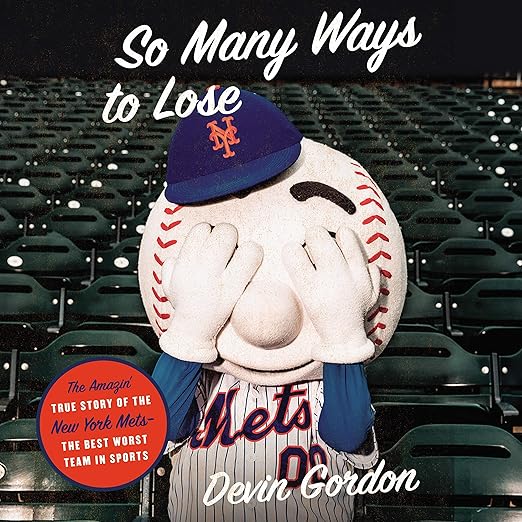
Quick Take
- Narration: Jeremy Arthur captures the comedic and elegiac registers of Devin Gordon’s prose without forcing either, his pacing matches the book’s mix of absurdist history and genuine emotional investment.
- Themes: Sports fandom as identity, the particular culture of losing, New York as a character
- Mood: Funny and genuinely felt, like laughing at something that also kind of hurts
- Verdict: The best kind of sports book, one that uses a team’s history to say something true about how we choose what to love and why we stay loyal long after the logic has expired.
I am not a Mets fan. I want to say that upfront, because I think this book works regardless of whether you are, and I want to be honest about where I’m coming from. What I am is someone who grew up around baseball and has been fascinated by the sociology of fandom for years, why people attach themselves to particular teams, what those attachments reveal about identity and place and the strange human need to organize hope around something fundamentally uncontrollable. Devin Gordon has written a book that addresses all of that through the Mets, which is a perfect lens for the subject because the Mets are an extreme case.
Our Take on So Many Ways to Lose
Gordon’s central argument is worth taking seriously. He draws a distinction between being bad and being gifted at losing, and he argues the Mets are the latter in a way that makes them genuinely unique in professional sports. This is not just a catalog of disasters, though there are disasters in abundance, the wild boar that took out an All-Star, the six-run ninth-inning lead evaporated, the manager fired before managing a single game. Gordon is interested in the pattern, in what the Mets’ particular form of failure reveals about the organization, the city, and the fans who have stayed with them across sixty-plus years.
The book is also a genuine piece of cultural criticism. The sections on Willie Mays’s famous catch compared to Endy Chavez’s 2006 NLCS catch, on the origins of the franchise and its relationship to Brooklyn’s displaced Dodgers fans, on Cleon Jones and the history his family carries from rural Alabama, these are not digressions. They are the actual argument. Gordon is as interested in what the Mets mean as he is in what the Mets have done, and the combination is what lifts this above the sports-book category into something with broader literary ambitions.
Why Listen to So Many Ways to Lose
Jeremy Arthur handles the tonal range of Gordon’s prose with real skill. The book moves between comedy and elegy sometimes within the same paragraph, a paragraph describing a genuinely humiliating organizational moment might end with a sentence that captures something real about why the fans are still there, and Arthur navigates those shifts without overplaying either register. At nearly thirteen hours, this is a full listen, but the pacing never sags. Gordon is a magazine writer by training and it shows in his efficiency; he doesn’t waste space.
Multiple reviewers have noted that the book captures what being a Mets fan feels like from the inside in a way that resonates regardless of when you’re reading. One reader finished it after the 2025 season and described it as the therapy they needed. Another wrote that asking what it means to be a Mets fan is like asking what it means to stick your fingers repeatedly into a spinning fan, you’ll be damned before you root for the Yankees. That particular spirit is all over this book.
What to Watch For in So Many Ways to Lose
Gordon is a lifelong Mets fan writing about the Mets, and his perspective is insider rather than objective. He is not interested in the Yankees except as a cultural foil. If your primary frame for baseball history is the American League or the AL East, some of the deep lore here will require orienting yourself. The book also assumes some baseline familiarity with the basic structure of baseball, it does not pause to explain what a pennant race is or why a six-run ninth-inning lead is theoretically safe.
A couple of reviewers noted that the characters, particularly the organizational figures Gordon writes about, occasionally feel thin. The book is more invested in the collective identity of the Mets fan base than in the inner lives of any individual player or executive, which is a valid choice but worth knowing going in.
Who Should Listen to So Many Ways to Lose
Mets fans are the obvious first audience, and the book will give them twelve hours of recognition, comedy, and the particular satisfaction of having their experience accurately described. Non-Mets baseball fans who are curious about one of the stranger franchises in the sport’s history will find it genuinely illuminating. And readers who care about sports fandom as a cultural and psychological phenomenon, regardless of what team or sport they follow, will find Gordon’s central questions worth engaging with.
Casual sports listeners or people without any prior interest in baseball will find less to hold onto here. The emotional resonance of the book depends on understanding, at least intellectually, what it means to care about a team across decades of disappointment. If that stakes that feeling means nothing to you, the comedy still lands, but the depth won’t.
Frequently Asked Questions
Do I need to be a Mets fan to get something out of this audiobook?
Not at all, though Mets fans will get the most out of the specific historical references. Gordon frames the Mets’ story as a larger argument about fandom, identity, and the difference between being bad and being genuinely gifted at losing, which has resonance well beyond Queens.
How does Jeremy Arthur handle the comedy in Gordon’s writing?
Arthur is well matched to the material. He doesn’t push the comedy, the absurdism of the Mets’ history is self-evident enough that it doesn’t need theatrical delivery, but he has good timing and handles the tonal swings between funny and genuinely moving with natural ease.
Is this primarily a record of Mets disasters, or does it engage with the good seasons too?
Both. Gordon gives substantial attention to the 1969 Miracle Mets, the 1973 ‘Ya Gotta Believe’ run from last place to Game 7, and the 1986 powerhouse season. His argument is that the franchise’s miracle runs are inseparable from its disaster runs, that the DNA of one is encoded in the other.
Does the book require deep baseball knowledge, or is it accessible to casual sports readers?
You need a baseline familiarity with how baseball works, pennant races, postseason structure, that sort of thing. But Gordon doesn’t write as if his readers have memorized box scores. The cultural and emotional dimensions of the book are accessible to anyone who has ever cared about a sports team, even if baseball isn’t your primary sport.