Quick Take
- Narration: Jeffrey Kafer is a reliable presence in legal thriller territory and keeps the multiple storylines of Small Town Conviction from bleeding into each other, which is no small feat given the book’s braided structure.
- Themes: Systemic corruption behind respectable facades, the vulnerability of the accused in small-town justice, personal cost versus professional obligation
- Mood: Tightly wound and procedural, with mounting stakes and a satisfying courtroom climax
- Verdict: A confident third installment in the Spencer Dunn series that works as a standalone legal thriller while rewarding readers who have followed the series from the start.
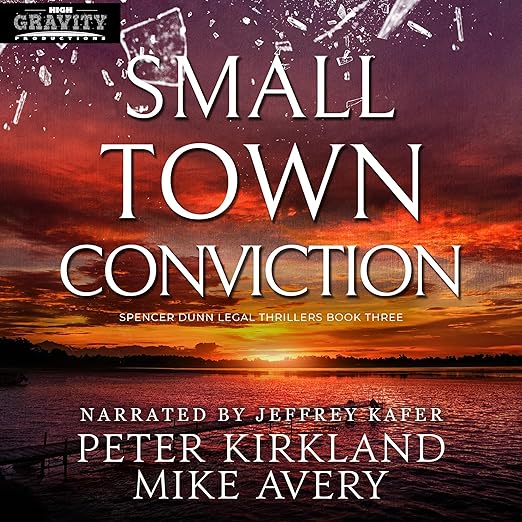
Legal thrillers have a particular problem that courtroom procedurals in other media do not: the reader has to believe both that the law is interesting and that the specific characters navigating it are worth following. Small Town Conviction, the third Spencer Dunn book from Peter Kirkland, handles both requirements competently and at points more than competently. I came to it without having read the earlier two volumes, specifically to test the author’s claim that it can be enjoyed as a standalone, and I can confirm that it functions on its own terms, though one reviewer who has read the series in order makes a convincing case that the character development lands harder when you have watched Spencer Dunn accumulate his particular damages over time.
The setup is structural rather than atmospheric: one small town, one deadly weekend, three crimes that appear unrelated. A business owner shot and disappeared. A hit-and-run rampage. A daycare incident that puts children in the hospital. Spencer Dunn, a criminal defense attorney working his father-in-law’s firm in the fictional small town of Autumn Harbor, Maine, begins to sense the thread connecting them, and that thread leads to Jack Butcher, the civic leader whose public respectability is, in the book’s framing, a performance masking something considerably worse.
Kirkland’s Braided Case Structure
The three-case structure is the book’s central formal challenge and its primary source of tension. Kirkland keeps the three storylines moving at roughly equal pace without letting any of them sit cold for too long, which is harder than it sounds in a seven-hour audiobook where the listener’s patience for structural complexity is finite. The payoff, when the cases converge, is described by one reviewer as multiple climaxes in the final chapters that are both satisfying and intelligent. That description matches the book’s intentions, even if the convergence itself is somewhat telegraphed in the setup.
The villain, Jack Butcher, is the character the book invests least in, and this is a genuine weakness. He is described primarily through the damage he has done and the fear he inspires rather than through any direct characterization that would make him feel dangerous in a specific, human way. The best legal thrillers give their antagonists enough interiority to be frightening for reasons other than their track record. Butcher remains a function of the plot more than a fully realized presence in it. That said, the procedural momentum is strong enough that his flatness does not sink the story.
Spencer Dunn as Series Protagonist
What saves the book from that limitation is Spencer himself. Multiple reviewers flag him as complex and struggling, someone working in his father-in-law’s firm taking the cases no one else wants, which is a richer professional situation than the standard lone-wolf attorney setup. The review from KTinMA describes him as going through something personally in addition to the professional pressure, and that combination of external stakes and internal difficulty gives Dunn enough dimension to carry the book even when the plot machinery is running on autopilot. His family being placed under threat by Butcher adds personal stakes that the purely professional conflict would not generate on its own.
One reviewer noted that the pacing is perfectly balanced, steady and engaging, building toward the climactic courtroom sequences without the false peaks that can make lesser legal thrillers feel like they are stalling. That assessment is largely accurate. Kirkland is good at economy. He does not spend words on scenes that are not earning their place.
Jeffrey Kafer and the Legal Thriller Register
Jeffrey Kafer is a veteran narrator in the legal thriller and crime fiction space, and Small Town Conviction plays to his strengths. His voice has the right combination of authority and urgency for a courtroom drama, and he keeps the multiple narrative threads distinguishable without resorting to exaggerated character voices that would undermine the book’s realistic tone. Seven hours and ten minutes moves efficiently under his pacing. Relay Publishing has produced the audio with the consistency you would expect from a series property at this stage of its development.
A Series Worth Entering at Book Three
Small Town Conviction is a solid choice for listeners who enjoy legal procedurals set in contained communities where the corruption is structural rather than random. The free audiobook availability makes it an accessible entry point into the Spencer Dunn series without any financial risk. Series readers will find the character continuity rewarding. New listeners will find enough context to follow the story and, if the Autumn Harbor setting and Dunn’s particular combination of professional competence and personal difficulty appeal to them, a two-book back catalog waiting when they are done. The book was released in February 2026 and has built a strong early readership that suggests Kirkland knows his audience and is delivering what they need.
Frequently Asked Questions
Can Small Town Conviction be listened to without having read the first two Spencer Dunn books?
Yes. Multiple reviewers confirm it works as a standalone. That said, the character development for Spencer Dunn and the recurring cast lands harder with series context, and one reviewer recommends the series in order for the fullest experience.
How does Kirkland manage three simultaneous crime storylines without losing coherence?
He keeps each storyline moving at roughly equal pace and brings them together at the end of the book in a convergence that reviewers describe as satisfying and intelligent. The connection between the cases is the book’s central mystery.
Is the villain Jack Butcher a well-developed antagonist, or more of a functional plot device?
He is more functional than fully developed. The book conveys his danger through impact rather than interiority. Readers who need complex antagonists may find him thin, but the procedural momentum compensates for that.
How does Jeffrey Kafer’s narration handle the multiple storylines and character voices?
Kafer keeps the threads distinguishable through voice variation without exaggerating into theatrical territory. His narration suits the book’s realistic procedural tone and maintains steady pacing across the full seven hours.