Quick Take
- Narration: Ryan MacConnell brings an energetic, genuinely teenage quality to Scott Hudson’s voice — the performance feels inhabited rather than performed, which is essential for a journal-format YA novel.
- Themes: identity formation in the first year of high school, the gap between who you were and who you might become, writing as a way of processing experience
- Mood: Funny, warm, and more honest than its light tone suggests
- Verdict: An underrated YA classic that holds up for adults returning to it decades later — the humor is real and the emotional core is not sentimental.
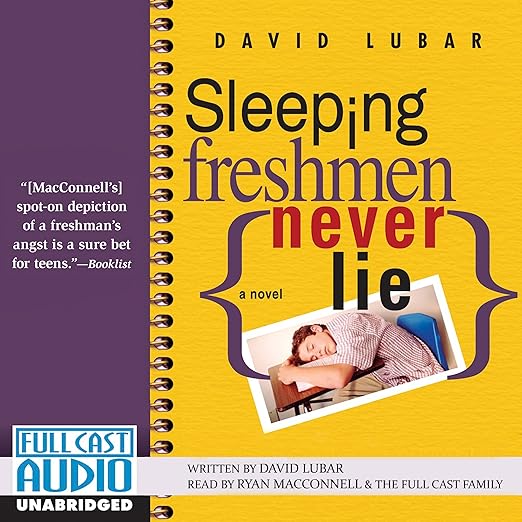
I first encountered Sleeping Freshmen Never Lie through a recommendation from a friend who described it as the book that made her miss being fifteen and be grateful she was not fifteen in the same sentence. That is imprecise language that means something precise about the experience of reading it: it is funny enough to be immediately pleasurable and honest enough about adolescence to be slightly uncomfortable. David Lubar is not a name that comes up in contemporary YA conversations the way it probably should, and this novel, widely considered one of the best YA titles of 2005, has the particular quality of being better than its premise suggests it will be.
The premise is deceptively simple. Scott Hudson starts high school at the same time his mother announces she is pregnant. Sideswiped by news he did not want, Scott begins keeping a journal addressed to the unborn baby — a running account of freshman year survival tips, relationship disasters, social hierarchies encountered, and the ongoing surprise of discovering that the person you are in September is not necessarily the person you will be in June. Ryan MacConnell voices the audiobook, and the format turns out to suit the material particularly well.
The Journal Device: Why It Works Here
Lubar is not the first writer to use the journal format for YA fiction, but his execution is worth examining. The journal addressed to an unborn sibling is not a neutral framing device — it forces Scott to be simultaneously honest, because he is writing privately and thinks no one will read it, and instructive, because he is writing for someone who will eventually need to understand the world he is describing. That double address creates a productive tension in the voice. Scott cannot just narrate his own confusion; he has to organize it into something transmissible, which means he has to understand it well enough to explain it, which means — and this is the psychological insight the device enables — that he is being forced to develop self-awareness in real time.
One reviewer described the voice as winsome and noted that Lubar counts on Scott’s personality rather than plot mechanics to carry the narrative. That is accurate and worth understanding before you start. The plot events of the novel — bullying, a journalism club, a first crush on a girl very unlike him, the pregnancy progressing week by week — are familiar enough that the freshness comes entirely from Scott’s way of seeing them. MacConnell understands this and builds his performance around Scott’s observational quality rather than around the events themselves.
The Unborn Baby Audience and What It Asks of Scott
One of the things Lubar does quietly with the journal device is use the unborn baby audience to give Scott a reason to be kinder to himself than teenagers typically are in first-person YA narration. Writing for someone who needs advice rather than someone who will judge the advice forces a certain generosity — Scott has to be instructive about his own confusion, which means he has to frame it as survivable, as the kind of experience that someone older might look back on with perspective. That framing, which the device generates organically, is what gives the novel its particular warmth and what distinguishes it from YA narrators who are primarily engaged in self-criticism or self-mythologizing. The baby is never born within the timeframe of the novel, which means Scott is writing into a silence that remains open — a small structural choice with a large emotional payoff.
What Lubar Does Quietly, and What MacConnell Delivers
This is a funnier book than it has any right to be given its subject matter. The humor is sharp without being mean, clever without being self-congratulatory, and it lands on the absurdity of social performance rather than on mockery of specific people. A reviewer who read it in high school and returned to it fifteen years later reported finding it just as good the second time around, describing it as hilariously outrageous at times and scarily true to real life in others. That pairing is unusual and hard to achieve — outrageous and true to life do not coexist easily without one undermining the other. MacConnell is a good reason to choose the audiobook over the print edition: the journal format lives or dies on voice, and he keeps Scott grounded in an adolescent register that does not tip into caricature. At six hours and fifty-one minutes, this is a comfortable single-day listen that was required reading for an incoming eighth-grader, one reviewer noted, and the student finished it in four days and loved it from the first chapter.
Frequently Asked Questions
Is Sleeping Freshmen Never Lie part of a series, and do I need to read in order?
There is a companion novel involving Scott’s younger sibling, but Sleeping Freshmen Never Lie stands entirely on its own. The book’s events are self-contained within the freshman year, and the series designation in the metadata reflects the companion relationship rather than a sequential plot dependency.
Is this appropriate for middle grade readers, or is it strictly high school material?
The novel is appropriate for middle school readers — one reviewer mentions it as required reading for an incoming eighth grader. The content involves bullying, a first crush, and some social pressure, but nothing that would be inappropriate for readers in the twelve to fourteen age range. Adults returning to it will find the humor holds up without requiring any adjustment.
Ryan MacConnell is not a widely recognized audiobook narrator — how does his performance compare to more established YA narrators?
MacConnell is a solid choice for this particular material. His teenage vocal quality feels natural rather than performed, which is essential for a first-person journal narration. The risk with YA performance is overcooking the emotional beats, and MacConnell consistently avoids that, letting the humor and feeling emerge from the writing rather than from added vocal emphasis.
How does this novel compare to other YA books about the high school experience from the same era?
Sleeping Freshmen Never Lie occupies a relatively distinct niche in the 2005 YA landscape in that it is neither a romance-first narrative nor a social commentary project. It is primarily a comedy of observation, and in that register it is more closely related to Paul Zindel’s work from an earlier generation than to the dystopian and paranormal fiction that would come to dominate YA in the following decade.