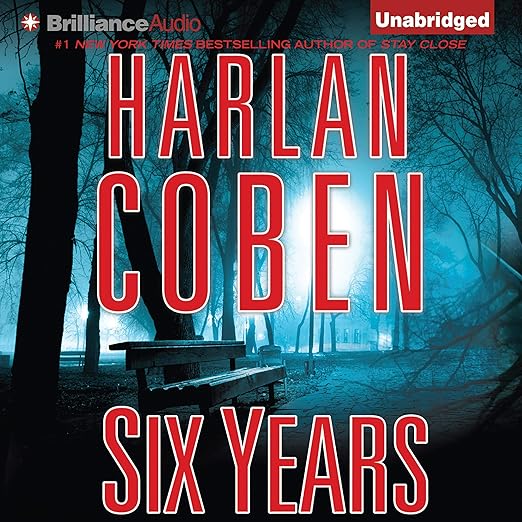
Quick Take
- Narration: Scott Brick is the canonical Coben narrator and brings his reliable propulsive intensity to Jake’s obsessive search, his voice suits the thriller’s relentless forward momentum.
- Themes: Obsessive love and constructed memory, identity built on fiction, the reliability of the past
- Mood: Tense and increasingly paranoid, with a gathering sense of unreality
- Verdict: A solid Coben thriller that does what the genre requires, the premise is clever, the reveals land, and the pacing keeps you committed, though its characters serve the plot more than the plot serves them.
I was halfway through a longer road trip when I started this one, which is close to the ideal condition for a Coben novel. The opening line, “I sat in the back pew and watched the only woman I would ever love marry another man”, is a Coben signature: immediate, emotionally legible, slightly too clean. It’s a line that announces genre rather than concealing it. You know going in that the love, the other man, and the six years of restraint that follow are all going to be more complicated than they appear. The question with any Coben is whether the complication earns the simplicity of that opening promise.
Our Take on Six Years
The setup is efficient. Jake Fisher has spent six years honoring a promise to leave Natalie alone after watching her marry Todd. When he finds Todd’s obituary and attends the funeral hoping to glimpse her, the woman mourning as Todd’s wife is not Natalie, and has apparently been married to Todd for nearly two decades. Everything Jake thought he knew about the best period of his life unravels from there. His search for an explanation gradually reveals that the mutual friends he remembers can’t be found, nobody remembers him, and the man he has become may be built on a fiction that someone else constructed.
Coben is one of the few thriller writers who has fully internalized the power of ordinary American settings. Jake is a college professor, not a spy or a detective. The investigation he conducts is the kind anyone would run, calling old contacts, revisiting remembered places, following the logic of what he thought he knew. That domestic scale is what makes the paranoia effective. The sinister elements in a Coben novel are usually suburban: the neighbor, the old friend, the spouse who isn’t what they seemed.
Why Listen to Six Years
Scott Brick has narrated more Coben novels than almost any other narrator in the backlist, and his voice has become so associated with the material that it’s difficult to imagine separating them. He reads with a controlled urgency that suits Jake’s obsessive internal logic, the sense of a man who knows intellectually that this search is irrational but cannot stop. Brick’s pacing matches Coben’s chapter structure, which moves quickly and ends on notes that pull you into the next section before you’ve decided you want to continue. At just over ten hours, this is a single-sitting drive or a couple of commuter days.
Reviewers who come to this as longtime Coben readers tend to find it satisfying while noting the genre’s recognizable contours. One describes him as “the author who puts the thrill into thriller” and identifies the characters becoming familiar across books as the main limitation of deep fandom. That’s an accurate observation about what happens when you’ve read a dozen Coben novels, the character types begin to cohere into a recognizable type rather than specific people.
What to Watch For in Six Years
One review cuts to a genuine weakness with useful precision: the question of motivation. Why, after six years of restraint, does Jake Fisher suddenly break his promise and attend the funeral? The book is apparently aware this question exists, multiple characters ask him, but never provides a satisfying answer. It’s the kind of narrative convenience that thriller fiction often requires but that becomes more visible when a reader is asked to carry the emotional weight of six years of longing without understanding what broke the stasis.
The characters more broadly tend to exist in service of the plot rather than generating it from their own interior logic. Jake is defined by his feelings for Natalie and his determination to understand what happened; beyond that, he is a function of the mystery rather than a fully inhabited person. This is a common Coben trade-off, and listeners who come to his novels knowing this will find it acceptable. Readers who expect the psychological thriller genre to offer psychological depth alongside its plotting may find the book shallower than the premise promises.
Who Should Listen to Six Years
Coben’s existing readership will know exactly what they’re getting and will likely find this one of his more compelling premises. The six-year time gap and the revelation that Jake’s memories may be systematically false is a stronger hook than some of his other standalone setups, and the reveals in the back half deliver the satisfying inversion the genre requires. Scott Brick’s narration is a significant draw for the audio format specifically.
Thriller listeners new to Coben could do worse than starting here, the setup is self-explanatory and the novel doesn’t require familiarity with the backlist. If psychological interiority and character motivation are your primary criteria, adjust expectations accordingly. This is a book about what happened more than it’s a book about why.
Frequently Asked Questions
Is Six Years a standalone or part of a series?
It is a standalone thriller, not part of a series with recurring characters. Coben has written both standalone novels and series fiction (the Myron Bolitar books, for instance), and Six Years falls in the standalone category, you don’t need any prior Coben to follow it.
How does Scott Brick’s narration compare to reading the print edition?
Brick’s narration is consistently praised for Coben’s material, his controlled urgency suits the propulsive chapter structure and Jake’s obsessive internal voice. Longtime Coben audio listeners often cite Brick as inseparable from the experience of these novels, and the audio format’s momentum may actually strengthen the book’s pacing advantages.
Is the central mystery of why Jake breaks his six-year silence satisfactorily explained?
This is a documented weakness in the book. Multiple characters within the narrative ask Jake why he attended the funeral after six years, and neither they nor the reader receive a fully convincing answer. It is a narrative convenience that the plot requires but doesn’t fully account for, worth knowing going in.
How does Six Years compare to other Coben standalone thrillers?
One experienced Coben reader describes the premise here as one of his stronger standalone setups, the six-year gap and the revelation that Jake’s memories may be constructed is a particularly effective hook. Readers who have consumed large portions of the backlist note that the character types across Coben novels can start to feel familiar, which Six Years shares with the broader catalog.