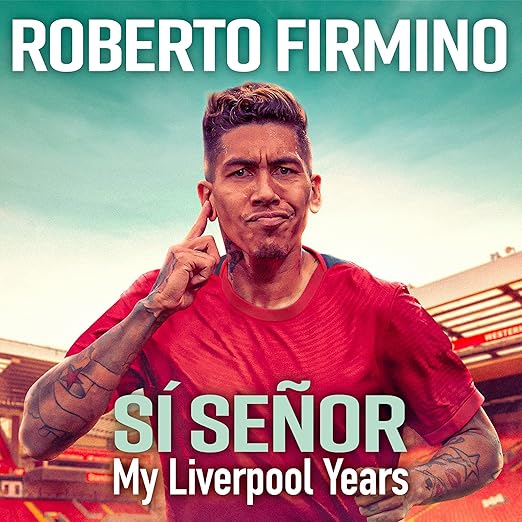
Quick Take
- Narration: Fernando Tiberini brings warmth and sensitivity to Firmino’s voice, a narration that suits the memoir’s Brazilian-English crossover register.
- Themes: identity and belonging at Liverpool, the Klopp era from the inside, faith and humility in elite football
- Mood: Celebratory and quietly introspective
- Verdict: An honest, warm memoir from one of the Klopp era’s most beloved players, less concerned with comprehensive history than with Firmino’s personal experience of belonging to something larger than himself.
I was not expecting to find a meditation on silence in a football memoir. Bobby Firmino is famously private. One reviewer captured it precisely: a shy man silently obsessed with fame and stardom. He gave almost no interviews during his eight years at Liverpool, which made the Kop’s devotion to him all the more striking. The chant that gives this memoir its title, ‘Si, Senor, give the ball to Bobby and he will score’, was written for a man most supporters knew almost nothing about personally. Si Senor fills that gap, quietly and honestly.
Firmino signed for Liverpool in July 2015 and became one of Jurgen Klopp’s most essential tactical instruments, serving as the pressing engine in a counter-pressing system that would ultimately produce a Premier League title, a Champions League, and six other winners’ medals over eight years. He departed in 2023. Between those dates, he formed part of the most celebrated attacking trio in Liverpool’s recent history alongside Mohamed Salah and Sadio Mane. The SAS, as they were known, is one of the central subjects of this memoir.
Our Take on Si Senor
Firmino’s account is structured around gratitude rather than grievance, which is both its defining quality and, for some readers, its limitation. He is generous about his teammates, his managers, and the club. He is honest about his faith, Christianity is a significant presence in the narrative, and about the moments when his form dipped and his confidence wavered. What he is less forthcoming about is the specific texture of difficult moments: one reviewer specifically noted that he avoids detail around key events, including the fallout from the widely reported dressing room disagreement between Mane and Salah. This is a memoir written by a man who values privacy, and that shapes what it reveals and what it withholds.
That said, the interior portrait of what it felt like to play under Klopp is genuinely valuable. Firmino describes the counter-pressing system not from a tactical analyst’s perspective but from the body, what it demands physically, what it requires mentally, how Klopp communicated the vision in a way that made players understand not just what to do but why it mattered. That kind of first-person access to the philosophy of a world-class manager is rare in football memoirs, and it is the most distinctive thing Si Senor offers.
Why Listen to Si Senor
Fernando Tiberini’s narration is a good match for the material. Firmino is Brazilian. He has spoken publicly in Portuguese, Spanish, and English across his career, and Tiberini’s voice carries a warmth and slight Mediterranean inflection that suits the memoir’s register. The result does not sound like an English narrator performing cultural neutrality. It sounds like someone who shares enough geography and warmth with Firmino to convey his voice with some fidelity.
The memoir’s 7-hour runtime is appropriate for what it contains. Firmino does not pad with statistics or contract negotiation detail. He moves through his story at a personal rather than encyclopedic pace, lingering on moments of connection, the friendships, the goals that meant most to him, the experience of the Kop’s support, and passing more quickly through the technical dimensions of his career. Liverpool fans who want a comprehensive chronology of the Klopp era may find this frustrating. Those who want Firmino’s emotional experience of that era will find it honest and affecting in a way that more comprehensive accounts rarely achieve.
What to Watch For in Si Senor
The chapters on Firmino’s Brazilian origins and early career are among the most revealing. His journey from Maceio in Alagoas, a city not typically associated with producing European football stars, to Bundesliga football at Hoffenheim, and then to Liverpool, required overcoming circumstances the memoir describes with disarming candor. The faith dimension of his story is woven throughout rather than confined to a designated chapter, which reflects how central it appears to be to his self-understanding and his resilience during difficult periods.
Readers hoping for revelations about the Klopp inner circle or specific dynamics between star players will not find them here. Firmino is careful with the privacy of others in a way that reflects his own values. What he does offer, the experience of the no-look goal, what it felt like to press relentlessly in a system that demanded total commitment, what the Kop’s love meant to a quiet man from Brazil who never quite understood why they sang his name so loudly, is specific enough to make the reticence worthwhile.
Who Should Listen to Si Senor
This is primarily for Liverpool supporters and admirers of the Klopp era, who will find genuine substance in Firmino’s account of what it meant to be part of that project. Football memoir readers more broadly will appreciate its emotional honesty and the unusual portrait of a superstar who defined himself by self-effacement. Those looking for football biography with comprehensive tactical or political analysis should look elsewhere. This is a personal memoir, not a history of Liverpool FC, and it is best approached as exactly that, the interior account of a singular career by the man who lived it.
Frequently Asked Questions
Does Si Senor cover Firmino’s time in Brazil and at Hoffenheim before Liverpool?
Yes, the chapters on his Brazilian origins and his path through the German Bundesliga with Hoffenheim are among the memoir’s most revealing, providing context that his public persona during the Liverpool years largely kept private.
Does the memoir address the reported Salah-Mane dressing room incident directly?
No. Firmino avoids specific detail around key flashpoints, which one reviewer noted as the memoir’s main limitation. He is generous about both teammates throughout but does not engage with reported conflicts.
Is Fernando Tiberini’s narration suited to Firmino’s voice and background?
Tiberini’s warm, slightly Mediterranean-inflected delivery suits the memoir well. He does not perform cultural neutrality, and the result feels closer to Firmino’s actual register than a purely British narration would have.
Does Firmino discuss his Christian faith in the memoir, and how central is it?
Faith is woven throughout rather than contained in a separate section. It appears to be genuinely central to how Firmino understands his career, his resilience during difficult periods, and his relationship to the privilege of playing at the level he reached.