Quick Take
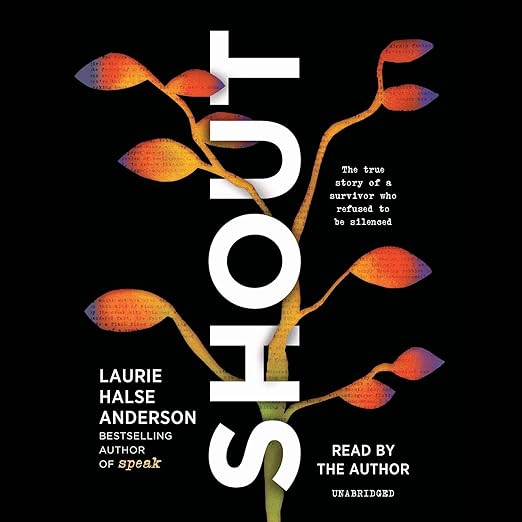
- Narration: Laurie Halse Anderson reads her own memoir in verse with the contained fury and measured grief of someone who has lived every line, no professional narrator could approximate this
- Themes: sexual assault survival, the systemic failure of institutions, the twenty-year distance between Speak and now
- Mood: Fierce, grief-soaked, and ultimately galvanizing
- Verdict: One of the most powerful author-narrated audiobooks in recent YA publishing, essential for anyone who has read Speak, and necessary for those who have not.
I finished SHOUT on a Sunday afternoon that had been ordinary up until that point. I had walked into it with some knowledge of Laurie Halse Anderson’s reputation, Speak is one of those novels that reshaped what YA fiction could do with silence and trauma, but I was not prepared for the specific quality of anger in this collection. This is not the anger that performs itself. This is the anger of someone who wrote a book twenty years ago about surviving sexual assault and then watched the cultural conversation advance by almost nothing.
The audiobook runs just under four hours, and Anderson reads every poem herself. Her voice is not a trained narrator’s voice. It is the voice of someone who has been saying these things in school gymnasiums and literary festivals for two decades, fielding questions from survivors who recognized themselves in Melinda, carrying the weight of correspondence from readers who found in Speak the first language for their own experiences. That accumulated weight is present in every line she reads here, and it changes the experience in ways that are not purely atmospheric, the weight is structural.
The Verse Memoir as Accusation and Autobiography
SHOUT opens in Anderson’s childhood and moves through the rape she survived as a teenager, the decades of silence, the writing of Speak, and then the cultural reckoning of #MeToo. The free verse structure allows for abrupt shifts in register, from the lyric to the polemic, from private memory to direct address, and Anderson uses those shifts deliberately. One poem will inhabit a specific sensory memory with precision and stillness. The next will be a list, or a rant, or a set of instructions addressed directly to perpetrators, bystanders, and institutional enablers.
One reviewer described it as a miraculous autobiography in a collection of poems, and that language is not overstatement. What Anderson has done formally is sophisticated: she has written a poetry collection that reads with the propulsion of memoir, where the emotional through-line is clear even when the chronology fractures. The poems about her parents’ dysfunction and her father’s alcoholism carry particular weight, the pre-assault childhood context is not prologue. It is argument. It is Anderson showing how the conditions for silence get constructed long before the assault itself occurs.
What Twenty Years of Advocacy Does to a Voice
SHOUT was written in part as a response to the letters Anderson has received from readers of Speak across two decades. That audience-awareness shapes the collection. The poems that address survivors directly are pitched with the precision of someone who has learned, from thousands of conversations, exactly what survivors need to hear and what they are exhausted by. The poems that address perpetrators and bystanders are less comforting and more useful, they do not soften the accusation, they do not provide exits, and they do not offer the false closure of individual redemption stories.
The nine starred reviews this collection received on publication reflect something real: this is Anderson at the peak of her technical control and at the limit of her patience with inadequate cultural responses. The combination is devastating in the best sense. One reviewer said they had to break at times because some of the poems hit them hard in the gut. That response is accurate, and it is worth naming: this is genuinely heavy listening, and it should be approached as such, with whatever preparation that requires.
Why the Audio Version Is the Definitive Experience
There is a category of poetry where the page is the primary object and the reading is a useful supplement. SHOUT is not in that category. Anderson’s narration adds layers of tone, restraint, controlled fury, tenderness, that printed text cannot fully convey. The line breaks and silences she builds into her reading are structural elements, not stylistic choices, and they land differently when you hear them rather than see them. The pauses carry specific emotional information: this is when the speaker is containing something, this is when she chooses not to say the next thing directly, this is the weight before the indictment lands.
If you are going to engage with this collection, the audio version is the more complete encounter. Not marginally more complete, substantially more. A print reading of SHOUT tells you what happened. Anderson’s narration tells you what it cost to write it down and read it aloud for the first time, and then again, in every gymnasium and auditorium where she has stood since.
Who This Listen Is For, and Who Should Prepare Carefully
SHOUT is essential for anyone who read Speak and wants to understand what came after for Anderson herself. It is essential for educators, librarians, and anyone who works with young people around conversations about sexual violence and consent. It is essential for readers of confessional poetry who want to see what the form can do when the stakes are as high as they get.
For survivors of sexual assault, the review community has already noted that this is heavy material. One reviewer stated explicitly: if you are a survivor of rape or sexual assault, this book is heavy for us. That acknowledgment deserves to be repeated clearly. The collection is not triggering in a gratuitous way, but Anderson does not protect the reader from the reality of what she is describing. Listen with that understanding, and make space for what it asks of you.
Frequently Asked Questions
Do I need to have read Speak before listening to SHOUT?
No, but the experience is richer with that context. SHOUT directly references the writing of Speak and the twenty years that followed its publication. Readers of Speak will find additional layers of meaning in the way Anderson traces the distance between that novel’s reception and the world she describes here.
How does SHOUT handle the balance between personal memoir and political advocacy?
Anderson moves between the two registers deliberately and often abruptly. The collection is autobiographical in its specificity about her own assault and childhood, and it is openly political in its critique of institutional failure and cultural complicity. Neither mode cancels the other, the personal detail gives the advocacy its emotional authority.
Is this collection appropriate for teen listeners, given its YA classification?
Anderson has always written for young adults without softening difficult material, and SHOUT continues that. The content is serious and at times graphic in its honesty about sexual violence and its aftermath. It is appropriate for mature teen readers and genuinely valuable for that audience, but parents and educators should preview it before assigning it to younger teens.
How does the audio format compare to reading SHOUT on the page?
Significantly better, in my view. Anderson’s own narration adds layers of tone, restraint, controlled fury, tenderness, that printed text cannot fully convey. The line breaks and silences she builds into her reading are structural elements, and they land differently when you hear them rather than see them. If you are going to engage with this collection, the audio version is the more complete experience.