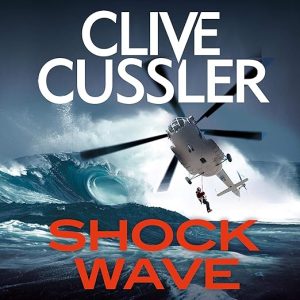
At a Glance
- Narrator: Scott Brick is the definitive voice for Cussler's Dirk Pitt series - his pacing matches the adventure thriller's demands perfectly, and eighteen hours in his hands never feels like duration to be endured.
- Subjects: corporate villainy at global scale, ecological destruction for profit, the lone hero against industrial monopoly
- Tone: Expansive and propulsive, spanning Antarctic ice fields, the Canadian coast, and the Tasman Sea with Cussler's characteristic geographic ambition
- Bottom line: Entry thirteen in the Dirk Pitt series delivers exactly what the franchise promises - globe-spanning adventure, a villain of operatic scale, and Cussler's structural generosity across eighteen hours.
Cussler sets his thirteenth Dirk Pitt adventure, Shock Wave, against a backstory that reaches back a hundred and forty years to a British ship wrecked en route to an Australian penal colony, survivors discovering diamonds on a tropical island, and the dynasty those diamonds eventually built. By the time the contemporary narrative begins - with Maeve Fletcher stranded in Antarctica and dolphins dying in the Weddell Sea - Cussler has already established the villain's inheritance and the stakes that will drive eighteen hours of audiobook. Scott Brick narrates, which for long-form Cussler is effectively a guarantee of audio quality delivered at exactly the scale the material requires.
What Clive Cussler Delivers
What distinguishes this entry in the Pitt series from the standard adventure template is its villain's scheme. Arthur Dorsett's diamond-mining technology is not merely profitable - it is generating acoustic shockwaves as a byproduct that are killing marine life across vast stretches of ocean. The dolphins and seals dying in the Weddell Sea that draw Pitt into the investigation are the visible symptom of a technology that, scaled up, threatens millions of human lives. Cussler constructs a science-based threat that operates with the kind of plausibility he consistently achieves - not rigorous enough for a physics paper, but coherent enough to drive a narrative across multiple continents and two timelines without losing the listener's trust in the stakes.
Maeve Fletcher's positioning in the story adds something the standard Pitt adventure occasionally lacks: a female character with genuine agency and historical connection to the central conflict. Her inheritance from the diamond-finding survivors of that 1850s wreck gives her a stake in the outcome that goes beyond a typical supporting cast role. Reviewers who noted "happiness and sadness" alongside the action are picking up on Cussler's willingness in this book to carry emotional consequence through the adventure alongside the set pieces, which is not a quality all Pitt novels sustain equally well.
Brick's narration across eighteen hours and twenty-eight minutes demonstrates why he has become the definitive voice for Cussler's adventure material. His ability to maintain energy and distinction across a large cast - across multiple geographic locations, across the nineteenth-century framing narrative and the contemporary thriller - is a technical accomplishment that elevates this well above what the text would deliver read silently. The extended runtime is not a problem with Brick at the controls; it is an asset, providing the scope Cussler needs to move Pitt from Antarctica to the Canadian coast to the Tasman Sea without rushing the geography or compressing the sense of physical scale that defines the series at its best.
One reviewer described the book as so different and exciting that it was "hard to put down," noting an abundance of action and "unusual happenings" throughout. A second reviewer, a longtime Cussler reader, flagged this as an older book presented in a fresh release package - a useful caveat for context, though it does not affect the listening experience. Cussler's plotting aged well in the adventure genre; the ecological dimension of Dorsett's threat actually reads with more contemporary resonance now than it did at original publication, which is either a tribute to Cussler's foresight or a comment on how little has changed in the intervening years.
Where Clive Cussler Loses Some Ground
This is book thirteen in the Dirk Pitt Adventures series. While Cussler's novels are more standalone-accessible than many long-running series, recurring relationships and character histories carry more weight with context from earlier volumes. New listeners to Pitt will follow this story without confusion - Cussler re-establishes his hero and the NUMA institutional context efficiently - but the emotional dimension of Pitt's relationships lands more fully with prior series familiarity. First-time Pitt listeners who enjoy this one have a rich back catalog to return to.
Cussler's structural approach in the Pitt novels is consistently generous: multiple storylines, multiple timelines, multiple geographic locations, a villain operation of genuine scale. This produces books that reward the extended audio format more than shorter, tighter thrillers that would feel constrained at eighteen hours. At this length, Shock Wave has the scope to earn its resolution through accumulation rather than shortcut. Listeners who find long-form adventure novels rewarding at the genre level will find this one of Cussler's more accomplished entries; those who prefer compressed, high-velocity thrillers should calibrate expectations for the Cussler pacing philosophy before committing.
The dual timeline - the 1850s shipwreck and diamond discovery alongside the contemporary thriller - is one of Shock Wave's more distinctive structural features. Cussler uses the historical section not merely as backstory but as a parallel narrative with its own momentum and characters. The survivors who discover the diamonds and eventually build the Dorsett dynasty are rendered with enough specificity that the nineteenth-century sections function as a separate story rather than an extended prologue. Scott Brick handles the transition between timelines smoothly, maintaining tonal distinction across historical and contemporary voices in a way that makes the dual structure feel like a feature of the story rather than an organizational convenience.
Who Should Pick Up Shock Wave
Existing Dirk Pitt series listeners are the natural audience, and they will find this a strong entry in the series by the consensus of both dedicated Cussler fans and more occasional readers. New listeners drawn in by the ecological stakes or the Antarctic setting can begin here without significant penalty; the adventure mechanics are self-explanatory enough that the series' characteristic pleasures are fully present from the opening pages. Scott Brick fans who follow his narration across genres will find this among his better-matched projects - Cussler's expansive adventure storytelling plays to Brick's particular strengths in ways that more intimate or character-focused genres do not.
Common Questions
How does Scott Brick's narration hold up across eighteen hours of this audiobook?
Brick is one of the definitive voices for this genre, and his pacing suits Cussler's adventure structure across extended runtimes. His handling of the large cast, multiple geographic settings, and the nineteenth-century framing narrative alongside the contemporary thriller is technically assured. Eighteen hours with Brick narrating is a strength of the format rather than a duration challenge.
Is the ecological threat in Shock Wave scientifically credible?
Cussler builds the acoustic technology threat with enough internal consistency to function as a compelling narrative driver without making hard scientific claims. The connection between industrial diamond-mining acoustic byproducts and marine animal deaths is the kind of plausible-adjacent scenario the series excels at constructing. Listeners looking for scientific rigor should calibrate expectations; those looking for a compelling villain mechanism will find it satisfying.
Does Shock Wave work as an audiobook for someone who primarily reads Cussler in print?
Cussler's adventure structure is well-suited to audio - the geographic scope, the large cast, and the extended narrative benefit from a strong narrator carrying the listener through the transitions. Brick's performance adds texture that enhances the experience beyond what silent reading delivers. Print readers who try this in audio form consistently report that the narrator adds rather than subtracts from the experience.