Quick Take
- Narration: Eileen Stevens reads with warmth and clarity, pitched at the right level for young female athletes and the parents listening alongside them.
- Themes: Confidence-building in youth sport, failure as practice, performance anxiety
- Mood: Encouraging without being saccharine, practical without being dry
- Verdict: A focused, genuinely useful listen for young female athletes struggling with self-doubt, and short enough to revisit before each season.
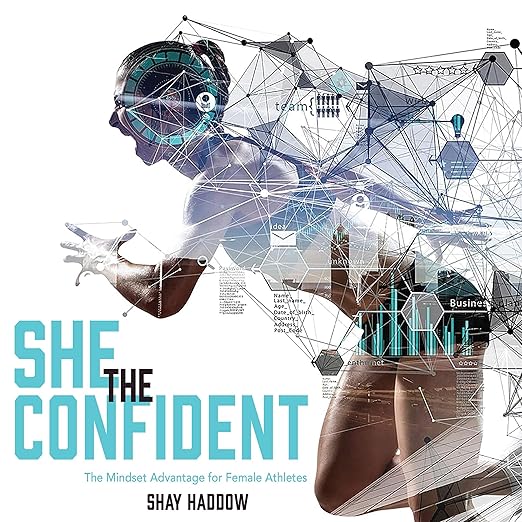
I came to She the Confident through a note in my review queue that flagged it as a youth sports title with an unusually high rating and a strong pattern of parent-daughter listening. That combination caught my attention because it suggests the book works on two levels simultaneously: as something a young athlete can engage with directly, and as something a parent can understand well enough to reinforce in conversation. That is harder to achieve than it sounds.
Author Shay Haddow writes specifically for female athletes, identifying a gap in sports psychology resources that tend to focus either on elite performance without regard for emotional development, or on general self-esteem without specificity about what happens when you are standing on a soccer field in the third quarter having just missed a clear shot. The audiobook addresses that specific terrain, and does it in under two and a half hours, which is the right length for an audience with limited patience for abstract theory.
Our Take on She the Confident
Eileen Stevens narrates with warmth and an even pace that suits the material. The book is not aiming for literary complexity; it is aiming for clarity and recognition. Stevens delivers both. Her voice has the quality of a trusted adult who is actually talking to the young athlete rather than performing at her, which matters when the content includes chapters on overthinking in games, fear of failure, and the particular exhaustion of letting self-doubt run in the background of everything you do on the field.
The structure is direct: specific strategies, action steps, and real-life examples rather than extended theoretical frameworks. Haddow covers overthinking, fear of mistakes, post-performance recovery, and pre-game anxiety as distinct chapters, each with practical tools the reader can test the next day. The bonus material included in this edition, six additional chapters covering topics like embracing imperfection and navigating pre-game nerves, extends the runtime beyond the core text and adds considerable value.
Why Listen to She the Confident
The reviewer responses point to something specific: girls who read this book tend to quote it and return to it. One parent described her daughter quoting the book frequently and approaching situations differently afterward; another noted that her daughter’s team used it as a book club text and found genuine takeaways. That kind of word-of-mouth among the target demographic suggests Haddow is speaking the right language for her audience, which is a different skill from writing well for a general adult readership.
The book’s argument, that confidence is the most essential performance asset and the one least developed in female youth sport, is supported by the observation that girls are quitting organized sports at an alarming rate partly because the psychological dimension of sport is undertreated. Haddow does not spend much time on the systemic argument; she moves quickly to what individual athletes can do with what they have. That focus makes the audiobook actionable rather than diagnostic.
What to Watch For in She the Confident
At two hours and twenty-two minutes, this audiobook is brief. Listeners who want depth on sports psychology, historical research context, or extended case studies from elite athletics will not find that here. The book is deliberately concise and practically oriented, which is a strength for its target audience and a limitation for adult readers seeking a more comprehensive treatment of the subject.
The real-life stories Haddow includes are illustrative rather than deeply reported, and the tone is consistently encouraging without spending much time on the harder structural realities of female participation in sports. For a broader analysis of the systemic issues, other books do that work more thoroughly. She the Confident is positioning itself as the tool you reach for before the game, not the book you read to understand why the game has always been harder for girls to stay in.
Who Should Listen to She the Confident
This audiobook is ideal for female athletes roughly in the eight to sixteen age range who are experiencing performance anxiety, fear of failure, or the kind of ambient self-doubt that quietly erodes enjoyment of sport. It is also well-suited for parents who want to understand what their daughter is experiencing well enough to have useful conversations about it. Coaches who work with young female athletes will find it a practical supplement to technical training. Adult readers who are not involved in youth sport will likely find it too abbreviated and introductory for their purposes.
Frequently Asked Questions
What age range is She the Confident designed for?
The book is pitched at youth female athletes, which the content and tone suggest roughly covers ages eight through sixteen. It is written plainly enough for younger readers while addressing issues, like post-performance recovery and pre-game anxiety, that are relevant across the full youth sport age range.
Can parents and coaches get value from this audiobook, or is it only for the athletes themselves?
Multiple reviewers describe listening alongside their daughters and finding the content directly useful for their own understanding. Coaches will find the practical strategies applicable to team environments. The book is designed primarily for the athlete but translates well to the adults supporting her.
Is the bonus material substantial, or is it filler added to extend the runtime?
The six bonus chapters, covering topics like embracing imperfection and navigating pre-game anxiety, address specific scenarios that complement the core text. They are reported as genuinely useful extensions rather than padding, and for the stated price point they represent meaningful added content.
How does She the Confident handle the topic of failure?
One of the central chapters addresses fear of mistakes and letting failure hold athletes back. Haddow frames failure as part of the training process rather than evidence of inadequacy, and provides specific tools for recovering from poor performances. The approach is practical and action-oriented rather than purely motivational.