Quick Take
- Narration: Liza Ross captures Camille’s flat, defensive interiority with precision, though the UK production occasionally creates minor tonal distance from Flynn’s Missouri setting.
- Themes: Maternal damage and inheritance, self-harm and survival, small-town toxicity
- Mood: Suffocating and psychologically dense, with a dark that accumulates rather than strikes
- Verdict: Flynn’s debut remains one of the most unnerving portraits of maternal menace in contemporary crime fiction, and it is significantly more complex than its murder-mystery frame suggests.
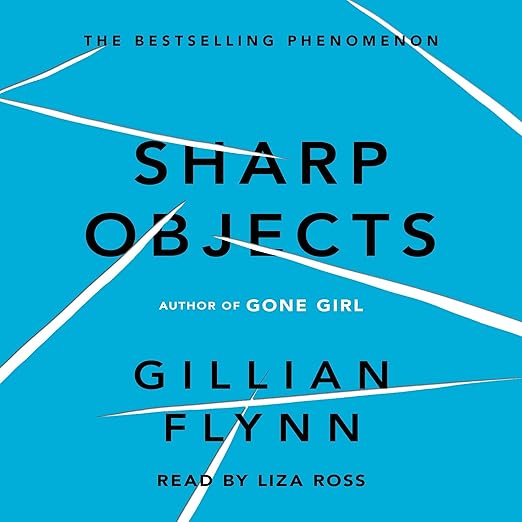
I first read Sharp Objects years before the HBO adaptation and before Gone Girl made Gillian Flynn a household name, and the version I remember is darker and stranger than either of those later contexts prepared me for. Returning to it via Liza Ross’s narration, I was reminded of what Flynn’s debut actually is: not primarily a thriller, but a study in how damage replicates across generations when the person doing the replicating is skilled enough at performing normalcy to evade detection for decades.
Camille Preaker returns to Wind Gap, Missouri, to report on the murders of two young girls. Flynn establishes the investigative frame early and then largely subordinates it to the real subject matter, which is what happened to Camille as a child in that house, with that mother. Adora Crellin is one of Flynn’s most precisely constructed antagonists: charming, refined, socially central, and profoundly destructive to everyone in her care. The novel builds its horror from the gap between Adora’s public presentation and what Camille knows she is.
Our Take on Sharp Objects
Several reviewers have compared Sharp Objects unfavorably to Gone Girl, and I think this comparison is worth interrogating directly. Gone Girl is formally trickier and its plot mechanism more elaborate. Sharp Objects is psychologically deeper and its horror more personal. Camille is not a reliable narrator in the conventional sense, not because she lies but because she has been trained not to see clearly, and Flynn writes that impairment into the narrative without undermining the reader’s ability to perceive what Camille cannot. One reviewer noted that the main character takes longer to realize the actual culprits than the reader does, which is true, and it is also structurally intentional. Flynn is writing about delayed recognition, about the particular difficulty of seeing clearly in a place that formed you.
The Wind Gap atmosphere is one of the novel’s most sustained achievements. Small-town Southern heat, the social granularity of old money families, the way local status functions as both armor and cage, these elements are rendered with enough specificity that the town feels like a real place governed by real logic rather than a generic Gothic backdrop. One reviewer described the atmosphere as suffocating in the best way, and that is accurate. The best way here means you feel the suffocation as Camille does, as something familiar and therefore more dangerous than something alien would be.
Why Listen to Sharp Objects
Liza Ross reads Camille from inside the flatness of Camille’s affect, which is the right interpretive choice. Camille is not performing emotional detachment; she has been living inside it so long that it is structural. Ross does not reach for sympathy through vocal warmth that the character would not authentically project. This creates a slight emotional distance that some listeners may find less immediately engaging than a more expressive narration, but it serves the material’s actual argument. The psychologically aware reader, as Flynn is asking us to be, should be suspicious of a Camille who sounds healed when she is not.
Flynn’s debut contains some of her most formally interesting writing. The device of Camille’s carved words, the scars she has given herself as a form of interior archive, is handled with remarkable restraint given its potential to become gratuitous. Flynn treats the self-harm not as shock content but as a record-keeping system, a way of marking what could not otherwise be acknowledged. One reviewer noted that the novel is a psychological exploration of trauma, generational damage, and the complicated relationships between mothers and daughters. That is exactly right, and it is why the murder investigation frame eventually feels secondary to everything else Flynn is doing.
What to Watch For in Sharp Objects
Some readers have found Camille difficult to sustain investment in, which is a genuine response to Flynn’s deliberate construction of her as someone who has learned to deflect connection. If you need a protagonist who invites warmth, Camille is not that character. The plot resolution is also less mechanically elaborate than Gone Girl’s, and readers who come to Flynn for structural plot twists may find the final reveal less satisfying than the psychological accumulation that precedes it. One reviewer called it a somewhat disappointing novel despite excellent writing, which reflects the experience of coming to it with wrong expectations rather than a failure in the book itself.
Who Should Listen to Sharp Objects
Readers interested in psychological literary crime fiction rather than puzzle-box plotting will find this is the Flynn that rewards the most careful attention. Those who want to understand how Flynn developed the themes she would later refine in Gone Girl and Dark Places should start here, where those themes are at their most raw and personal. If you are primarily interested in a clean thriller structure with a satisfying resolution, Gone Girl is the better choice. If you want Flynn writing at her most unsettling and psychologically serious, Sharp Objects is the one.
Frequently Asked Questions
Is Sharp Objects better or worse than Gone Girl, and should I read them in publication order?
They are doing fundamentally different things. Gone Girl is more formally ingenious in its structure. Sharp Objects is more psychologically sustained and personal in its horror. Publication order, Sharp Objects first, is recommended because you see Flynn building toward the techniques she would develop in Gone Girl, and Sharp Objects is more rewarding before Gone Girl teaches you to expect her structural tricks.
How does Liza Ross handle Camille’s emotional detachment without making the narration feel cold or disengaging?
Ross reads from inside Camille’s flatness rather than performing it from outside. The approach creates some emotional distance, which is structurally appropriate since Camille herself is a character who has learned to keep distance from her own experience. It may take listeners a chapter or two to calibrate to Ross’s register, but the choice is defensible and consistent with Flynn’s intent.
Is Wind Gap rendered as an authentic Southern setting or does it feel like generic Gothic backdrop?
Authentic and specific. Flynn grew up in the Midwest and the social granularity of the Southern small-town setting, the old money families, the local status hierarchies, the particular relationship between heat and repression, is rendered with enough detail to feel real rather than atmospheric shorthand. The town’s logic is internally consistent rather than merely menacing.
Does the HBO adaptation follow the novel closely, and does knowing the adaptation affect the reading?
The adaptation is fairly faithful to the novel’s major events and characters, with some structural differences in pacing. If you have seen the HBO series, you know the central revelation, which does diminish one dimension of the novel. However, Flynn’s prose and the specific psychological texture of Camille’s experience are not replicated by the screen version, and the novel remains worth the listen even if the plot surprise is no longer available.