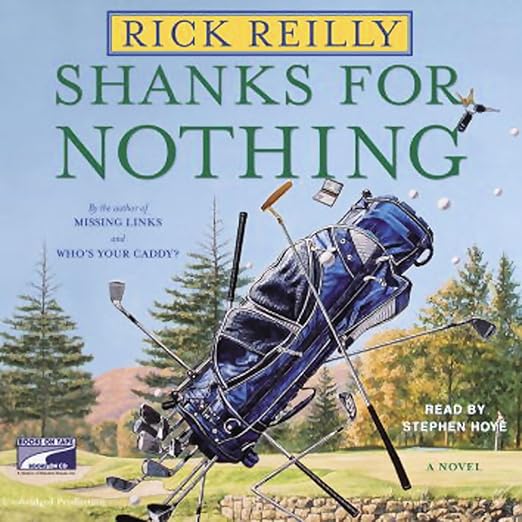
Quick Take
- Narration: Stephen Hoye captures Stick’s wisecracking voice with excellent comic timing and genuine affection for the material.
- Themes: Golf culture and camaraderie, suburban working-class identity, friendship under pressure
- Mood: Fast, funny, and affectionate, with genuine comic set pieces
- Verdict: A sequel that mostly honors its predecessor, best enjoyed by golfers and fans of Missing Links who want more time at Ponky.
I should be transparent: I am not a golfer, and I came to Rick Reilly’s Shanks for Nothing knowing nothing about its predecessor, Missing Links. Within the first chapter, narrated with ideal comic rhythm by Stephen Hoye, I understood this was not going to be a problem. Reilly writes about golf in the way good sports novelists always write about their sport: as a vehicle for character, friendship, class anxiety, and the specific absurdity of caring intensely about something that is ultimately just a game. The golf is atmospheric. The people are what matters.
Raymond Hart, Stick to everyone who knows him, is one of those fictional protagonists you recognize as a fully inhabited human being within the first twenty minutes. He writes greeting cards for fifty dollars each, is genuinely in love with his wife Dannie, has a friend named Two Down who is constitutionally incapable of not making a bad bet, and lives in proximity to Ponky, which Reilly describes with fond contempt as the worst golf course in America. Then everything falls apart simultaneously, in the manner of comic fiction, and Stick decides the solution is to qualify for the British Open.
Our Take on Shanks for Nothing
Reilly made his reputation as a Sports Illustrated writer, and his comic instincts are those of someone who has spent decades finding the human story inside athletic absurdity. The novel has a stream-of-consciousness quality that one reviewer called a little weird but makes for a quick, funny as hell read. That is accurate. Stick narrates his own disaster with the self-aware resignation of someone who has learned not to be surprised when his life produces ten-car pile-ups. Hoye captures that register with what feels like genuine enjoyment.
The cast at Ponky is Reilly’s great achievement in this series. One reviewer who has spent years on golf courses noted that Reilly has a master’s touch for creating quirky personalities, the kind found at every course across the country. Dom, who describes himself as the World’s Most Sexual Man and relentlessly pursues the new clubhouse employee Kelly, is the kind of character who should be annoying but is instead precisely calibrated to the particular self-delusion of a certain type of middle-aged golfer. Hoover, whose golf game is catastrophic and whose wife controls the household finances, generates real sympathy alongside the comedy.
Why Listen to Shanks for Nothing
Stephen Hoye is well-matched to Reilly’s material. He handles the comic timing in Stick’s narration without over-performing it, and the ensemble scenes at Ponky benefit from his ability to differentiate voices without theatrical excess. The 8 hours and 59 minutes moves quickly, which is partly a function of the prose pace and partly Hoye’s natural feel for Reilly’s rhythm. This is golf comedy, which means the jokes come dense and the sentimentality arrives in short, effective bursts rather than prolonged emotional passages.
Reilly’s plotting is organized around cascading disasters rather than a single linear problem, and Hoye keeps the separate threads, Two Down’s Russian mob debt, Hoover’s score deadline, Stick’s domestic exile to the Ponky couch, Stick’s hated father’s death, distinct without losing the comic momentum that propels the whole. The intersection of these threads in the novel’s final third is where Reilly earns his readership’s affection, if not their complete aesthetic admiration.
What to Watch For in Shanks for Nothing
The honest critical note is that reviewers who loved Missing Links most are somewhat divided on whether this sequel fully matches it. A reviewer who enjoyed this book acknowledged that the first was funnier and more enjoyable. Another flagged a sense that the author is capable of something even sharper. These are the critiques of fans rather than of skeptics, and they are worth acknowledging. The British Open qualifier plot requires a certain suspension of disbelief that the tighter, more contained world of Missing Links did not need to ask for.
That said, the 4.4 rating across 326 reviews suggests the book delivers generously on its core promise. Multiple reviewers reported laughing out loud, which is the actual bar for comedy fiction and one that most books claiming the genre fail to clear. Reilly clears it consistently in the first two-thirds, and reliably if not constantly in the final third.
Who Should Listen to Shanks for Nothing
Golfers will get the most from this, particularly those who play at the kind of municipal or working-class course where the regulars develop the kind of eccentric group identity Reilly portrays. Fans of Missing Links should read this as a companion rather than an improvement. Non-golfers who enjoy comic ensemble fiction and do not need to understand handicaps to appreciate friendship under stress will find this accessible and rewarding. Readers who have not read Missing Links can start here, but the relationships will land harder with the prior context.
Frequently Asked Questions
Is it necessary to read Missing Links before Shanks for Nothing?
Not strictly necessary. Reilly reintroduces the characters and the Ponky setting with enough context for new readers to follow. But the emotional weight of the relationships draws on history established in the first book, and fans of Missing Links will get considerably more from this sequel.
Does the novel require any knowledge of golf to enjoy it?
No. Reilly uses golf as setting and atmosphere but writes for readers whose real interest is in the characters. Non-golfers who enjoy ensemble comedy will find the sport-specific references either self-explanatory or irrelevant to the comedy.
How does Stephen Hoye handle the working-class registers in the character voices?
Hoye differentiates the Ponky regulars with light touches rather than caricature, which suits Reilly’s approach to character. He is particularly good with Stick’s first-person narration, capturing the wry, resigned quality of someone telling a disaster story they know ends in survival.
Is the Russian mob subplot handled with comic consistency, or does it introduce a tonal shift that jars with the golf comedy?
Reilly keeps the mob element firmly in comedy register rather than thriller territory. It generates stakes and urgency without displacing the book’s fundamental personality as comic ensemble fiction.