Quick Take
- Narration: B. Jay Kaplan delivers McCallum’s sharp journalistic prose with consistent energy, handling the rapid-fire coaching staff dialogue and locker room exchanges convincingly.
- Themes: System vs. personnel in professional basketball, inside access to a season-defining run, the fragility of a team built on offensive innovation
- Mood: Inside-baseball and absorbing, for readers who like sports writing that takes its subjects seriously without deifying them
- Verdict: One of the best sports journalism books to emerge from the NBA, and a document of a Phoenix Suns team whose offensive revolution still echoes in how basketball is played today.
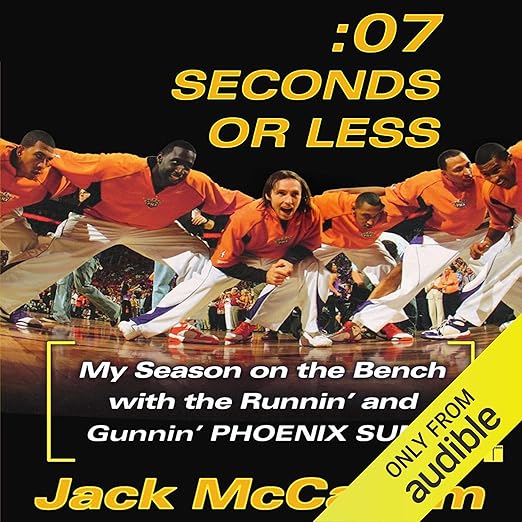
I came back to Seven Seconds or Less during an NBA playoff run that featured several teams trying to approximate what Mike D’Antoni’s 2005-06 Phoenix Suns accomplished with Steve Nash and a roster that had no business competing at the level it did. The book holds up. McCallum embedded with the Suns not for a week or a series but for an entire season, and the depth of access he secured is the kind that simply doesn’t happen anymore in professional sports.
The premise requires some context for listeners who didn’t follow the NBA in that era. The Phoenix Suns of the D’Antoni years were running a pace-and-space offense built around Steve Nash’s vision and speed that violated most of the received wisdom about how to win in the playoffs, where conventional thinking held that defense and half-court execution were what survived in May and June. The Suns challenged that assumption and came close enough to proving it wrong that the subsequent decade of NBA basketball spent a significant portion of its energy trying to answer the question they posed.
Our Take on Seven Seconds or Less
McCallum had been SI’s chief NBA writer for decades before this book, and the access he received reflects that institutional trust. The Suns allowed him into practices, coaches’ meetings, locker rooms, and film sessions. What he found was a coaching staff that was remarkably candid on the record and a roster of professional athletes who are rendered as people rather than symbols. Reviewer James Horlan specifically credits McCallum for not treating the players as gods, noting that someone like Shawn Marion is portrayed as he apparently was: a talented, insecure professional in a complicated relationship with his own value to the team. That honesty is not unkind but it is clear-eyed, which is rarer in access sports journalism than it should be.
The structure follows the season chronologically, with each chapter organized around a specific game or period. The coaching staff, particularly D’Antoni and his assistants, emerges as the book’s most compelling ensemble: intelligent, profane, self-doubting people who have built something unusual and aren’t entirely sure it will survive contact with the playoffs. Reviewer ICUH8N observes that the Suns are a notably clean organization, and the book reflects that: there isn’t the nightlife content that characterizes some access sports books. The drama here is competitive and interpersonal rather than tabloid.
Why Listen to Seven Seconds or Less
B. Jay Kaplan’s narration handles McCallum’s prose effectively. Sports journalism has a specific rhythm, a combination of statistical precision and character observation, that requires a narrator who can keep pace without losing either element. Kaplan manages this across the 8 hours and 49 minutes, though the narration is functional and professional rather than particularly distinctive. The material does the heavier lifting.
Andy O’s review is the most comprehensive of the batch, citing McCallum’s 40 years of journalism experience as evident in the construction of the narrative, particularly in the sections covering the season-ending injuries to Amare Stoudemire and Kurt Thomas and how D’Antoni and his staff responded to those losses. Those chapters are the book’s best, covering the specific basketball and human problem of a system player becoming unavailable in the middle of a run that depends on his presence.
What to Watch For in Seven Seconds or Less
The book is a historical document at this point. The 2005-06 season is almost twenty years ago, the Suns themselves have had multiple subsequent reinventions, and several of the central figures have retired from playing or coaching careers that evolved significantly after this period. Listeners who weren’t following the NBA in that era may need some background context to fully appreciate why this particular team mattered to the sport’s subsequent development. The book itself doesn’t provide much of that framing because McCallum was writing for a contemporary sports audience.
Reviewer Timothy Schum notes the book’s value in illuminating D’Antoni’s low-key management style and the role of his assistants, which is an accurate reading of where some of the book’s most interesting material lives. The coaching dynamics are more developed here than in most sports access books, which tend to focus on players as the primary subjects of interest.
Who Should Listen to Seven Seconds or Less
NBA fans who want to understand the Steve Nash Suns from the inside, and who appreciate access journalism that combines basketball intelligence with genuine character work, will find this essential. Readers of other high-access sports books like Michael Lewis’s Moneyball or David Halberstam’s Breaks of the Game will find McCallum’s methods familiar and his execution comparable.
Casual sports fans looking for a narrative with broader human stakes beyond the basketball itself will find this somewhat narrowly focused. The audience is sports readers rather than general readers who happen to have picked up a basketball book. Within that audience, it is among the better books the NBA has generated.
Frequently Asked Questions
Do I need to know the 2005-06 NBA season in detail to follow Seven Seconds or Less?
Helpful but not required. McCallum explains the team’s roster and the significance of key players as he goes. Some background knowledge of Steve Nash and the D’Antoni offensive system adds context, but the book functions as an introduction to the material for readers who don’t have it.
How does McCallum handle the controversial moments from that Suns season, including the playoff suspensions?
The book covers the full season including the playoff run. The access McCallum had to the coaching staff means the internal reactions to difficult moments are documented in real time rather than retrospectively, which gives those sections particular texture.
Is this primarily about basketball strategy or about the people involved?
Both, and that balance is the book’s strength. McCallum is interested in the offensive system D’Antoni built, but he is equally interested in the coaching staff dynamics, the player personalities, and the specific pressures of a team managing season-ending injuries in a playoff race.
How does B. Jay Kaplan’s narration compare to the experience of reading the print edition?
The narration is professional and clear, handling the sports journalism rhythm well. It isn’t a case where the narration dramatically elevates the source material, but it serves it competently. The print edition’s intensity is preserved rather than diminished in the audio version.