Quick Take
- Narration: Ian Grimley pitches his delivery at the right level for the audience, direct and matter-of-fact without sounding like an authority figure talking down.
- Themes: Impulse control, emotional self-awareness, goal setting under pressure
- Mood: Brisk and no-nonsense, like a good coach running a practice drill
- Verdict: A short, focused workbook-style listen that punches above its runtime for teen boys who respond better to action-oriented framing than reflective journaling.
There is a particular kind of frustration parents describe when a teen boy is struggling emotionally but resists anything that looks like therapy, journaling, or what he might call talking about feelings. I have heard this in various forms from friends who have teenage sons. The books that tend to work in those situations are the ones that frame emotional intelligence as a skill set rather than a vulnerability, and that lead with practical exercises rather than introspective prompts.
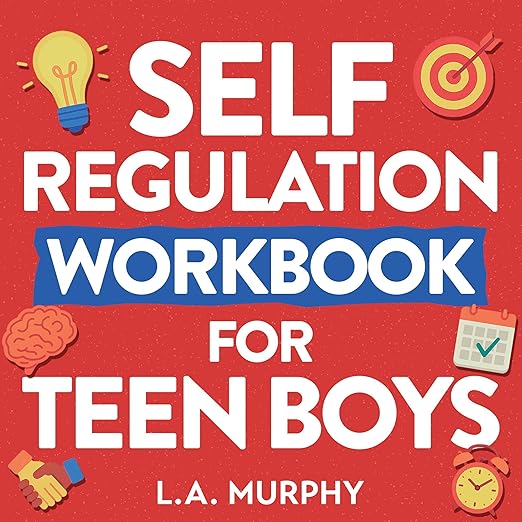
L.A. Murphy’s Self Regulation Workbook for Teen Boys understands this. At under two hours, it is a tight listen that wastes no time on preamble. Murphy writes as someone who has thought carefully about what makes self-regulation content land with a teenage male audience, and the result is a book that reviewer Lindsay’s son took straight to his therapist, who was, apparently, extremely impressed.
Our Take on Self Regulation Workbook for Teen Boys
The framing throughout is deliberately non-clinical. Murphy does not talk about therapeutic modalities by name. What he offers instead are CBT-adjacent tools packaged as practical skills: the pause-and-plan technique, think-before-you-react exercises, and a structured approach to goal setting that does not feel like a worksheet from a school guidance counselor. The tone is consistent with what reviewer Kristina Brown described: language that a teenager would actually engage with rather than dismiss, including vocabulary that her son found impressive enough to confirm the author knew what he was talking about.
The workbook designation is important. This is not a book you passively listen to for insight. The audio version functions as a guided experience through the material, and listeners who engage with the pause-points and reflection exercises will get considerably more from it than those who treat it as background listening. Reviewer M.J.C.K., a clinical professional, noted that the structured format would work well in a group therapeutic setting, which suggests the material has enough internal scaffolding to be facilitated rather than just consumed.
Why Listen to This Rather Than Read It
Ian Grimley’s narration is a genuine asset. He sounds like a slightly older peer rather than a distant expert, and that register is exactly what this audience needs. The under-two-hour runtime means this can be completed in a single sitting, or broken into short sessions that match the chapter structure. For a teen who would resist committing to a longer book, the brevity is a feature rather than a limitation.
The 2025 updated edition positions the content as current and relevant to the specific social pressures teens face now, including digital distraction and social pressure in high-stakes environments. Murphy acknowledges these without dwelling on them, using them as context for why the skills the book teaches are necessary rather than making them the entire subject.
What to Watch For in Murphy’s Workbook Format
The audio format creates one genuine limitation: the workbook components that rely on written responses cannot be completed while listening. Reviewer Amazon Customer noted that the pause-and-plan exercises and the written reflection prompts were among the most valuable elements. Listeners who want to engage with those fully will need to pause the audio and work through them separately, which requires a bit more intentional use than a conventional audiobook.
At under two hours, the book also does not have room for deep exploration of any single area. It covers anger, stress, focus, and goal-setting with reasonable thoroughness given the runtime, but teens who are dealing with more complex challenges, including diagnosed ADHD or anxiety disorders, will find this a supplement rather than a comprehensive resource.
Who Should Listen to Self Regulation Workbook for Teen Boys
Teen boys aged thirteen to seventeen who are dealing with impulsive reactions, difficulty managing frustration, or poor focus in high-pressure situations. Also useful for parents, therapists, and school counselors looking for a low-resistance entry point for this age group. Not a substitute for clinical intervention in cases of diagnosed behavioral or emotional disorders, but a solid first resource or companion tool.
Frequently Asked Questions
Can this audiobook be used alongside formal therapy for a teen with ADHD?
Yes, and reviewer Lindsay specifically mentioned her son with severe ADHD using it alongside his therapist, who responded positively. The structured exercises are compatible with CBT approaches commonly used in ADHD treatment, though the book is not a clinical resource and should supplement rather than replace professional support.
How does the workbook format translate to the audio version?
The audio covers all the explanatory content and frames the exercises clearly, but any written reflection components require pausing the playback and working through them separately. Listeners who engage actively with those pauses will get significantly more value than those who listen passively.
Is this book specific enough to teen boys that girls would not find it useful?
The framing, examples, and tone are calibrated for a male teenage audience. The underlying skills, impulse control, stress management, goal setting, are universal, but the voice and scenarios skew specifically toward boys. Girls looking for similar content would be better served by books written with a broader or female-specific audience in mind.
At under two hours, is this long enough to make a real difference?
Several reviewers report meaningful behavioral changes in their teens after engaging with the material, including one mother who described a noticeable difference at school and at home. The brevity works because the book is focused on a tight set of skills rather than broad wellness. Sustained practice of the techniques matters more than the runtime.