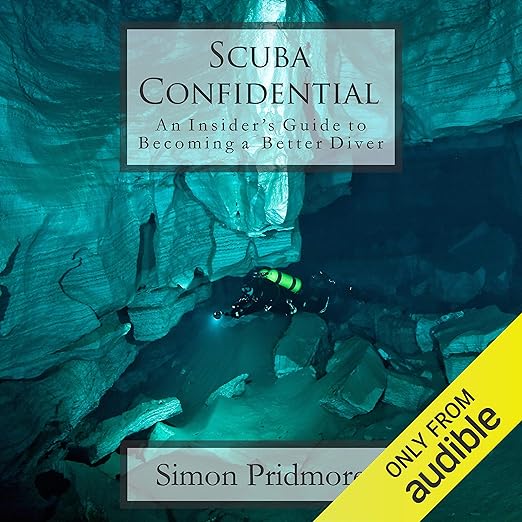
I don't dive, which made listening to Scuba Confidential an interesting exercise in what a well-made niche audiobook can do for someone entirely outside its intended audience. I picked it up because a reader had written to recommend Simon Pridmore's work, describing it as what you wish someone had handed you the day after your certification. By the time I finished it, I had a reasonably clear picture of why it has accumulated nearly 500 ratings and sits at 4.6, and also of who gets the most out of it.
Pridmore has spent three decades involved in virtually every branch of the sport: recreational diving, technical diving, cave diving, wreck diving, divemaster work, instruction. The depth of that experience is evident from the first chapter. He writes with the authority of someone who has made the mistakes he's warning you about, and he's candid in a way that distinguishes this from standard-issue dive certification materials. The question of whether you'd actually be safer without a buddy in certain situations, for instance, is addressed with the kind of nuance that most certification curricula are constitutionally unable to offer.
The Verdict, Briefly
The book is organized around a logic that works well in audio format: each chapter addresses a distinct topic or question, functioning almost as a series of extended conversations rather than a linear argument. Whether Pridmore is explaining what a cave diving course actually involves, walking through how diving accidents typically unfold and why, or offering a candid assessment of which training certifications are genuinely valuable and which represent expensive time, the chapters hold their shape individually. You can dip in and out around your dive schedule without losing track of where you are.
One reviewer who has been diving for nearly fifty years described agreeing with everything Pridmore says, high praise from someone with that kind of experience in the water. Another, a newer diver waiting for an Advanced Open Water course, found the material packed with information they wished they'd had earlier. The breadth of coverage is part of the point: cave diving, wreck diving, deep diving, night diving, drift diving, rebreathers, equipment selection, instructor selection, photography underwater, managing air consumption, solo diving considerations. Pridmore does not pick a lane and stay in it. He covers the whole sport.
The sections on accident analysis are worth the price of admission on their own. Pridmore examines how diving accidents actually occur, not through dramatic freak events but through patterns of complacency, equipment mismanagement, and the slow erosion of good habits. His approach is not alarmist; he loves the sport and that love is present throughout. But he is honest that the risks are real and that most accidents are preventable, which makes the analysis both useful and uncomfortable in exactly the right measure.
The equipment chapter is similarly valuable. The question of how to make sure you are buying the right gear, who to trust when a dive shop makes recommendations, and what to look for in an instructor are the kinds of practical questions that official certification materials tend to skate past. Pridmore addresses them with the directness of someone who does not have a financial stake in steering you toward any particular answer.
Weak Spots in Scuba Confidential
The format is comprehensive rather than deep. On any specific topic, cave diving, rebreathers, technical diving, the chapter provides an excellent introduction and orientation, but Pridmore himself acknowledges that more specialized books exist for each discipline. This is explicitly positioned as a gateway and a framework, not a complete technical manual for any single branch of the sport. One reviewer noted that images would be helpful when Pridmore references specific equipment or techniques; as an audiobook that limitation is obviously more pronounced, and some of the equipment discussions will be clearer to listeners who can supplement with visual references.
Experienced dive professionals may find significant portions of the material familiar. As one longtime diver noted, someone with decades in the water will recognize most of what Pridmore covers, though the organization and the candor make it a worthwhile read regardless. The sweet spot is the intermediate diver who has certification but is still building judgment and experience.
Who Will Get the Most From It
Intermediate divers, those past initial certification and beginning to explore the broader diving world, will get the most from this. Newer divers who want to understand what the sport actually encompasses beyond their first course will also benefit significantly. Very experienced professionals may enjoy it as a well-organized survey of their own field, though it will offer less that is genuinely new. Non-divers who are curious about what serious recreational and technical diving actually involves will find Pridmore's candid tour of the sport surprisingly engaging, I am proof that the book communicates across the knowledge gap.
How does the audiobook format work for a book that includes equipment discussions and technical advice?
Reasonably well, because Pridmore writes clearly and avoids relying heavily on visual references. One reviewer did note that images would be helpful in places, which is a genuine limitation in audio form. For equipment-specific sections, supplementing with visual searches for the items discussed will help.
Does Scuba Confidential take a position on controversial topics like solo diving or deep diving beyond certification limits?
Yes, and that candor is one of the book's distinguishing qualities. Pridmore addresses solo diving, deep diving, and rebreathers with balanced assessment rather than reflexive prohibition, offering the kind of informed perspective that official certification materials cannot always provide.