Quick Take
- Narration: Ken Dryden reading his own book is exceptional: the depth of his personal relationship with Scotty Bowman and with the history of the game comes through in every measured sentence.
- Themes: Sustained excellence and its ingredients, the evolution of hockey over six decades, the nature of coaching genius
- Mood: Reflective and authoritative, with a warmth that deepens the analytical rigor
- Verdict: The definitive account of the greatest coach in hockey history, essential listening for hockey fans and an unexpectedly compelling study of excellence for anyone who has never watched a game.
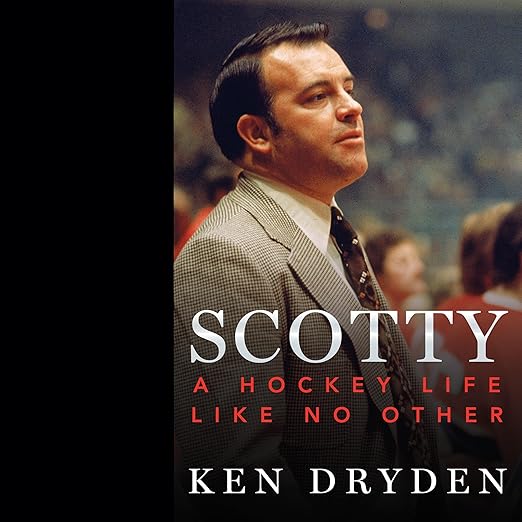
I am not a hockey person by background. My sport was football, and my understanding of hockey extended roughly as far as knowing the difference between icing and offside. I mention this because Scotty, Ken Dryden’s biography of coach Scotty Bowman, held my complete attention for fifteen hours despite this deficit, and I think the reason is that the book is genuinely not only about hockey. It is about what sustained excellence looks like across six decades, how one person can be continuously at the top of a field as the field transforms around them, and what that kind of career costs and reveals about the person who achieves it.
Dryden is uniquely positioned to write this book. He was a Hall of Fame goaltender with the Montreal Canadiens who won five Stanley Cups with Bowman as his coach. Their relationship was not always easy: Bowman was by multiple accounts a difficult man who used discomfort as a coaching tool, who pushed players in ways that were sometimes productive and sometimes simply unpleasant, and who did not confuse being liked with being effective. Dryden writes about this with unusual honesty. He is not writing a hagiography, which makes the eventual portrait of Bowman’s genius more convincing rather than less.
The Unusual Architecture of This Biography
Dryden structures the book around a challenge he poses to Bowman: describe all the great players and teams you have seen across your career, not just their strengths but their weaknesses, and then tell me who the greatest teams of all time were and how they would perform against each other. This device is more than a parlor game. It is a mechanism for extracting Bowman’s actual coaching philosophy from the mind of a man who has spent sixty years observing the game at the highest level without ever losing his competitive acuity.
Bowman saw Rocket Richard play every Saturday night at the Montreal Forum as a teenager with a precious standing room pass, scouted Bobby Orr as a thirteen-year-old in Parry Sound, coached Guy Lafleur and Mario Lemieux, and spent the last decade observing Sidney Crosby, Alex Ovechkin, and Connor McDavid as an advisor for the Chicago Blackhawks. The historical sweep of his experience is genuinely astonishing: no one alive has seen the full arc of modern hockey at that level of proximity. Dryden uses this to construct a kind of living archive, filtering hockey’s transformation through the perspective of the one person who experienced all of it firsthand.
Bowman’s Mind and What Coaching Actually Requires
The most valuable sections of the book are Bowman’s analyses of the players and teams he has known. He is asked to describe weaknesses rather than strengths, to imagine coaching against rather than coaching with the figures he admired most. His observations are precise and sometimes counterintuitive: the assessments of what specific championships required, why certain dynasties ended, what separated the teams that repeated from the teams that peaked once, reflect a lifetime of attention that is genuinely illuminating even for a listener who has never watched a playoff series.
One reviewer with a lifelong investment in the Montreal Canadiens described the final rankings and playoff bracket as definitively satisfying, particularly the conclusion that the late-1970s Canadiens teams would have prevailed over the Gretzky-era Oilers because of defensive depth and skating. Whether you agree with these conclusions is almost beside the point: Bowman’s reasoning for them is the value, and Dryden extracts that reasoning with the persistence of someone who has spent decades writing about hockey at the highest level.
Why Dryden Narrating Himself Is the Right Choice
Dryden is a writer of unusual literary quality for a sports figure. His previous book, The Game, is routinely cited as one of the finest pieces of sports writing in the English language, and Scotty continues in that tradition. His prose is unhurried and precise, aware of the specifics of the game without drowning in jargon, and consistently attentive to the human dimensions of competition. Read by a professional narrator, the book would be good. Read by Dryden himself, it achieves something additional: you are hearing a man think through his relationship with the most important coach of his career, working out in real time what that relationship meant and what Bowman’s extraordinary longevity reveals about the nature of excellence at any level.
This free audiobook on Audible is available for eligible members, and at fifteen hours it earns every minute. Dryden’s measured delivery suits the reflective tone of the project, and the quality of live thinking that runs through his narration is what makes the commitment feel not long but necessary. For hockey fans, the archival value is obvious. For everyone else, this is a study of how one person navigates a career across six decades of transformation in their field, which is a subject with considerably wider relevance than the Stanley Cup standings suggest. For hockey fans, the archival value is obvious. For everyone else, this is a study of how one person navigates a career across six decades of transformation in their field, which is a subject with considerably wider relevance than the Stanley Cup standings suggest.
The book’s treatment of what coaching genius actually looks like, as opposed to what popular sports narratives tend to claim it looks like, is one of the more useful correctives to conventional success mythology available in audio. Bowman was not inspiring in the conventional sense. He was precise, strategic, and relentlessly adaptive. Dryden’s portrait suggests that excellence at the highest level often has less to do with motivation than with sustained, granular attention to what actually works.
Frequently Asked Questions
Is Scotty accessible to listeners who don’t follow hockey closely?
More than most hockey books. Dryden grounds the hockey history clearly enough that non-followers can track the argument, and the underlying themes of sustained excellence and coaching philosophy work independently of specific game knowledge. Some of the player-analysis sections require more hockey context, but the biographical and philosophical core is fully accessible.
How honest is Dryden about his complicated relationship with Bowman as a coach?
Significantly honest. He acknowledges that Bowman was not liked by all his players, that he used discomfort strategically, and that the relationship was sometimes difficult. This honesty gives the eventual assessment of Bowman’s genius more credibility than a purely celebratory account would.
Does the book’s hypothetical playoff bracket feel like a gimmick or does it add genuine analytical value?
It adds genuine value because it is a mechanism for extracting Bowman’s actual coaching philosophy. The conclusions are debatable, as Dryden acknowledges, but the reasoning Bowman applies is illuminating about what he actually values in teams and players.
Ken Dryden is reading his own work. Does that narration choice pay off for a 15-hour listen?
It pays off completely. Dryden writes about his own history with Bowman, and hearing him narrate that history adds a layer of authenticity that no professional narrator could replicate. His measured, deliberate delivery suits the book’s reflective tone perfectly across the full runtime.