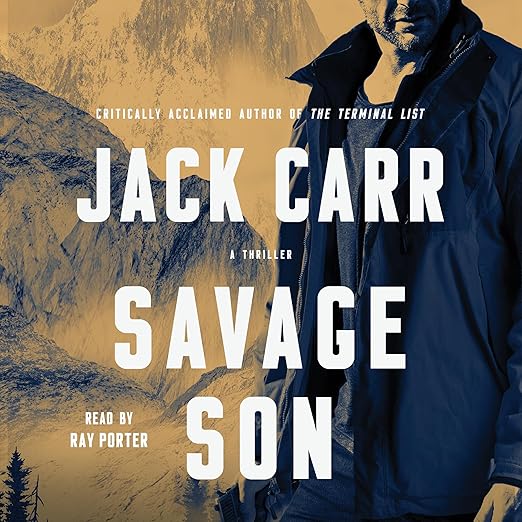
Quick Take
- Narration: Ray Porter is the definitive voice for James Reece, matching the character’s controlled intensity and the novel’s tactical specificity without overselling either.
- Themes: Predator and prey, loyalty under pressure, violence as vocation and burden
- Mood: Relentless and visceral, with occasional stillness in the Montana recovery sequences
- Verdict: The Terminal List series hits its most elemental register in this third book, and Porter’s narration is as much a reason to listen as Carr’s plotting.
I was halfway through a quieter week when I started Savage Son, which was probably the wrong context. The book does not accommodate quiet. By the end of the first two hours I had stopped trying to do anything else while it was playing, which is the most direct measure I know of how a thriller audiobook is working.
Savage Son is the third book in Jack Carr’s Terminal List series, following former Navy SEAL James Reece as he recovers from brain surgery in the Montana wilderness and finds himself targeted by the Russian mafia. A traitorous CIA officer has made common cause with organized crime to ensure Reece does not survive. The novel is structured partly as a pursuit narrative and partly as what one reviewer accurately identifies as a Most Dangerous Game scenario, though Carr executes it with enough tactical specificity and character investment that the familiar bones feel freshly clothed.
Our Take on Savage Son
Ray Porter narrating James Reece has become one of the more compelling audiobook pairings in the thriller genre. Porter does not perform bravado. He narrates from inside the character’s discipline, with a voice that suggests controlled capability rather than performed toughness. For a protagonist who is simultaneously physically damaged from brain surgery and psychologically operating at a level most characters cannot reach, that restraint is essential. The combat sequences benefit particularly from Porter’s pacing, which tracks the tactical logic without losing narrative momentum.
Carr’s novel is the most physically specific of the first three Terminal List books. The Montana wilderness sequences, Reece’s recovery, the hunting dynamics of the final act on Medny Island, all of it is rendered with the kind of operational detail that comes from a writer who has actually done versions of these things. One reviewer called the Medny Island sequence the best Carr has written, and that assessment holds up. The geography is legible, the stakes are concrete, and the physical cost of violence is not elided.
Why Listen to Savage Son
The audiobook format amplifies what Carr does best. His prose moves quickly through action sequences without sacrificing tactical coherence, and Porter tracks that movement without rushing it. The Montana recovery chapters, which might feel slower in print, benefit from Porter’s ability to hold the quieter register without losing tension. Reece’s internal state during recovery, the disorientation, the loss of certainty about his own capabilities, is more present in Porter’s narration than it might appear on a page.
The international dimension of this book, moving between Montana, CIA corridors, and Siberia, also works well in audio. Porter maintains consistent geographic and temporal orientation through tonal choices rather than explicit signposting, which keeps the listener in the story rather than the structure.
What to Watch For in Savage Son
One reviewer noted significant product placement throughout the novel, which is a fair observation. Carr’s tactical specificity extends to gear, weapons, and vehicles in ways that some readers experience as authentication and others experience as advertisement. Your tolerance for that will depend on how you engage with the military thriller genre more broadly.
The review that called some of Reece’s wilderness survival moments otherworldly, in the sense of exceeding plausibility, also has merit. Carr writes his protagonist at the extreme limit of human capability, and in some sequences that limit is stretched. If you are coming from literary fiction and expect naturalistic limits on what a character can survive and accomplish, this will require some calibration of expectations. If you are coming from the genre knowing its conventions, this is squarely within them.
Who Should Listen to Savage Son
Listeners who have followed Reece through the first two Terminal List books should start here immediately. The character development across the series rewards continuity, and the events of the previous books shape this one’s stakes in ways that a new listener would miss. New listeners to the series should begin with The Terminal List rather than here. Military thriller fans who have not encountered the series at all will find this a strong recommendation to start from the beginning. At nearly thirteen hours, Porter makes the investment straightforward.
Frequently Asked Questions
Does Ray Porter narrate all the Terminal List books, and is his performance consistent across them?
Yes, Porter narrates the full series. His performance has been consistently praised across all installments, with the consensus being that he is as responsible for the series’ audiobook success as Carr’s writing.
How much does Savage Son depend on knowledge of the earlier Terminal List books?
Significantly. The Russian mafia plot, the CIA betrayal, and Reece’s current physical and psychological state all flow directly from events in books one and two. New listeners can follow the basic plot but will miss the weight behind Reece’s choices.
Is the Siberia setting in Savage Son as well-researched as the other settings in the series?
Reviewers describe the Medny Island sequence in particular as the most fully realized set piece Carr has written in the series to that point. The geography is specific enough that it feels documented rather than invented.
Is Savage Son appropriate for listeners who are not already military thriller fans?
The book assumes some familiarity with military fiction conventions and technical vocabulary. Readers from other genres can adapt, but the tactical specificity is consistent throughout rather than selective, and tolerance for operational detail is a prerequisite for enjoying this series.