Quick Take
- Narrator: Jerome Rand narrates his own memoir with the plainspoken delivery of someone recounting what actually happened rather than performing a hero's journey, which is precisely the right register for this material.
- Subjects: Solo endurance, the psychology of isolation at sea, physical and mental attrition across a 271-day voyage
- Tone: Immersive and honest, with the particular quiet intensity of someone describing something that nearly broke them
- Bottom line: Sailors and non-sailors alike will find Jerome Rand's audiobook account of his solo circumnavigation one of the more honest and absorbing endurance memoirs of recent years.
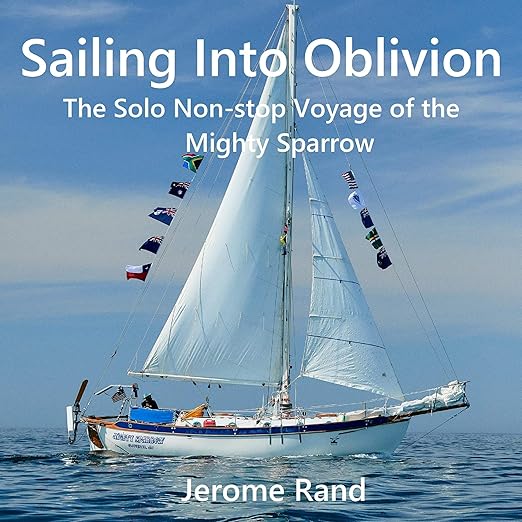
Jerome Rand spent 271 days alone on a Westsail 32 called the Mighty Sparrow, circling the globe without stopping, and the audiobook he made from that experience carries the weight of every one of those days. Sailing into Oblivion: The Solo Non-stop Voyage of the Mighty Sparrow is narrated by Rand himself and runs five hours and eight minutes. The Westsail 32 is not a racing yacht. It is a heavy, seaworthy cruising boat designed for exactly this kind of sustained ocean passage, capable and dependable but not fast, which means Rand's 2017-2018 circumnavigation took approximately twice as long as a modern racing solo sailor would take. Those extra months of ocean are part of what makes the account extraordinary. He was out there long enough to run through every register of experience: exhilaration, boredom, fear, competence, exhaustion, clarity, hallucination, and the particular cognitive state that extended isolation at sea produces in even the most experienced sailors.
The book's structure alternates between narrative memoir passages and actual ship's log transcripts, a structural choice that one reviewer identifies as particularly effective at creating a sense of real-time immersion. The log entries have the unadorned, functional quality of something written while cold and tired and possibly slightly dehydrated, and that quality counterbalances the retrospective narrative passages in a way that keeps the account honest. You get both the event as Rand processed it afterward and the event as he recorded it in the moment, and the gap between the two is often instructive.
The Verdict, Briefly
What separates this memoir from the genre's more self-mythologizing entries is Rand's consistency of tone. He's not performing bravery. He describes fear when he was afraid, stupidity when he made mistakes, loneliness when the isolation became acute, and satisfaction when the conditions and his own handling aligned correctly. The moment when a serious equipment failure threatens to end the voyage is recounted with the same unflashy specificity that characterizes the account throughout. He doesn't reach for the dramatic register. He describes what he saw, what he did, and what the consequences were, and the result is a narrative that earns the reader's trust page by page.
The choice to attempt a solo nonstop circumnavigation in a Westsail 32 rather than a more modern offshore design is itself a statement that Rand addresses but doesn't overexplain. The boat is capable. It is not fast. The voyage will be long. That decision and its implications for fatigue, provisioning, and psychological endurance run through the entire account without Rand ever making them the explicit subject. He simply describes what it was like to be at sea for nine months, and the boat's particular character is part of that texture.
Why Sailing into Oblivion Works as an Audiobook
Rand narrating his own memoir is the right call. His voice has the quality one reviewer describes accurately: a normal guy doing the sort of extraordinary thing we all dream about. There's no professional narrator gloss on the delivery. It's direct, occasionally imprecise in the way of someone telling a story rather than performing one, and the emotional weight arrives without being signaled in advance. The ship's log sections are read with the flat, factual tone they require, and the contrast with the more reflective memoir passages is handled cleanly.
At five hours and eight minutes, the runtime is appropriate for a memoir of this scope. Rand doesn't pad. The voyage was 271 days, and the book compresses that time without losing the sense of duration that is central to the experience. By the final third, the listener has accumulated enough context about the boat, the route, the conditions, and Rand's own psychology that the account of the final passages carries genuine emotional weight.
Points to Consider
Listeners who want technical sailing instruction will not find it here. Rand assumes a baseline of sailing familiarity without making the book inaccessible to non-sailors. One reviewer explicitly notes that the account works for sailors and landlubbers alike, and that's accurate: the technical elements are explained enough to follow but not developed to the level of a seamanship manual. What the book rewards is an interest in endurance and in the particular experience of sustained solitude, rather than a technical interest in offshore racing or passage planning.
The account is also honest about what the voyage cost physically and psychologically. This is not a triumphalist memoir. Rand describes the toll clearly, and while the circumnavigation is completed successfully, the account doesn't end on a note of uncomplicated victory. The candor is one of the book's genuine strengths, but listeners who prefer their endurance memoirs to trend toward inspiration rather than documentation should be prepared for a more ambivalent conclusion.
Who Should Pick Up Sailing into Oblivion
Sailors who have spent time offshore and want a first-person account of what extended solitary ocean passage actually involves will find this audiobook compelling and honest. Non-sailors with an interest in endurance, in the psychology of extreme isolation, or in the tradition of solo circumnavigation will find Rand's direct voice accessible and the account absorbing. Listeners who love Bernard Moitessier's The Long Way or Robin Knox-Johnston's A World of My Own will feel the kinship immediately, though Rand writes with more emotional plainness than either of those precursors. Anyone who needs high dramatic production values or a narrator-as-performer register should look elsewhere: this is a man telling you what happened, without embellishment, and that is its particular strength.