Quick Take
- Narration: Jason Culp delivers a clean, propulsive performance that honors the documentary nature of the material without losing dramatic tension.
- Themes: Youth and resistance, sacrifice, the weight of historical consequence
- Mood: Tense and cinematic, grounded in verifiable history
- Verdict: One of the stronger YA military history audiobooks around, Bascomb knows how to make the stakes feel real without fictionalizing the record.
I listened to this one over the course of a long weekend drive, and somewhere around the second hour, when the Norwegian commandos are moving through the frozen wilderness before the Vemork raid, I found myself genuinely holding my breath. That is not a common experience with nonfiction written for a school audience, and it says something about what Neal Bascomb has managed here.
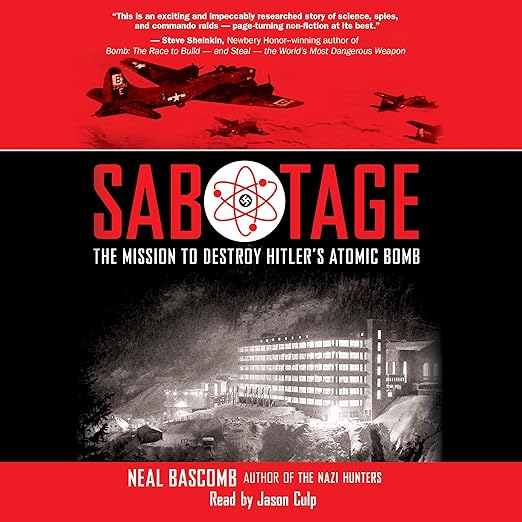
Sabotage: The Mission to Destroy Hitler’s Atomic Bomb belongs to Bascomb’s series of WWII narrative nonfiction adapted for young adults, following The Nazi Hunters. The Scholastic Focus edition targets middle and high school readers, and at six hours with Jason Culp narrating, it is substantial enough to feel like a real historical account rather than a simplified summary. The 4.7 rating across 143 reviews reflects a consistent reader experience, this one lands.
Our Take on Sabotage
The central premise of this book is legitimately astonishing, and the fact that it is all true makes it land harder. In February 1943, a small group of Norwegian commandos, young men operating largely on courage and improvisation, completed what the synopsis accurately calls the greatest act of sabotage in World War II. They destroyed the heavy water production facility at Vemork, denying Hitler’s scientists the material they needed to develop a nuclear weapon. The British had already tried and failed catastrophically. These Norwegians, armed with skis and explosives and months of wilderness survival, succeeded where a larger, better-equipped force could not.
Bascomb structures the narrative around a handful of central figures whose backgrounds he develops before the mission itself. That groundwork pays off. By the time the commandos are on the mountain in winter, the reader knows enough about who they are for the stakes to feel personal rather than historical-abstract. One reviewer described the story as humbling, that word applies. The gap between what these young men risked and what most of us are ever asked to do is significant, and Bascomb does not allow the reader to forget it.
Why Listen to Sabotage
Jason Culp’s narration is a major asset. He keeps the pacing tight without rushing through the historical context, and he modulates between the procedural sections and the action sequences with genuine craft. Scholastic Audio Books has a strong track record with this kind of material, and the production here is clean. The six-hour runtime is appropriate for the scope of the story, long enough to do it justice, short enough to feel efficient.
Reviewers noted this was purchased for 13-year-old readers and then read by the parents as well, which is a reliable signal that the material does not condescend. One reviewer specifically mentioned that illustrations in the print version added to the experience, listeners should know those are not available in audio format, but Culp’s description of the terrain and events compensates effectively.
What to Watch For in Sabotage
The early chapters covering the German occupation of Norway and the political context of the Allies’ nuclear research are denser than what follows. Some listeners may find the setup slower than the action-oriented second half. That is a fair observation, but the context is necessary, without understanding why Vemork mattered, the sabotage mission is just an adventure story rather than an act of world-historical consequence. Stick with it through the first hour.
Who Should Listen to Sabotage
It is also worth noting that this is the kind of book that tends to create readers out of teenagers who previously had no interest in history. The mission narrative does the work of getting them in the door; Bascomb’s careful historical framing keeps them engaged long enough to absorb something genuinely significant.
This is genuinely well-suited for teens aged 12 and up with any interest in WWII, military history, or stories of individual courage under political extremity. It is equally worth the time for adult listeners who want a concise, well-researched account of an underreported chapter of the war. Listeners who found books like Unbroken or Between Shades of Gray compelling will find the same DNA here, calibrated for a slightly younger audience without feeling diminished by that calibration.
Frequently Asked Questions
How closely does Sabotage follow the historical record versus dramatizing events?
Bascomb is careful to ground the narrative in documented sources. He reconstructs the commandos’ experiences using survivor accounts and historical records. The emotional interiority he attributes to the men is inferred from those accounts rather than invented, reviewers with knowledge of the history found the account credible and well-sourced.
Is this the same story covered in the Norwegian film and television series about the Vemork sabotage?
Yes, the heavy water sabotage at Vemork is the same event depicted in productions like Kampen om tungtvannet and the Saboteurs series. Bascomb’s book focuses specifically on the Norwegian commando operation in the 1942-1943 period, covering the mission in documentary detail rather than dramatic reconstruction.
Does Jason Culp attempt any Norwegian accents or character differentiation in his narration?
Culp narrates in a clear, consistent American register rather than performing accents. This is a sensible choice for documentary-style nonfiction, the restraint keeps attention on the events rather than on the performance itself.
Is Sabotage appropriate for a 13-year-old, or does the violence require parental review?
Multiple reviewers purchased this specifically for 13-year-olds and found it appropriate. The violence is present but not graphic, it is framed in terms of mission stakes and casualties rather than described in detail. Parents who read WWII nonfiction themselves should have no concerns.