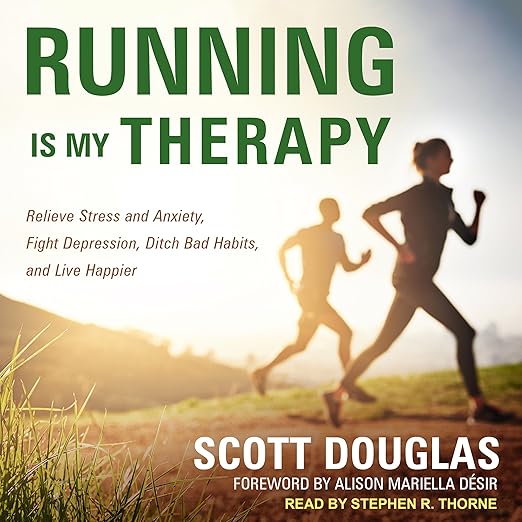
Quick Take
- Narration: Stephen R. Thorne delivers a calm, measured read that suits the book’s tone, steady, unhurried, and grounded. His voice carries the emotional weight of Douglas’s personal disclosures without overstating them.
- Themes: mental health and running, neuroscience of exercise, depression and anxiety management
- Mood: Steady and quietly revelatory
- Verdict: Readers living with depression or anxiety who already run, or who are wondering whether to start, will find this both validating and practically useful.
I picked this one up on a Tuesday evening after a week where I had skipped every planned run and could not quite explain why. I needed something that would meet me where I was, not lecture me, not sell me a program, just talk honestly about the relationship between moving your body and managing what is happening inside your head. Scott Douglas, a running writer with over 100,000 miles of personal mileage behind him, does exactly that.
What separates this audiobook from the crowded field of running memoirs and wellness manifestos is that Douglas does not ask you to believe him on faith. He marshals a growing body of scientific research alongside his own story, and the two threads work together in a way that feels organic rather than illustrative. He has dealt with depression himself, and that honesty gives the science a texture it would otherwise lack.
Our Take on Running Is My Therapy
This is a quietly unusual book. It is not structured as a training plan, and it is not a collection of feel-good anecdotes about runners who overcame adversity. Douglas is making a more specific and more interesting argument: that running produces lasting physiological changes in brain structure and chemistry that other forms of exercise do not replicate to the same degree. He is careful to frame running not as a replacement for therapy or medication but as a complement to them, something that can enhance the effects of cognitive behavioral therapy or antidepressants rather than substitute for them. That modesty is refreshing. He is not selling a miracle; he is describing a mechanism.
Why Listen to Running Is My Therapy
The audiobook format suits this material particularly well. Douglas writes in a voice that is conversational without being casual, and Stephen R. Thorne’s narration matches that register precisely. Thorne reads with a steadiness that mirrors the act of running itself, one foot in front of the other, no dramatic flourishes, just consistent forward motion. For a book about the calming effects of a rhythmic activity, this is exactly the right interpretive choice. Several listeners noted in their reviews how personal Douglas’s writing feels, and Thorne preserves that intimacy without leaning on it.
The passages where Douglas discusses his own encounters with depression are the most affecting in the book. He does not dramatize them; he reports them with the same precision he applies to the research citations. One reviewer described it as finding "passages that detail the exact thinking mechanisms I had and gave me labels for them and also hope that there were ways to cope." There is something disarming about a sports writer who can discuss the exact thinking mechanisms of depressive episodes without either minimizing them or making them the whole story.
What to Watch For in Running Is My Therapy
Listeners who are not runners should know that Douglas does write from the perspective of someone already committed to the sport. He addresses beginners and returns thoughtfully to the question of how to start, but the book’s center of gravity is the experienced runner who has sensed that running is doing something for their mental state and wants to understand why. If you are looking for a couch-to-5K framework, this is not that book. What it offers instead is a richer understanding of what is already happening when you lace up.
Some readers have noted that the scientific sections can accumulate detail. Douglas is thorough, and the chapter-by-chapter breakdown of neurological research, hormonal responses, and behavioral psychology is dense in places. The audiobook format actually helps here, Thorne’s pacing keeps things moving, and listening rather than reading lets you absorb the information without feeling like you need to take notes. But if you prefer narrative-forward nonfiction, be prepared for passages that read more like science writing than memoir.
Who Should Listen to Running Is My Therapy
This audiobook is well suited to runners managing depression, anxiety, or chronic stress who want language and evidence for something they already know intuitively. It is also genuinely useful for therapists, coaches, or anyone supporting someone who runs as a coping mechanism. Listeners who find wellness books too prescriptive or too vague will appreciate Douglas’s specificity. Those expecting a pure memoir or a training guide should adjust their expectations, this is a hybrid, and its strength lies in the overlap between the personal and the scientific.
Frequently Asked Questions
Does Scott Douglas recommend running as a substitute for therapy or medication?
No. Douglas is explicit that running works best as a complement to professional mental health treatment, including talk therapy, antidepressants, and cognitive behavioral therapy, not a replacement for any of them.
Do you need to be an experienced runner to get value from this audiobook?
Not necessarily, though the book’s perspective is that of a committed long-distance runner. Douglas does address beginners, but the content will resonate most with listeners who already have some relationship with running.
How does Stephen R. Thorne’s narration handle the more personal sections of the book?
Thorne reads with a calm, measured quality that suits Douglas’s low-key confessional style. He does not dramatize the personal disclosures, which is the right call, the restraint makes them land more effectively.
Is the science in this book accessible to non-specialists?
Yes, though some chapters are denser than others. Douglas explains neuroscience concepts in plain language, and the audiobook format helps listeners stay with the material without feeling overwhelmed.