Quick Take
- Narration: Jon Gauger delivers a warm, respectful reading that honors the memoir’s spiritual tone without becoming overtly reverential.
- Themes: immigration and family sacrifice, faith and athletic resilience, the American marathon legacy
- Mood: Earnest, warm, and quietly moving
- Verdict: A genuinely affecting sports memoir anchored by a life story more extraordinary than any race result.
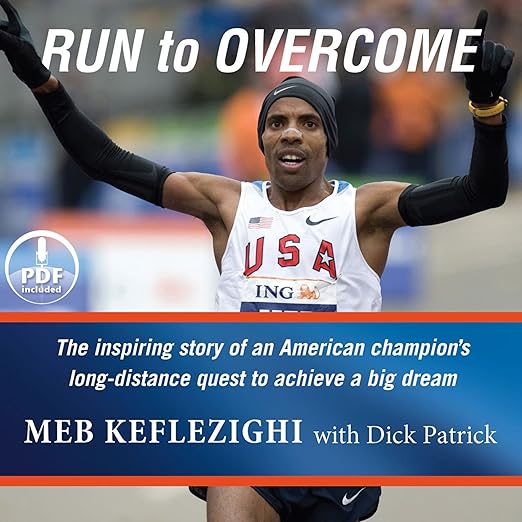
I finished Run to Overcome on a Tuesday evening after a frustrating week, and I found myself unusually moved by a book I had filed mentally under ‘inspirational sports biography’, a category that often means well and delivers little. Meb Keflezighi’s story turned out to be something different from what I expected, and considerably harder to put down.
Meb is best known in American running as the silver medalist at the 2004 Athens Olympics and the winner of both the 2009 New York City Marathon and the 2014 Boston Marathon, the latter victory coming a year after the bombing, an emotional weight the audiobook carries with appropriate gravity. But his running career, remarkable as it is, occupies a smaller share of this book than you might expect. What Run to Overcome is really about is the journey from Eritrea, a small East African nation caught in brutal conflict, to a small apartment in San Diego, with everything his family sacrificed and survived along the way.
Our Take on Run to Overcome
Meb grew up one of ten siblings in a country ravaged by war. His father made a series of consequential decisions, sending the children ahead, then following years later, that the book traces with honesty about what those separations cost. The early chapters, covering Eritrea and the family’s gradual migration through Italy and eventually to California, are the book’s strongest. Meb writes with clear-eyed gratitude rather than self-pity, which gives the hardship sections genuine weight. He is not performing suffering; he is accounting for the circumstances that shaped him.
Jon Gauger narrates with a measured warmth that fits the material well. He does not over-dramatize the emotional passages, which is the right call for a memoir written in this key. The book has a Christian framework that runs through it consistently, Meb’s faith is not decorative but structural, informing how he processes setbacks and victories alike, and Gauger reads those sections without either flattening them or making them feel sectarian. Listeners who share that faith will find it enriching; those who do not should know it is present but not proselytizing.
Why Listen to Run to Overcome
The running sections are vivid and specific. Meb describes the 2004 Olympic marathon in Athens with the kind of detail that only a participant can provide, and his account of the crash that followed, the injuries, the USADA investigation that cleared him of wrongdoing but still cost him time and reputation, the long road back, is more candid than you might expect from an athlete who remained in the public eye throughout. He does not spare himself the embarrassment of that period, which makes his eventual comeback more meaningful than if he had glossed over it.
Several reviewers noted the book’s value for young athletes and families, and that assessment holds. The narrative is accessible without being simplified, and the values it articulates, hard work, family loyalty, gratitude, persistence through setback, are neither naive nor preachy. A cross-country coach who recommended this book to student athletes describes it as “a story about the American dream and why our country needs immigrants,” and that framing captures something true about what the book achieves beyond running.
What to Watch For in Run to Overcome
The book’s scope ends around 2010, predating Meb’s 2014 Boston Marathon win, which many consider the emotional capstone of his career. Listeners who know that story will feel its absence. Additionally, the middle section, which covers Meb’s college career at UCLA and his early professional years, is detailed in a way that rewards fans of the sport but may feel granular to listeners primarily drawn by the immigration narrative. The book does not always manage the transition between its two registers, family memoir and running memoir, with equal grace.
At six hours, the runtime is on the shorter side for a memoir, and a few episodes feel compressed where they could have been expanded. The Eritrean political context, for example, is sketched rather than explained, which may leave listeners unfamiliar with the region wanting more background.
Who Should Listen to Run to Overcome
Runners who want a memoir that goes beyond race results and into the life behind them will find this richly satisfying. Listeners interested in immigration stories and the specific sacrifices that characterize the Eritrean-American experience will appreciate the early sections especially. Parents looking for sports audiobooks that are genuinely appropriate for teenage athletes, in terms of values, not just content, will find this one of the better options available.
Listeners primarily interested in elite marathon training or the technical aspects of Meb’s preparation will need to supplement this with his other writing. And anyone who wants the Boston 2014 story specifically should know it is not in this book, though the character that made that day possible is fully on display here.
Frequently Asked Questions
Does Run to Overcome cover Meb’s 2014 Boston Marathon win?
No. The book was released in 2011, predating that victory. It ends around the time of his 2009 New York City Marathon win. Listeners specifically interested in the 2014 Boston story will need to look for subsequent interviews or articles.
How prominent is the Christian faith content, and does it affect listeners who are not religious?
It is woven throughout the narrative rather than confined to specific sections. Meb’s faith is central to how he frames adversity and success. The tone is personal and reflective rather than prescriptive, so non-religious listeners generally find it readable, though it is genuinely present.
Is Jon Gauger’s narration a good fit for this memoir given that Meb did not narrate it himself?
Yes. Gauger’s warm, unhurried delivery matches the book’s tone well. He does not try to impersonate Meb or perform an accent, which is the right call. The narration serves the story without drawing attention to itself.
Is this appropriate for young athletes, including high schoolers?
Yes, and specifically recommended for that audience by several reviewers who have used it with cross-country programs. The content is entirely age-appropriate, and the themes of perseverance, family loyalty, and overcoming setbacks through character rather than shortcuts translate well for young listeners.