Quick Take
- Narration: Ryan Hall narrates his own memoir with an athlete’s directness, sincere, unpolished, and completely without performance pretense.
- Themes: faith-driven athletic purpose, dealing with failure and injury, the gap between talent and calling
- Mood: Earnest and propulsive, with an explicitly Christian devotional undercurrent
- Verdict: A short, honest memoir from one of America’s best distance runners that speaks most clearly to readers who share Hall’s faith framework.
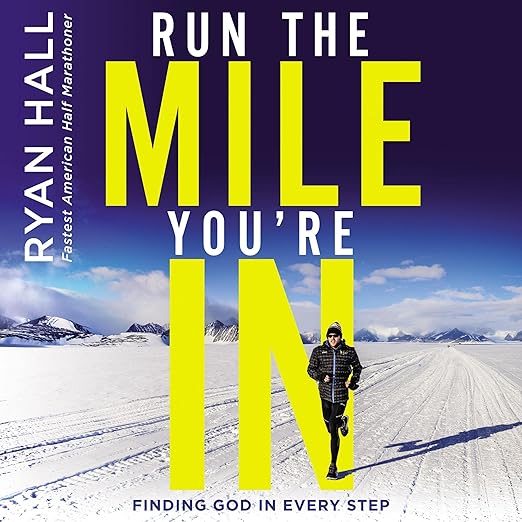
I picked this one up on a Tuesday evening after a run that went sideways about forty minutes in, the kind where you’re negotiating with yourself about whether the last mile counts. Ryan Hall’s title felt pointed. Run the mile you’re in. Not the one behind you, not the one ahead. The one under your feet right now. Four hours and 58 minutes later, I had a clearer sense of what Hall actually means by that, and it is both simpler and more specific than a motivational poster suggests.
Hall is the American record holder in the half marathon and a two-time Olympic marathon runner who came to the sport accidentally. As a teenager who hated running, he felt a sudden compulsion to run fifteen miles around his neighborhood lake. He did it. He was hooked in the way that only people who have experienced something genuinely inexplicable can be hooked, not by the result but by the sense of purpose behind it. From that day, Hall’s running was inseparable from his faith, and this memoir makes no pretense otherwise. The faith is not a sidebar. It is the operating system of his entire athletic career.
What It Actually Means to Run for God
The explicit Christian framing of this book will determine much of how you receive it. Hall is not using faith as decoration. He is describing a life organized entirely around the belief that his athletic talent was a gift given to serve others, and that the correct response to that gift was not to optimize it for personal achievement but to run in a way that honored the giver. That framework shapes everything: his training philosophy, his decisions about coaching, his retirement from competition, his relationship with his wife Sara, who is also a professional runner with her own accomplished career.
For listeners who share that framework, the book will read as unusually honest. Hall doesn’t present a cleaned-up Christian athlete testimony. He discusses the injuries that ended his competitive career, the years when his body stopped responding as it should have, and the disorientation of retirement from a sport that had been his identity and his calling simultaneously. Meb Keflezighi, who provides a jacket endorsement, calls Hall’s journey touching and notes that his sense of purpose in helping others is what defines the book. That’s accurate, but it understates the degree to which the book is a devotional text wearing athletic clothes.
Self-Narration and What It Reveals
Hall reads his own memoir, and this is the right decision for this material. His voice carries the quality of someone who is used to long silences, training camps, solo long runs, post-race reflection in empty arenas. He does not narrate with the smooth professionalism of a studio voice actor, and the occasional roughness in his delivery is itself informative. This is not a performance. He is talking to you about his life the way he would talk to someone sitting across a table from him. The authenticity is audible and it suits the book’s register.
One reviewer described the book as a handbook, not just for running, but for life. Another called it every page is gold. Those responses reflect genuine resonance, but they also reflect a particular kind of reader: one who finds the intersection of athletic practice and spiritual discipline not only acceptable but essential. At under five hours, the book doesn’t overstay its welcome, which is itself a kind of discipline that Hall practices in his running and extends to his writing.
The Parts That Work Less Well
Where Hall is least effective is in the sections that try to generalize his experience into transferable principles, the bulleted list near the end about focusing on purpose, dealing with defeat, building resilience. These passages read like a TED talk abstract and feel disconnected from the specific, particular story he tells elsewhere. The title’s insight, stay present in the mile you’re actually running, gets diluted when it’s converted into a self-improvement framework. The memoir is considerably stronger when Hall trusts his own story rather than reaching for universalism.
There is also a relative thinness to the discussion of his actual training and racing, the technical specifics that a serious runner might want. Hall was one of the most analytically sophisticated self-coached athletes of his generation, and glimpses of that mind appear but don’t fully develop. The book skims past the Boston 2011 race, which Hall ran in conditions that should have been physically impossible, in favor of the spiritual lesson it yielded. Runners who want the race-by-race account will need to look elsewhere.
Who Should Queue This Up
Runners who are also people of faith, particularly Christian faith, will find this genuinely nourishing. Anyone navigating injury, career transition, or the question of what to do when the thing you were built for stops being available to you will find Hall’s particular wrestle useful. Secular readers who are comfortable with religious frameworks without sharing them may still find value in Hall’s account of purpose-driven athletics. Those who find explicit evangelical Christianity alienating in memoir should probably pass, not because the book is preachy but because it assumes a shared vocabulary that not everyone will have. The experience of listening without that vocabulary is like following a conversation in a language you mostly but don’t quite speak.
There is a particular kind of honesty in Hall’s account that distinguishes it from the genre of athletic memoir that packages failure as prologue to triumph. His injuries are not merely setbacks on the way to a comeback. His retirement is not reframed as the beginning of something better. He sits with the losses long enough that the reader believes him when he says they shaped him, rather than simply being told to believe it. That patience with discomfort is itself a running lesson, and it’s one the book earns through accumulation rather than declaration.
Frequently Asked Questions
How explicitly religious is this audiobook, and does it preach?
It is explicitly and pervasively Christian. Hall’s faith is not background color, it is the organizing principle of the entire memoir. He doesn’t lecture, but the book assumes the reader finds his framework meaningful rather than trying to convince skeptics.
Does Ryan Hall’s self-narration work, or would a professional voice actor have been better?
His self-narration works precisely because it’s imperfect. Hall’s unpolished delivery carries authenticity that a studio performance would have smoothed out. Listeners looking for audio production quality may be distracted; listeners looking for honest testimony will prefer the author’s own voice.
Is this useful for non-elite runners, or is it only relevant to Olympic-level athletes?
Hall explicitly frames the book for runners of any ability and even non-runners. The athletic content is mostly philosophical and spiritual rather than technical. You don’t need to be a serious runner to engage with it.
How does this compare to Meb Keflezighi’s memoir, Run to Overcome?
Both are faith-driven athletic memoirs by elite American distance runners, but Meb’s book gives more race-by-race specificity and a fuller narrative arc of an immigrant athletic career. Hall’s book is shorter, more introspective, and more devotional in orientation.