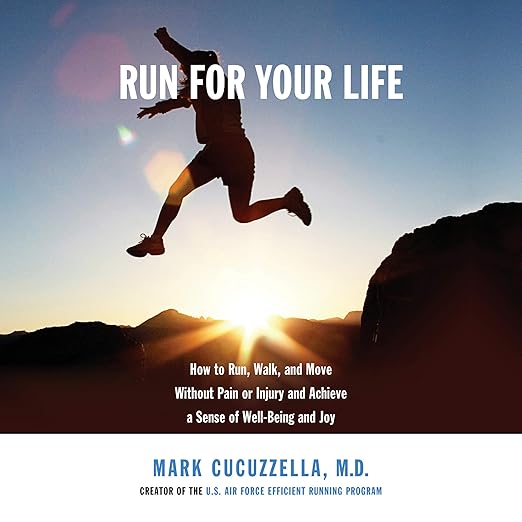
Quick Take
- Narration: Dr. Cucuzzella narrates his own book, and the effect is immediate authenticity. His pace is measured and his enthusiasm for the subject is genuine without tipping into infomercial energy.
- Themes: Injury-free running, biomechanics, nutrition and health over performance
- Mood: Encouraging and methodical, grounded in decades of clinical practice
- Verdict: One of the most thorough running books available in audio, with the added credibility of a physician-narrator who has clearly lived every principle he teaches.
I picked this up during a stretch when my left knee had started protesting the mileage I had been putting in, and I was deep enough in denial to want a book that confirmed I could keep running if I just changed a few things. What Dr. Mark Cucuzzella actually delivers is more useful and more demanding than that: a complete rethinking of what running is, what it does to a body, and what most of us are doing wrong from the first step.
The fact that Cucuzzella narrates his own work matters more here than it would in a novel. He is a professor of medicine, a competitive runner himself, and the creator of the Air Force Efficient Running program. Listening to him explain biomechanics and nutrition feels less like an audiobook and more like sitting across from someone who has spent thirty years watching bodies move and break and recover. The effect is persuasive in the best possible way.
Our Take on Run for Your Life
Cucuzzella’s central argument is that running injuries are not inevitable. Most of them, he contends, stem from how we run rather than that we run. The book covers the full range: anatomy, biomechanics, foot mechanics and footwear, nutrition with a particular emphasis on fat adaptation and metabolic health, and clinical approaches to common running injuries. One professional running researcher and coach with 24 years of experience called it the most comprehensive book they had encountered. That is not a claim I would repeat lightly, but the depth of the content supports it.
The nutrition chapters stand out in particular. Cucuzzella pushes back against conventional endurance sport dietary wisdom in ways that are well-supported by current science and are likely to challenge long-distance runners who have been carbohydrate-loading for years. He makes a compelling case for viewing running as a health practice first and a performance endeavor second, which reorients the entire conversation.
Why Listen to Run for Your Life
The audiobook includes a bonus PDF with training plans, graphs, and illustrated exercises, which addresses the obvious limitation of receiving biomechanics instruction in audio format. The companion document is worth downloading before you start listening so you can pause and reference the visuals when Cucuzzella describes movement patterns and drills. One reviewer, a chiropractor, noted that they aligned closely with Cucuzzella’s interpretation of health, community, and movement and had already recommended it to multiple patients. The book operates at that level of credibility.
The walking section, a component that several reviewers specifically mentioned, is a quiet highlight. In an era of running optimization culture, Cucuzzella’s patient attention to walking mechanics and its role in overall movement health feels genuinely counterintuitive and valuable.
What to Watch For in Run for Your Life
The book is dense. Not inaccessible, but dense. Listeners who want a quick plan to follow will need to do some patience-building first. The science-backed explanations are thorough, and the payoff comes from understanding rather than skimming. One reviewer described it as challenging long-held myths and incorrect practices, which is accurate, but that process requires sustained attention. The audiobook format means you cannot easily flip back to a diagram or re-read a passage on muscle activation during heel strike. The companion PDF mitigates this but does not eliminate it entirely.
Newer runners may find certain sections assume a baseline familiarity with endurance training concepts. This is not a beginner couch-to-5K guide. It is a comprehensive approach to running for life, aimed at people who are already running but suspect they could be doing it better and more safely.
Who Should Listen to Run for Your Life
Essential listening for any runner dealing with recurring injury, anyone curious about natural running mechanics, and athletes who want to understand the relationship between nutrition and long-term health rather than just short-term performance. Also valuable for healthcare providers who work with active patients. Less suited to complete beginners who need basic programming before biomechanical refinement, though even beginners will benefit from the foundational philosophy. Proceeds support Cucuzzella’s nonprofit community running work, which is worth knowing.
Frequently Asked Questions
Does Dr. Cucuzzella’s self-narration make the technical content more or less accessible?
More accessible, without question. His familiarity with the material lets him modulate pacing naturally around complex concepts. He knows which explanations need extra time and which analogies will land. It also makes the nutrition and clinical sections feel like professional guidance rather than abstract theory.
How important is the bonus PDF companion for following the audiobook?
Fairly important, particularly for the biomechanics and exercise chapters. Cucuzzella describes movement patterns and drills that are significantly easier to understand with the accompanying diagrams. Download it before you start and have it available to reference when he moves into specific technique instruction.
Is the nutrition advice in this book compatible with mainstream marathon training programs?
It is compatible but challenges some mainstream assumptions, particularly around carbohydrate dependence. Cucuzzella advocates for metabolic flexibility and fat adaptation, which diverges from traditional high-carbohydrate endurance fueling strategies. Experienced runners may need to reconcile this with their existing approach rather than adopting it wholesale.
Is Run for Your Life relevant for recreational joggers or just serious athletes?
Cucuzzella explicitly frames the book for everyone from beginning runners to experienced marathoners. The philosophy that running should be injury-free and sustainable throughout life applies regardless of pace or mileage. Several reviewers with no racing ambitions found it equally useful for making their daily runs healthier and more enjoyable.