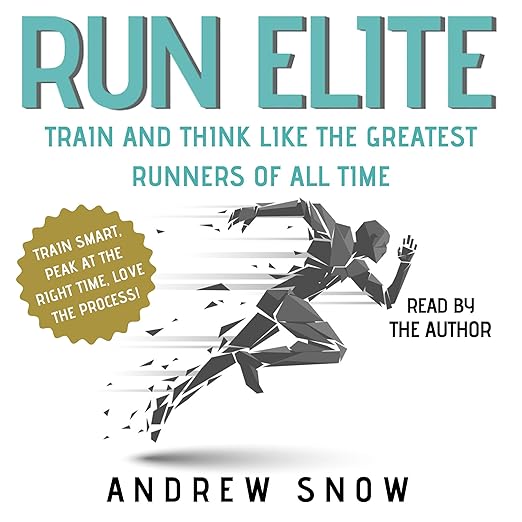
Quick Take
- Narration: Andrew Snow narrates his own book, and the result is a coaching session rather than a performance, direct, unhurried, and credible in the way only genuine expertise makes possible.
- Themes: Evidence-based training periodization, performance mindset, the triphasic model
- Mood: Motivating without being evangelical, grounded in research
- Verdict: The best running audiobook for listeners who want principles over prescriptions, though those who need a ready-made training schedule will need to supplement elsewhere.
I am not a competitive runner. I want to be clear about that before I say anything else about Run Elite. I am someone who runs for the usual mixture of reasons, habit and sanity and the vague maintenance of a body that will keep working for decades to come. I picked up Andrew Snow’s book because I’d heard it mentioned repeatedly by people who were very serious about their performance, and I was curious what a coaching philosophy designed for elites actually looked like when opened up for a general audience.
What I found was one of the most clearly structured sport-training books I’ve encountered in audio form. Snow has twenty-seven years of coaching experience, and more importantly, he has thought carefully about how to communicate the principles behind elite performance rather than just describing what elite athletes do. Those are different projects, and Run Elite mostly pursues the right one.
Our Take on Run Elite
Snow’s triphasic model is the organizational spine of the book: a three-phase approach to training that mirrors how elite programs are structured, with each phase building specific physiological and psychological capacities that compound into peak race-day performance. What’s notable is that he doesn’t just describe this model; he explains the reasoning behind it in enough detail that listeners could theoretically construct their own program rather than following a prescribed plan.
That’s both the book’s greatest strength and the point at which some readers have wanted more. Multiple reviewers noted that the absence of specific training schedules for different distances or fitness levels left them wishing for a more turnkey product. Snow’s intention seems to be the opposite: to give runners the conceptual tools to evaluate and customize any training plan rather than to provide another plan to follow blindly. That’s a more sophisticated gift, but it requires more from the listener.
Why Listen to Run Elite
Andrew Snow narrating his own work is an asset here. There’s no performance layer between the ideas and the listener. He reads the way a coach talks, which is to say with specificity about things he genuinely understands and without the theatrical urgency that plagues a lot of sports audiobooks. One reviewer who had been running for fifty years described feeling sadness at discovering the book so late; another, who described themselves as a middle-of-the-pack runner, credited it with helping them shave twelve minutes off a half marathon time. That range of applications speaks well of the book’s accessibility.
The sections on mindset draw on research from the US Military and Stanford University and cover territory that running books don’t always take seriously. Snow is not talking about positive thinking in the pop-psychology sense; he’s addressing the specific cognitive patterns that allow elite athletes to sustain effort past the point where the body is demanding a stop. That distinction matters, and he makes it clearly.
What to Watch For in Run Elite
The book is explicitly principles-driven, which means listeners who need a concrete weekly schedule to execute will have to do additional work. Several reviewers flagged this directly, and it’s worth understanding going in. Run Elite will not tell you how many miles to run on Thursday. It will tell you why the length and intensity of that Thursday run should vary depending on where you are in your periodization cycle, and it will give you the framework for figuring that out yourself.
The endorsement from Bill Rodgers, the four-time Boston and New York Marathon champion, lends the book a credibility signal that is worth noting. Snow is not an outsider making claims from the margins; he’s working within the established tradition of elite distance running coaching, just bringing it to a wider audience.
Who Should Listen to Run Elite
Runners at any level who want to understand the principles behind their training rather than just following a plan will find significant value here. It’s particularly useful for athletes who have plateaued and want to understand why, and for anyone in their forties or fifties who has been told their best running is behind them. The research Snow cites on performance improvements in older athletes is specific and encouraging. Skip it if what you need is a twelve-week marathon plan; this book is the education that makes the plan make sense.
Frequently Asked Questions
Does Andrew Snow provide specific weekly training plans in Run Elite, or is it more of a framework?
It’s primarily a framework. Snow explains the triphasic periodization model in depth but doesn’t provide ready-made training schedules for specific race distances. Listeners who want to apply the principles will need to either adapt existing plans or work with a coach.
Is Run Elite relevant for recreational runners, or is the content pitched primarily at competitive athletes?
Snow explicitly addresses runners across the fitness spectrum, including older athletes and those returning from injury. Multiple listeners describe applying the book’s methods as recreational runners with strong results.
How does Snow’s triphasic model differ from standard periodization training that most running coaches already use?
Snow frames periodization through the lens of physiological adaptation at each phase rather than simply cycling mileage up and down. The distinction is in the specificity of what each phase is building and how that connects to race-day peaking.
Does the mindset section of Run Elite go beyond generic motivational content?
Yes. Snow grounds the mental performance material in research from the US Military and Stanford University, addressing specific cognitive patterns relevant to sustained high-intensity effort rather than general positive thinking.