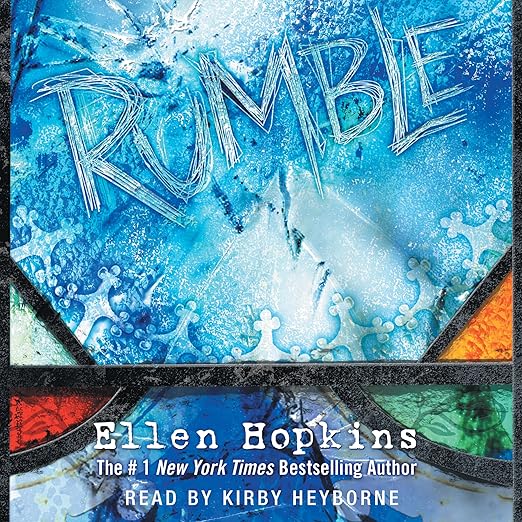
Quick Take
- Narration: Kirby Heyborne captures Matthew’s bitterness and slow unraveling with a performance that earns the emotional weight Hopkins demands.
- Themes: Grief and guilt, LGBTQ+ bullying, the cost of forgiveness
- Mood: Raw and relentless, with occasional breaks of fragile hope
- Verdict: Hopkins at her most unflinching, and Heyborne’s narration makes Matthew’s spiral genuinely hard to look away from.
I was halfway through my morning commute when I had to pull out one earbud and just sit with what I had heard. Ellen Hopkins writes in verse, which is already unusual enough to demand a certain kind of attention, but it was a specific passage, Matthew’s account of the moment he did not answer the phone, that stopped me completely. That is the inciting wound at the center of Rumble: his younger brother Luke called him on the brink of suicide, and Matthew was busy with his girlfriend and let it go to voicemail. Luke is dead. And Matthew cannot forgive himself, which means he has decided, on some level, to forgive no one.
Hopkins is the New York Times bestselling author of Crank, and she has built her career on taking the subjects that YA fiction often softens and refusing to soften them. Rumble is about bullying, about the aftermath of suicide, about what happens to a family when it loses a child to a cause that could have been stopped. It is also, more quietly, about Matthew’s relationship with faith and with his girlfriend Hayden, whose father campaigns to ban books from the school library because of their homosexual content. That detail is not incidental. It places Rumble in the middle of a cultural argument that was ongoing when it was published in 2014 and remains unresolved now. Hopkins has a gift for embedding very large questions inside very particular lives, and that gift is fully on display here.
Matthew as an Unreliable Protagonist
What Hopkins does particularly well here is make Matthew difficult to like while keeping him completely understandable. He is bitter, he lashes out, he blames people who may not deserve the full weight of what he assigns them. Reviewers noted that the protagonist was honest with his questions about God and that parents do not always behave like the mature adults we assume them to be. That honesty is part of what makes Matthew a convincing portrait of grief rather than a sanitized one. He is not working through his loss on a schedule that feels manageable. He is being consumed by it, and the verse form forces you to feel that accumulation one short line at a time.
His relationship with Hayden is the other central thread. They are genuinely in love in a way that Hopkins renders clearly and without sentimentality. But Hayden’s faith leads her toward forgiveness as a practice, and Matthew experiences that as moral evasion rather than spiritual maturity. When her father moves to ban books with homosexual content from the school, the fracture in their relationship becomes structural. Matthew starts to wonder if the two of them ever shared actual values or just the same proximity. Hopkins handles this without declaring a winner. Both positions are given their due weight, and the reader is left to sit with the discomfort of that ambiguity.
Hopkins’s Verse Form in Audio
Hopkins writes in verse, and listening rather than reading changes the experience in ways worth considering before you start. The form gives the audiobook a rhythm that feels almost percussive at times, the short lines accumulating pressure and then releasing into something quieter. Heyborne’s pacing honors that structure. He reads with a restraint that keeps the verse from becoming melodramatic, which would be an easy mistake with this material. The emotional peaks land harder precisely because he earns them slowly over the preceding pages, rather than reaching for them immediately.
One reviewer described it as visceral in every way, and that word fits. The book does not offer a comfortable distance from what Matthew is going through. It puts you inside his head in a way that the verse form actually intensifies, because there is nowhere to hide in short lines. Every image lands clean. A reviewer with long familiarity with Hopkins’s catalog noted this one met their expectations to the highest level, which is meaningful praise given how strong her earlier work is.
What This Book Is Asking
Underneath the specific tragedy of Luke’s death, Rumble is asking something larger: whether forgiveness is something we do for ourselves or for the people we forgive, and whether a person drowning in guilt can survive without eventually making peace with the gaps in their own decency. Hopkins does not answer that cleanly, which is the right choice. The novel acknowledges that Matthew’s process of reckoning is real and ongoing, not something a plot can simply resolve by the final page. Reviewers described the book as dealing with suicide, PTSD, depression, beliefs, and trust, and that catalog is accurate. Hopkins is holding all of them at once rather than selecting one and using the others as backdrop.
Heyborne’s Performance as a Tonal Guide
Kirby Heyborne is a narrator with a substantial catalog, and he brings to Rumble an understanding of when to hold back and when to let a moment land. The verse structure that Hopkins works in means the audiobook has a different rhythm than prose, and Heyborne navigates that rhythm with consistency. He does not read the verse as poetry, which would create distance. He reads it as thought, as internal experience, which is the correct interpretive choice for a first-person verse novel. The emotional density of the material is served by restraint rather than performance, and Heyborne understands that distinction.
This audiobook is best suited to older teens and adults comfortable with heavy subject matter. It handles suicide, bullying of LGBTQ+ youth, and religious conflict without sanitizing any of them. Those who want YA fiction that trusts its audience to carry real weight will find Rumble among the more uncompromising entries in Hopkins’s catalog. Available as a free audiobook on Audible, it is among the stronger titles available in its genre and age category.
Frequently Asked Questions
Does Rumble need to be read as part of a series, or does it work as a standalone?
It works as a complete standalone. While it shares thematic territory with Hopkins’s other novels like Crank and Tricks, there are no shared characters or continuing storylines. You can start here without any prior knowledge of her work.
How explicit is the content in Rumble, and is it appropriate for younger teens?
Rumble deals directly with suicide, homophobic bullying, grief, and relationship conflict. It is written for a YA audience but is better suited to older teens and adults. Hopkins does not soften these subjects by design. Parents of younger teens should preview it first.
Does Kirby Heyborne’s narration handle Ellen Hopkins’s verse format well?
Yes. Heyborne paces the verse with restraint rather than performing it, which keeps the emotional material from becoming melodramatic. The rhythm of the verse actually benefits from audio delivery, and his reading earns the heavier moments by building them slowly rather than announcing them.
Is the central question about forgiveness in Rumble resolved by the end?
Not cleanly, and that is intentional. Hopkins is interested in the moral and emotional complexity of forgiveness rather than offering a prescription. The ending provides movement rather than resolution, which fits the honesty of the rest of the novel.