Quick Take
- Narration: Daniel Butler brings warmth and sincerity to Ruettiger’s autobiographical voice without losing the rougher edges that make the story credible.
- Themes: Perseverance against judgment, dyslexia and late achievement, the dream as identity
- Mood: High-energy and earnest, with enough honest failure to make the triumph feel earned
- Verdict: An autobiography that goes meaningfully deeper than the film it inspired, tracing the full arc from a struggling kid in Joliet to the strange second act of getting that movie made.
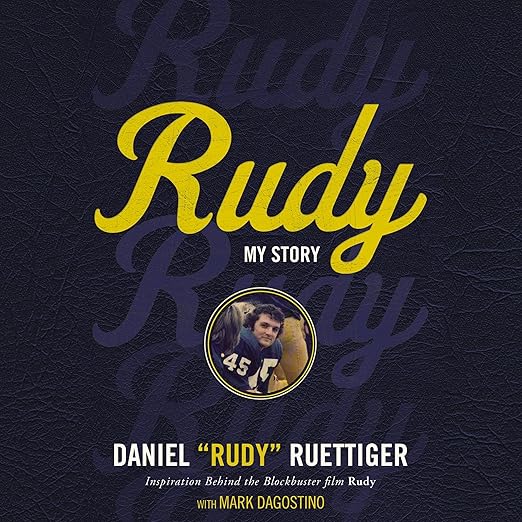
I watched the film Rudy for the first time in a gym lobby, of all places, during a school trip when I was around twelve. The final sequence, the one on the Notre Dame field, was playing on a mounted television in the corner, and by the time I understood what was happening I was standing still in the middle of a lobby full of moving people, not quite sure why I was so moved by a football moment in a sport I had never watched. That is what the Rudy story does. It operates on something prior to sports fandom. The autobiography, narrated by Daniel Butler in this audiobook edition, is the version of that story that has room for everything the film could not hold.
Daniel Ruettiger grew up in Joliet, Illinois, the third of fourteen children, in a household where college was not the assumed next step for anyone. He struggled through school with undiagnosed dyslexia at a time when that diagnosis was not widely understood, found himself mixed up with the wrong crowd, and eventually identified Notre Dame as the destination that would give his life the shape he could not otherwise imagine. The film covers the final push: the acceptance, the walk-on attempt, the twenty-seven seconds on the field. The book covers the ten years before that and the ten years it took to get the movie made after.
Our Take on Rudy
Ruettiger is a natural storyteller, and the book is most alive in the chapters about his childhood and young adulthood. The dyslexia section is particularly valuable because it describes how a learning difference that was not understood functioned as a sentence in an environment that only measured academic performance. The failures are specific and the humiliations are real, which is what makes the persistence feel like something earned rather than just a character trait. One reviewer who had experienced serious illness describes reading this during recovery and finding it genuinely sustaining, which is a specific and meaningful kind of testimony.
Why Listen to Rudy
Daniel Butler’s narration is well-suited to the material. He gives Ruettiger’s voice an earthy quality that matches the story’s working-class origins, and he handles the emotional peaks, the field moment, the movie premiere, without overselling them. The autobiography format rewards audio because Ruettiger’s voice as a storyteller is rhythmic and physical in ways that benefit from being spoken rather than read. At nearly twelve hours, this is a full listen, and one reviewer notes a slight sag in the later chapters about the movie-making process, but the core story, from Joliet to Notre Dame, is consistently compelling.
What to Watch For in Rudy
The section of the book covering the production of the film and its aftermath is less compelling than the autobiographical material that precedes it. One reviewer describes the book as starting strong and limping home, which is a fair characterization of the pacing shift in the final third. The Hollywood material has interesting details about the ten-year effort to get the film made, but it does not carry the emotional momentum of the Notre Dame chapters. If you come to this primarily for the football story, be aware that the film section is substantial and paced differently than the biographical core. Ruettiger also tells the story with a conviction and optimism that is occasionally overwhelming in its relentlessness, which some listeners find exhausting rather than inspiring.
Who Should Listen to Rudy
This is for people who loved the film and want to understand where it came from and what it left out. It is for listeners who are facing something they have been told they are not capable of and need the company of someone who was told the same thing many times before finding a way anyway. Skip it if you need emotional complexity or ambiguity in your memoir listening, or if Ruettiger’s brand of unshaded optimism strikes you as naive rather than instructive. Come to it if you want the full story, the family context, the dyslexia years, the grinding failures, and then the twenty-seven seconds, and then the decade it took to turn those twenty-seven seconds into something the world could see.
Frequently Asked Questions
Does the Rudy autobiography cover material beyond what the 1993 film depicts?
Yes, significantly. The book covers Ruettiger’s childhood in Joliet, his years with undiagnosed dyslexia, the period between his military service and Notre Dame admission, and an extensive section on the ten-year process of getting the film made after his time at Notre Dame. The film is essentially the final act of a much longer story.
How accurate is the 1993 film Rudy compared to the autobiography?
Ruettiger himself describes the film as faithful to the spirit of his story with some artistic license involved. The core events, the walk-on attempt, the final game, the teammates rallying for him, are broadly accurate. The book fills in considerably more context around those events.
Does the book address Ruettiger’s dyslexia in depth?
Yes, and this is one of the more substantive sections of the autobiography. Ruettiger describes struggling through school in an era when dyslexia was not widely diagnosed or accommodated, and how that experience shaped his relationship to academic achievement and self-belief.
Is the audiobook narrated by Rudy Ruettiger himself?
No. The audiobook is narrated by Daniel Butler, a professional voice actor. Butler brings warmth and authenticity to the material, but this is not an author-narrated audiobook.