Quick Take
- Narration: Caroline Feraday gives Sophia a physical presence and intelligence that keeps the dual-identity structure legible throughout; the pacing is consistently kinetic.
- Themes: Hidden identity, duty versus desire, the ethics of revolution and who gets to decide who is worth saving
- Mood: Kinetic and romantic, with enough genuine menace in the political backdrop to prevent the lightness from feeling hollow
- Verdict: A Scarlet Pimpernel retelling that earns its independence from its source material through confident worldbuilding and a protagonist with real agency.
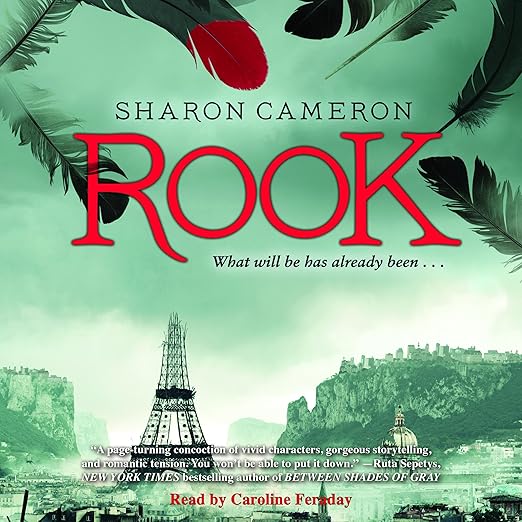
There is a reason The Scarlet Pimpernel has been retold in essentially every genre available to storytellers. The premise is structurally near-perfect: a figure of apparent frivolity concealing extraordinary courage, running an operation to save people from political violence while playing an elaborate game of misdirection with everyone around them. Sharon Cameron’s Rook transplants the structure into a future-Paris she calls the Sunken City, where a new revolution mirrors the original Terror and the mysterious Red Rook leaves feathers in the place of prisoners who should have died. Caroline Feraday narrates the Scholastic Audio recording, and I listened to the first six hours on a train, which turns out to be an ideal environment for this kind of story.
Sophia Bellamy is the protagonist, and she is not a passive figure waiting to be rescued. Her arranged marriage to the wealthy Rene Hasard is a transaction designed to save her family from financial ruin, and she walks into it with full knowledge of its terms. When the search for the Red Rook arrives at her doorstep, the novel’s central irony, that Sophia has secrets as significant as Rene’s and that both have been reading each other incorrectly, gives the romance its particular pleasure. Feraday handles Sophia’s intelligence without making her seem invulnerable, which is the right balance for a YA protagonist carrying this much narrative weight.
Our Take on Rook
Cameron’s decision to set the story in a post-apocalyptic future rather than an alternate past is the most distinctive element of the adaptation. The Sunken City is recognizably Paris, with cultural echoes, the architecture of revolutionary politics, the social hierarchies that make the Terror legible. But it has been through whatever catastrophe made it sunken, which means Cameron can draw on the emotional and aesthetic register of the Revolution without being bound by historical fact. This gives her room to build the cat-and-mouse dynamic on her own terms.
Some readers found the initial worldbuilding slightly confusing, and that confusion is real for the first hour or two; the world assumes its coherence gradually rather than delivering it upfront through exposition. This is the right narrative choice but it does require patience. By the third hour the setting clicks into place and the story moves quickly. The reviews that call this a homage rather than a retelling are accurate. The Scarlet Pimpernel’s DNA is everywhere, but Cameron has enough of her own ideas about Sophia and Rene that the book develops well beyond its source material into something with its own identity.
Why Caroline Feraday’s Narration Sustains Fourteen Hours
The audiobook is fourteen hours and forty-one minutes, which is long for a YA title. Feraday keeps the pacing from dragging through consistent energy in the dialogue sequences and careful management of the action beats, which Cameron writes with a physical specificity that requires a narrator to stay kinetic. The romantic tension, Sophia and Rene circling each other across misunderstandings that are both real and strategic, is handled with the kind of precise comic timing that the material requires. Neither character is allowed to seem foolish for missing what the reader can see; Feraday makes the misreading feel plausible rather than convenient, which is the harder thing to accomplish.
What to Watch For in the Double-Identity Dynamic
The novel’s central game is information management: who knows what about whom, and when. Cameron seeds the early chapters with details that read differently on a second listen once the full picture is clear. This is one reason at least one reviewer read the book twice back to back. First-time listeners should pay attention to the moments where Sophia misreads Rene’s behavior, because those misreadings are doing narrative work that becomes visible in retrospect. The construction rewards attentive listening even on a first pass, because the clues are there if you are looking for them.
Who This Story Was Made For
Readers who already love The Scarlet Pimpernel will find this a rich and respectful adaptation that gives the premise new life rather than simply recostuming it. YA readers without that prior knowledge will find a fast, romantically satisfying adventure with a protagonist whose competence feels earned across the fourteen hours rather than asserted. Those who need contemporary YA realism should look elsewhere; this is a full-throated historical adventure transposed to a future setting, and it leans into that register wholeheartedly. One reviewer described it as their favorite YA read of 2015. The enthusiasm holds up: it is a book that lingers after the final chapter more than its genre reputation might suggest.
The Scarlet Pimpernel has been adapted into musicals, films, television series, and now YA dystopian fiction. Cameron’s version stands in that tradition by understanding what the original story is actually about beneath its swashbuckling surface: the question of identity as performance, of how much a person can maintain two completely different versions of themselves before the versions begin to collapse into each other. Sophia’s version of that question is different from the Scarlet Pimpernel’s original framing, because she is a woman operating in a world where women’s options are more constrained and her performance has different stakes. Cameron makes that difference count. Feraday’s narration honors it. The result is a retelling that says something the original could not quite say with its own historical materials.
Sharon Cameron’s career after Rook has continued in the direction of serious, research-grounded historical fiction, and looking back at this book with that later work in mind, it reads as a transitional piece: still firmly YA in its pacing and romantic conventions, but reaching toward the kind of historically and psychologically serious storytelling she has developed since. Feraday’s narration suits this transitional quality. It does not oversell the darkness that is present in the political backdrop, the executions, the genuine danger, but it does not suppress it either. The result is a book that works for the YA audience it was written for while carrying enough thematic weight to reward adult readers who come to it later.
Frequently Asked Questions
Do I need to know The Scarlet Pimpernel to appreciate Rook, or does it work as a standalone adventure?
It works on its own terms. Cameron provides enough internal context that readers unfamiliar with the source will follow the double-identity plot and the revolutionary setting without difficulty. Prior knowledge of the Pimpernel adds an additional layer of pleasure, catching the echoes and noting the departures, but it is not required to enjoy the story on its own merits.
The worldbuilding was described as initially confusing. How much time does it take to orient to the Sunken City?
Roughly the first hour or two of audio requires patience as Cameron layers in the future-Paris setting. The revolution’s structure, the Commonwealth across the sea, and the political mechanics of the Red Rook situation become clear through context rather than exposition. By the third hour most listeners report feeling fully at home in the world.
Is the romance central enough to satisfy readers who came primarily for that element?
The romance is central and built on a specifically satisfying dynamic: two characters hiding major things from each other while genuinely falling for what they can see. The misunderstanding-driven tension is resolved in a way that feels earned rather than arbitrary, and Cameron does not subordinate the romance to the political adventure. They develop together across the full arc.
Caroline Feraday narrates a YA title that runs fourteen hours. Is the length a problem in audio?
Feraday manages the length through consistent energy in the action and dialogue sequences. Cameron writes kinetically, and Feraday matches that energy. The slowest sections are the early worldbuilding passages, which resolve once the setting clicks into place. Multiple reviewers report staying up past bedtime to finish, which suggests pacing fatigue is not a significant issue.