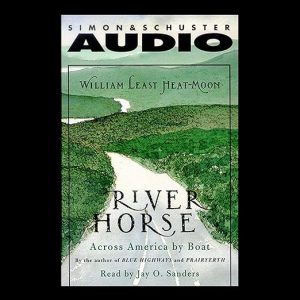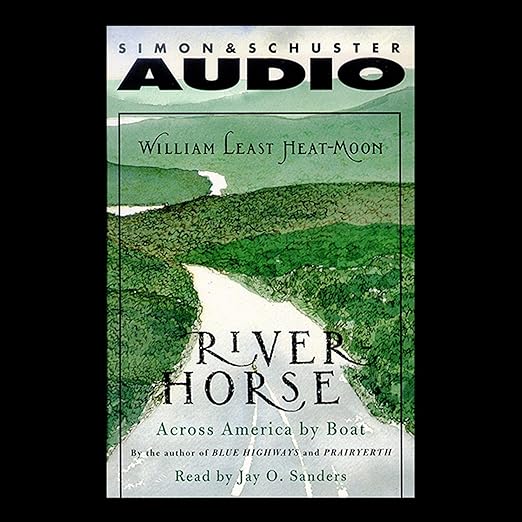
I came to River Horse backwards, which I suspect is how many people find it. I'd read Blue Highways years earlier, that quietly beloved account of Heat-Moon driving America's back roads after his marriage ended, and the discovery that he'd written two more substantial travel books in the same vein sent me looking for the rest. Prairyerth, the middle book, is an epic meditation on a single Kansas county that demands patience I wasn't quite prepared to give on a commute. River Horse was different. I was fifteen minutes in, Jay O. Sanders steering the narrator's voice through the departure from New York Harbor aboard a small boat named Nikawa, and I knew I was going to follow this one all the way to Oregon.
The premise is both simple and audacious: Heat-Moon and his companion, identified throughout only as Pilotis, attempt to cross the continental United States entirely by water, taking whatever combination of rivers, lakes, and canals will get them from the Atlantic at New York to the Pacific near Astoria, Oregon - approximately five thousand miles, more than any previous cross-country river traveler had managed. This abridged audiobook, originally published in 1999 and released in audio form by Simon and Schuster, runs six hours and thirty-seven minutes. That's necessarily incomplete, but the abridgement preserves what matters most: the rhythm of the journey, the texture of the landscape, the encounters that accumulate into something like a portrait of the country.
What We Made of It
Heat-Moon is one of the finest practitioners of American travel writing alive, and this book showcases why. His prose is lyrical without being precious, historically grounded without being pedantic, and attuned to the comic potential in human endeavor without undermining the genuine stakes of what he and Pilotis are attempting. The hazards are real: massive floods, submerged rocks, dangerous weather, equipment failures, moments where the expedition might simply end. Heat-Moon describes all of this with the same measured, almost understated voice that characterizes his best work, which creates a peculiar tension - you know the danger is serious because he doesn't dramatize it.
What makes the book more than a travelogue is its sustained engagement with American history along the waterways. Heat-Moon follows routes taken by Henry Hudson, Lewis and Clark, and others, and he consistently connects the landscape he's moving through to the human stories embedded in it. The rivers carry memory, and he's attentive to that. He's also attentive to what has changed: the pollution, the dams, the altered ecosystems, the towns that once depended on river commerce and now have almost no relationship with the water that defined them. This isn't polemic; it's observation delivered with the kind of sorrow that comes from genuine love of a place.
What Makes River Horse Worth Hearing
Jay O. Sanders is a good fit for this material. His voice has a roughness and warmth that suits Heat-Moon's narrative persona - the curious, stubborn, occasionally cantankerous traveler who is also paying close attention to everything. Sanders doesn't try to glamorize the voice; he reads it as the voice of a real person making a difficult and sometimes frightening journey for reasons that are hard to explain in purely rational terms. The abridged format is the one genuine limitation here. Six-plus hours covers the journey, but listeners who get captured by Heat-Moon's prose may find themselves wanting the full experience. The unabridged book runs considerably longer and is worth seeking out after this introduction.
The audiobook format works particularly well for travel writing, where the movement and accumulation of landscape imagery translates naturally to something you listen to while moving yourself. Several reviewers have noted using the book as a companion during their own travels, which is exactly the relationship Heat-Moon's work tends to invite.
What Might Not Land
This is an abridged recording, and that matters more with Heat-Moon than it would with some other writers because his books work through texture and accumulation rather than plot. The abridgement necessarily cuts passages that contribute to the book's cumulative depth without advancing the narrative, and some of what makes the full text extraordinary lives in those passages. Additionally, while the book follows the river journey chronologically, Heat-Moon's digressions into history, ecology, and personal reflection don't always signal themselves clearly, and listeners need to be comfortable with a certain fluidity of focus to get the most from the experience.
The Right Listener for River Horse
This is required listening for fans of American travel and nature writing - readers who love Annie Dillard, John McPhee, or Barry Lopez will find Heat-Moon operating in recognizable and excellent company. It's also for anyone who has ever looked at a river and wondered what's upstream, or who wants to experience the country's interior geography through the medium of water rather than asphalt. It's not the right entry point if you're new to Heat-Moon - Blue Highways is the more approachable beginning - but as a third book in a reading sequence, it delivers something none of the others quite do: the country seen from below, moving with the current rather than against it.
In Brief
- Narrator: Jay O. Sanders brings a gruff, warm quality to Heat-Moon's voice that captures the author's weathered curiosity without turning it into caricature.
- Subjects: American waterways and national character, the discipline of sustained journeying, nature as counterweight to modern noise
- Tone: Expansive and meditative, with bursts of real danger and unexpected comedy
- Bottom line: The most ambitious entry in Heat-Moon's travel trilogy delivers in full, essential listening for anyone who loves American landscape writing.