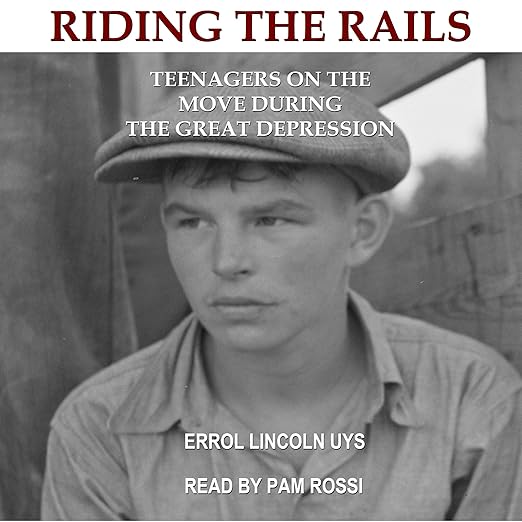
Quick Take
- Narration: Pam Rossi reads with warmth and historical attentiveness, giving the oral history passages the intimacy they require while handling the documentary sections with clarity.
- Themes: Depression-era survival and resilience, youth on the margins, the American myth of freedom on the road
- Mood: Moving and quietly harrowing, with an underlying respect for the people whose stories are being told
- Verdict: A neglected chapter of American history told through the voices of those who lived it, essential for anyone interested in the 1930s or in how ordinary people endure extraordinary circumstances.
I was listening to Riding the Rails on a quiet afternoon and found myself thinking about the gap between the history we teach and the history that actually happened to people. We know the Great Depression as an economic event, unemployment figures, bank failures, the New Deal. Errol Lincoln Uys’s book makes it something else entirely: the story of a quarter million teenagers who hit the road, hopped freight trains, and built lives of extraordinary improvisation because the alternative was to watch their families collapse under the weight of shame and poverty.
This is one of those nonfiction listening experiences where the source material does the heavy lifting. Uys draws on letters and oral histories from three thousand men and women who rode the rails in the 1930s, and those voices are the book’s most durable quality. The first-person accounts of life in hobo jungles, of hiding from railroad guards with clubs, of girls traveling in male disguise because the dangers for women on the road were qualitatively different, these are not the polished recollections of people who have processed their experiences into tidy narratives. They are the raw memories of people who survived something and are still slightly astonished by it.
Our Take on Riding the Rails
Uys is a careful historian and a sympathetic one. He does not romanticize the road, the book is honest about the violence, the exploitation, and the genuine terror that characterized life in the hobo jungles and on the trains. But he also understands that these young people were doing something that required courage and adaptability of a high order, and he gives that due credit. One reviewer described the book as a masterful depiction of life and death of those who took to the rails, and the word masterful is not misused here, Uys has assembled a complex body of source material into something that reads as a coherent, humane account rather than a catalogue of suffering.
The coverage of African American teenagers riding the rails is one of the book’s most important sections. The double jeopardy of being young, poor, and Black in Depression-era America is addressed with appropriate specificity, the dangers they faced were not merely the dangers of poverty but the additional, potentially fatal danger of racism. Uys does not allow this to be a footnote.
Why Listen to Riding the Rails
Pam Rossi’s narration is well-suited to material that moves between statistical context and deeply personal oral history. She reads the testimony passages with an intimacy that honors the specificity of individual experience, and she handles the broader historical context passages with the clarity of a good documentary narrator. The tonal shifts are frequent, and she manages them without jarring transitions.
At just under ten hours, the book is long enough to build genuine cumulative effect without overstaying its welcome. The structure, moving between individual stories and broader contextual analysis, gives listeners both the human texture and the historical framework they need to understand what they are hearing.
What to Watch For in Riding the Rails
One reviewer noted that the book does not acknowledge the continuation of certain Depression-era programs, specifically the Job Corps as a successor to the CCC, and this is a fair observation for listeners interested in policy history. Uys is focused on the 1930s specifically, and the book does not follow its subjects’ legacies into the postwar period in any systematic way. That is a scope decision rather than a flaw, but it means the book ends at a particular historical moment rather than tracing longer consequences.
The book also originated as a companion to a PBS documentary, and occasionally that origin is legible, some passages read more like documentary script than literary nonfiction. These moments are minor and do not undermine the book’s overall quality, but listeners who prefer sustained narrative prose to episodic documentary structure should be aware of the texture.
Who Should Listen to Riding the Rails
This is essential listening for anyone interested in American social history of the 1930s, in the experience of young people on the margins, or in how oral history can rescue stories that conventional historical archives ignore. It also works for listeners drawn to the broader American mythology of the open road, Uys understands that mythology and interrogates it without destroying it. Skip it if you want a single-narrative biography rather than a collective portrait.
Frequently Asked Questions
Is this book connected to the PBS documentary of the same name?
Yes. The book is a companion to the American Experience documentary Riding the Rails. It draws on the same body of oral history research, though the book covers more ground and goes into greater analytical depth than the documentary could.
Does Uys cover the experiences of girls and women on the rails, or is this primarily focused on boys?
Both are covered. The book includes specific attention to girls who rode the rails, often in male disguise, and addresses the particular dangers they faced. African American teenagers are also given dedicated coverage.
How does Pam Rossi handle the oral history sections compared to the historical analysis passages?
She adjusts her register clearly between the two modes, warmer and more intimate for the first-person testimony, more measured and informational for the contextual passages. The transitions work well and do not feel mechanical.
Does the book cover what happened to these young people later in life?
To some extent, yes, Uys includes reflections from his subjects as older adults looking back on their Depression-era experiences. The book is more interested in the 1930s than in later decades, but there is some sense of long-term impact.